The fastest, most reliable way to gain backyard privacy is a layered approach: install a structural screen (fence or panel) for immediate coverage, then add evergreen planting and one or two targeted architectural elements around it. Structure gives you privacy on day one; plants build long-term softness and resale value over the following seasons. Skipping either half of that pairing means you either wait years for coverage or end up staring at a bare wall.
TL;DR:
- Installing a fence or panel provides immediate privacy, but adding evergreen trees and targeted plants creates long-lasting coverage that matures over three to five years.
- Mapping specific sightlines from frequently used yard spots ensures privacy efforts focus only on exposed areas, avoiding unnecessary screening costs.
- Fast-growing arborvitae, such as Thuja “Green Giant,” can reach effective screening height in three to five years, gaining three to five feet annually under optimal conditions.
- Combining hard structures with layered planting—low, mid, and vertical elements—resists failure and maintains more light than a single dense hedge.
- A phased plan, starting with immediate fencing and short-term plantings for quick coverage, is more cost-effective and sustainable than attempting full maturity all at once.
Table of Contents
- What Are the Best Backyard Privacy Landscaping Options?
- How Do You Map Sightlines Before You Design Anything?
- Which Plants Give You the Best Privacy Screen?
- What Structural Options Work Best for Privacy?
- How Do You Layer Plants and Structure Without Losing Yard Space?
- What Do Privacy Upgrades Really Cost and How Fast Do They Work?
- How Do You Keep a Privacy Buffer Working Long Term?
- How Do You Make Privacy Features Look Intentional, Not Defensive?
- How Does a Local Landscaping Company Actually Execute This?
- A Straight Answer on Where to Start
- Ready to Get Your Backyard Privacy Project Started?
- Sources
- FAQ
What Are the Best Backyard Privacy Landscaping Options?
You have three broad categories to choose from, and most well-designed yards end up using all three in different spots.
Instant privacy comes from fencing. A solid wood fence typically runs $25 to $60 per linear foot installed, while vinyl or composite fencing lands around $40 to $60 per linear foot. Wood needs periodic staining and eventually rots at the posts, but vinyl and composite cost more upfront but shrug off weather for decades. Either way, you get full coverage the day the crew leaves.
Fast living screens close the gap plants usually take years to fill. Large-caliper evergreens (think 6 to 8 foot balled-and-burlapped trees) give you real height immediately, at a premium price. Clumping bamboo grows fast and looks striking, but running bamboo spreads through underground rhizomes and needs a root barrier or container to stay contained. Never plant running bamboo without one.
Targeted architectural solutions solve specific problems rather than the whole yard. A few examples:
- Metal privacy panels for a modern look that survives weather without fading or warping
- Trellises paired with vines for a spot that needs height but not full opacity
- Large planters positioned to block a single sightline into a hot tub or patio seating area
- Pergolas with retractable canopies for overhead privacy on a deck or dining space
A combined strategy of fence, evergreen trees, and understory shrubs consistently outperforms any single fix, because it delivers privacy immediately while the planting matures into something that looks intentional rather than utilitarian.
How Do You Map Sightlines Before You Design Anything?
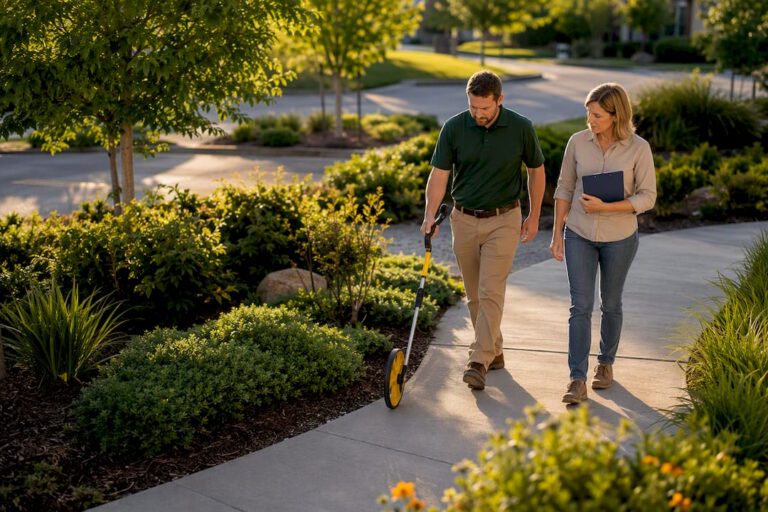
Before you buy a single plant or call a fence company, walk your yard and figure out exactly where the exposure is coming from. Most homeowners overcorrect by screening the entire perimeter when the real problem is two or three specific sightlines.
Here is a practical sequence to follow:
- Sit in every spot you actually use: the patio chair, the grill station, the hot tub, the kitchen table if you can see out a window.
- From each spot, note where your eye lands on a neighbor’s window, a second-story deck, or a public sidewalk.
- Mark those exact sightlines with stakes, flags, or even a piece of tape on a fence rail so you remember the angle later.
- Measure the distance and rough angle from your seating area to each exposure point.
- Photograph each sightline at eye level, seated, since that is how you will actually experience the yard.
- Repeat the walk at a different time of day, since low sun angles and shadow patterns change what is visible.
This is where the idea of a “privacy line” becomes useful. Your property line is a legal boundary; your privacy line is wherever a screen actually needs to intercept a sightline, and the two rarely match up. Designers consistently map sightlines and place height exactly where the view crosses rather than lining plants along the fence by default. If a neighbor’s upstairs window looks straight down onto your patio, the fix might be a single well-placed tree 15 feet from the fence, not a wall of hedges running the whole property line.
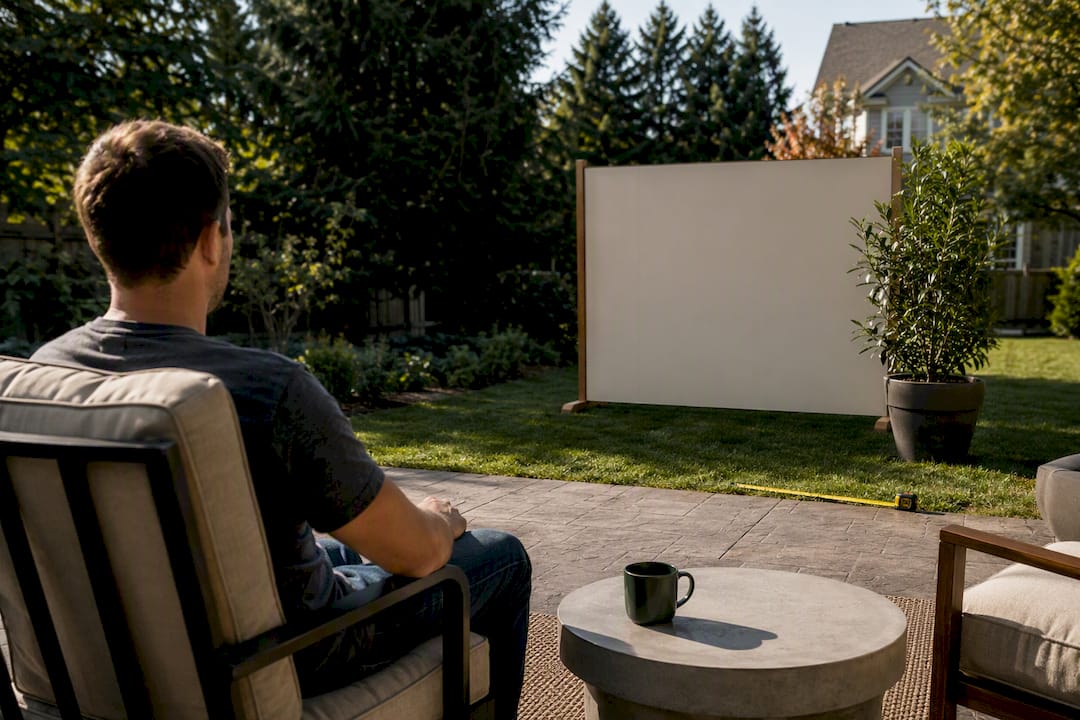
Pro Tip: Before committing to permanent structure, hold up a temporary panel or a tall potted plant at the suspected trouble spot and check the view from your seating area with guidance from How do I makeover my house? | One Day Doors & Closets. It takes ten minutes and can save you from building a fence six feet from where it actually needs to be.
Collect this information before you design anything or call a contractor: sightline photos from each seating area, rough measurements to each exposure point, notes on sun exposure and soil drainage in the planting zones, and any HOA or setback restrictions that might limit fence height or placement.
Which Plants Give You the Best Privacy Screen?
Living screens are where backyard privacy landscaping earns its long-term value, but plant choice depends entirely on how much space, sun, and patience you have.
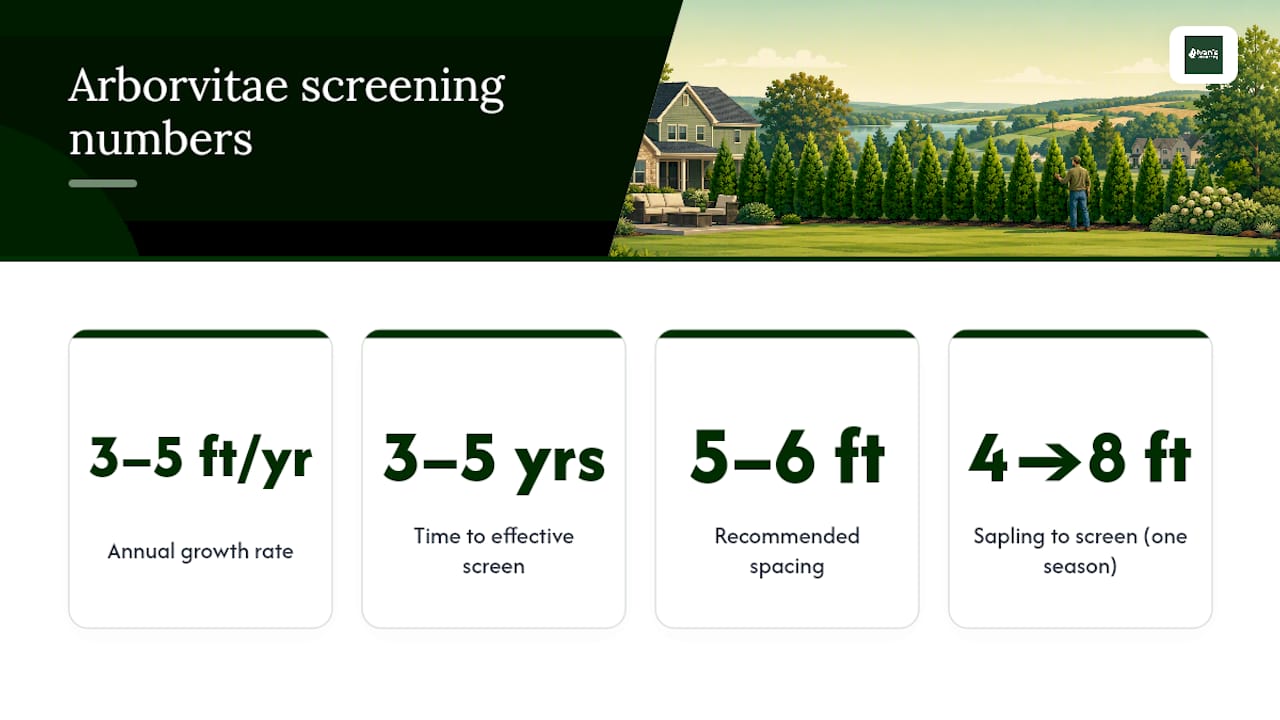
Evergreen hedges and trees form the backbone of most privacy plantings. Thuja “Green Giant” arborvitae is the workhorse choice for a reason: it grows 3 to 5 feet per year and can form an effective screen within three to five years when spaced and watered correctly. Space these roughly 5 to 6 feet apart for a solid wall, or wider if you want individual specimens with visible trunks. Arborvitae wants full sun and well-drained soil; in heavy clay or shady side yards, it struggles and thins out.
For narrow side yards or tight lots, columnar varieties solve a problem broad hedges can’t. Skip Cypress, columnar Norway spruce, and narrow arborvitae cultivars deliver height without eating six feet of width. These are the plants to reach for when you have three feet of clearance between your house and the property line and still need real screening.
Ornamental grasses and perennials add a softer, less permanent layer. Miscanthus, switchgrass, and tall Joe Pye weed reach 5 to 7 feet by late summer and screen effectively from June through the first hard frost, then die back for winter. They’re useful as a mid-height filler in front of a fence or as seasonal screening around a hot tub that only gets heavy use in warmer months.
Vines on trellises solve privacy problems where ground space is limited. Clematis, climbing hydrangea, and Boston ivy will cover a trellis or arbor in two to three growing seasons, giving you vertical screening without taking up a planting bed. Containers extend this further, letting you place a screening plant on a concrete patio or deck where there’s no soil at all. Just know that container-grown evergreens need more frequent watering and eventually need root pruning or upsizing.
One statistic worth building your plant list around: fast-growing arborvitae varieties gain 3 to 5 feet of height annually, which means a 4 foot sapling can become an 8 foot screen in as little as one growing season under good conditions. That single number should drive your spacing and patience expectations more than almost anything else in this article.
A word of caution on plant safety and containment: running bamboo species spread aggressively through rhizomes and can invade a neighbor’s yard within a few seasons if left unchecked, so always use a clumping variety or install a physical root barrier. Also double check toxicity if you have pets or young children in the yard; some fast, dense screening shrubs (certain yews, for example) are toxic if ingested.
Designers also recommend mixing evergreen and deciduous species rather than relying on one uniform wall of green. A mixed planting gives you winter structure from the evergreens, seasonal flowers or fall color from the deciduous layer, and a screen that reads as a real garden instead of a green fence.
Match plant form to the role it plays in your layered buffer: low plants (2 to 3 feet) for foreground softness, mid plants (4 to 8 feet) for the main screening body, and vertical elements (trees, trellised vines) for the height that actually blocks upper-story sightlines.
What Structural Options Work Best for Privacy?
Structure earns its place when a sightline is too tight, too immediate, or too awkward for planting alone to solve. Here’s how the main options stack up.
- Solid wood fencing gives full opacity at a moderate cost, but expect to restain or reseal every two to three years and to eventually replace posts as they weather.
- Vinyl and composite fencing costs more upfront but needs almost no maintenance beyond an occasional wash, and it won’t warp, rot, or need repainting.
- Metal privacy panels, including laser-cut decorative screens, cost more per panel than wood but hold up to decades of weather and often satisfy HOA design requirements that reject solid wood.
- Masonry or retaining walls do something plants and fences can’t: they meaningfully cut street noise, which matters if your privacy problem is really a noise problem in disguise.
- Pergolas with curtains or retractable canopies solve overhead privacy from a second-story neighbor window looking down onto a patio, a sightline no fence can touch.
- Trellises bridge the gap between hard structure and living screen, giving vines something to climb while adding visual interest immediately.
The Garden Scene’s step-by-step framework for suburban privacy buffers puts it plainly: add structure only where plants cannot solve the angle. That’s a useful filter. If a six-foot fence already blocks the sightline from your patio chair, you don’t need a tree there too, and the money is better spent on planting somewhere else.
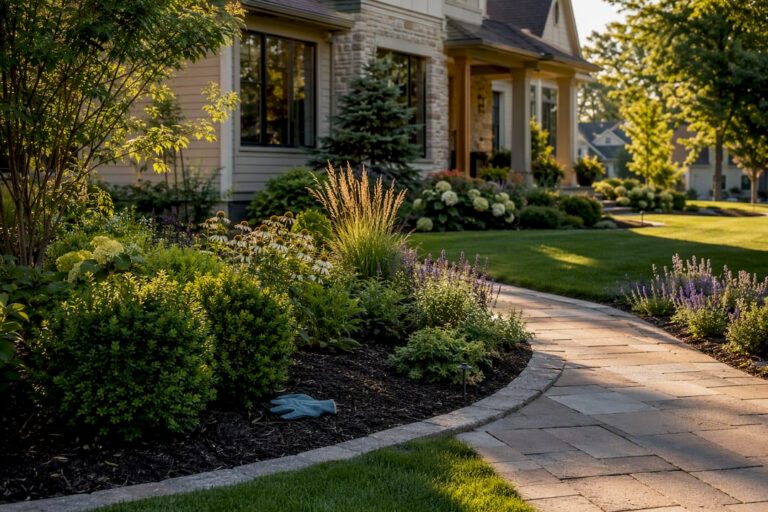
The most successful yards pair structure with plants rather than choosing one or the other. A set-back planting bed in front of a fence softens the hard line and hides the base rail. A low planter wall along a patio edge doubles as a seat wall and a privacy buffer. A trellis attached directly to an existing fence turns a flat surface into a vertical garden without adding a new footprint. None of these require tearing anything out. They just add depth to what’s already there.
How Do You Layer Plants and Structure Without Losing Yard Space?
The layered buffer is the single most useful concept in backyard privacy landscaping, and it’s the framework professional designers actually use rather than a marketing term. It works in three bands.
- Low layer (2 to 3 feet): ornamental grasses, low shrubs, or perennial borders that soften the transition between lawn and screen without blocking any sightline themselves.
- Mid layer (4 to 8 feet): the workhorse shrubs and hedges that do most of the actual blocking, positioned where they intercept the sightline you mapped earlier.
- Vertical layer (8 feet and up): trees, trellised vines, or tall structural elements that handle upper-story views and add the height a fence alone can’t reach.
Layered planting preserves more light and resists failure better than a single dense hedge, because if one plant in the layer struggles or dies, the buffer as a whole still functions. A monoculture hedge that gets hit by disease leaves you completely exposed until it regrows.
Stagger your rows rather than planting everything in a straight line along the fence. A common professional pattern places one row of shrubs just inside the fence and a second, shorter row closer to the seating area, which doubles your screening depth without doubling your yard footprint. Resist the instinct to plant everything directly on the property line. Height often needs to sit closer to your seating area, exactly where the sightline crosses, not at the boundary.
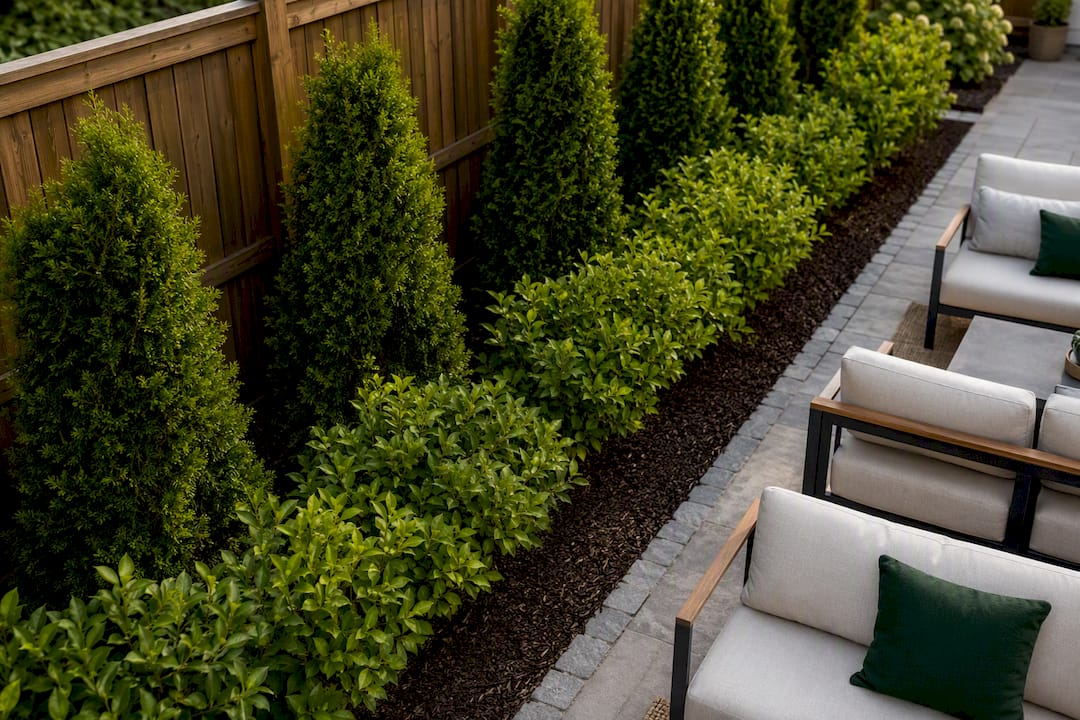
Garden designers often cite a rule of three when grouping plants for a natural look: plant in odd-numbered clusters (three, five, seven) rather than single specimens or even pairs, since asymmetrical groupings read as more natural and less like a row of soldiers.
Pro Tip: Leave at least one gap in your layered buffer to frame a view you actually like, whether that’s a mature tree next door or open sky. Total visual blockage rarely feels as good on paper as it does in the yard, and a little airflow keeps the space from feeling boxed in.
Keep a maintenance lane of at least 18 to 24 inches behind your mid layer so you can actually reach the plants to prune, and don’t let vertical elements crowd walkways or gates.
What Do Privacy Upgrades Really Cost and How Fast Do They Work?
If you want privacy this weekend, you’re buying structure. If you want privacy that improves with age, you’re planting. Most yards end up doing both in phases.
A 6 foot solid wood fence installed along a typical suburban side yard runs $25 to $60 per linear foot, which puts a 50 foot run somewhere between $1,250 and $3,000 depending on materials and site prep. Vinyl or composite pushes that to $40 to $60 per linear foot, with the tradeoff of far less maintenance over the fence’s lifespan. Metal privacy panels cost more per linear foot than either, but many homeowners find the durability and design options worth it, especially on properties where an HOA restricts solid wood.
- Week one: fence or panel installation gives immediate full or partial coverage.
- Season one: temporary screens, potted plants, or annual vines fill visible gaps while permanent planting establishes roots.
- Year one to three: fast-growing evergreens like Thuja “Green Giant” add 3 to 5 feet of height annually, closing most remaining gaps.
- Year three to five: the planted layer reaches full screening height, and the fence becomes a backdrop rather than the main event.
A realistic phased plan for a typical quarter-acre backyard might combine a $2,500 fence run, $800 to $1,500 in evergreen trees along the worst sightlines, and a couple hundred dollars in fast perennials or grasses to fill the low layer in year one. That gets you full privacy immediately and a mature, layered look within three to five years, at a fraction of the cost of an all-at-once mature-tree installation.
How Do You Keep a Privacy Buffer Working Long Term?
A privacy screen that looked perfect at installation can fail within a few seasons if nobody plans for growth, airflow, or gaps. Build a maintenance rhythm into the plan from day one.
- Prune hedges and screening shrubs on a seasonal schedule, typically late winter for structure and midsummer for shape, rather than waiting until they’ve overgrown their space.
- Leave a dedicated access lane behind mid and vertical layers so pruning and inspection don’t require trampling other plants.
- Water new plantings deeply and consistently through their first two growing seasons; a screen that’s stressed for water grows slower and thins out at the base.
- Retest your sightlines from the porch, seated, from the driveway, and from any second-story neighbor window at least once a year, since plant growth and pruning both shift what’s actually visible.
- Check the buffer again in winter. Deciduous plants drop leaves and evergreen gaps become obvious once summer growth is gone, which is exactly when testing sightlines matters most.
- Plan phased infill for any thin spots rather than replanting the whole buffer at once.
If you decide to bring in a professional at any point, ask direct questions before signing anything: what size plants will actually be installed (a 3 foot arborvitae and a 6 foot one create very different first-year results), what the pruning and maintenance schedule looks like after installation, whether a warranty covers plant loss in the first year, and how the crew plans to handle irrigation until roots establish. An HOA-focused maintenance checklist is a useful reference even for a single-family yard, since the access, spacing, and airflow principles are the same.
How Do You Make Privacy Features Look Intentional, Not Defensive?
The difference between a privacy yard that looks designed and one that looks like a fortress usually comes down to proportion and restraint. A trellis or fence panel that’s twice as tall as it needs to be reads as defensive; matching the height to the actual sightline you measured earlier keeps it looking like a design choice.
- Keep a consistent material palette across fence, trellis, and any planters so the hardscape reads as one coordinated system rather than several unrelated projects.
- Use a focal point, a piece of art, a water feature, an accent tree, to draw the eye away from the screening element itself.
- Soften every hard edge with planting; even six inches of low grasses along a fence base changes how the whole structure reads.
- Add low-level lighting along the buffer rather than one harsh floodlight, since even, ambient light at night preserves privacy without turning your yard into a stage.
- Choose materials that age well on purpose. Cedar grays gracefully, while some composites can look dated within a decade.
Nighttime privacy deserves its own thought, since a well-lit interior against a dark yard can expose you to neighbors even after a great daytime screen is in place. Path lights, uplighting on trees, and warm-toned fixtures aimed downward keep your evenings private without floodlighting the whole property.
How Does a Local Landscaping Company Actually Execute This?
Reading about layered buffers is one thing; getting a crew to install one correctly on your specific lot is another. A local landscaping company with experience in McHenry County since 2008 often follows the same logic covered above: a fence backbone paired with staggered evergreen and deciduous planting, sized to the actual sightlines on the property rather than a generic plan.
A common project pairs a new privacy fence with layered hedge planting along the interior, then finishes the space with a paver patio positioned so the seating area faces away from the remaining exposure points. Estimates typically include a satisfaction guarantee, timely free quotes, and a clean job site upon completion.
Before hiring anyone for a privacy project, ask:
- What size plants are actually being installed, and what’s the realistic timeline to full coverage?
- Is there a written maintenance plan for the first two years, and what does it cover?
- What’s the warranty on plant material if something doesn’t establish?
- How will the crew protect existing landscaping and lawn during installation?
A Straight Answer on Where to Start
Most homeowners try to fix the whole yard at once and burn their budget on plants that won’t matter for five years. Start with the one or two sightlines that bother you daily, the ones from your porch chair or your kitchen window, and fix those first with a mix of quick structure and a couple of fast-growing evergreens. Everything else can fill in over a few seasons. Map before you plant, test before you commit, and build the maintenance plan in from the start rather than bolting it on later.
— Chas
Ready to Get Your Backyard Privacy Project Started?
Hiring a landscaping company experienced in McHenry County can be a practical alternative to piecing together a privacy project yourself from fence quotes, nursery trips, and weekend labor. Such teams can design and install combinations like fence coordination, tree and shrub planting sized for real coverage timelines, and paver patios positioned around actual sightlines rather than generic layouts. Projects can include satisfaction guarantees and custom maintenance plans to keep the buffer looking good beyond installation.
Before your free estimate, snap a few photos from your porch, patio, and any spot where you feel exposed, and jot down the sightlines that bother you most. That’s the same site-assessment step covered above, and it’s exactly what the crew needs to scope the job accurately. Browse the full range of landscaping services or check availability for your area directly on the McHenry landscaping services page to request a free estimate.
Sources
- How to Create a Privacy Buffer in a Suburban Yard step-by-step – The Garden Scene
- A designer’s guide to creating privacy in the garden – Gardens Illustrated
- How to make your backyard more private: fences, screens and natural privacy solutions – Build & Construct
- Hadaa
FAQ
How do I block a neighbor’s view into my backyard?
Map the exact sightline from your patio or deck first, then place a fence, screen, or tree precisely where that view crosses your yard rather than lining the whole property line. A single well-positioned tree or panel often solves the problem more efficiently than a full perimeter hedge.
How do you landscape a backyard for privacy?
Combine a structural screen (fence, panel, or wall) with a layered planting plan of low, mid, and vertical plants staggered in two rows rather than one straight line. This gives you immediate coverage from the structure and long-term resilience from the plants as they mature.
What is the fastest-growing privacy plant?
Thuja “Green Giant” arborvitae is among the fastest options, gaining 3 to 5 feet of height per year and forming an effective screen within three to five years under good sun and watering conditions. Clumping bamboo grows even faster but requires strict containment to prevent spreading.
What is the rule of three in landscaping?
The rule of three suggests planting in odd-numbered groups, typically three, five, or seven, because asymmetrical clusters read as more natural than plants set in even rows or pairs. Designers apply it to shrubs, ornamental grasses, and accent trees within a layered privacy buffer.
How much does a backyard privacy fence cost?
A solid wood fence typically costs $25 to $60 per linear foot installed, while vinyl or composite fencing runs about $40 to $60 per linear foot with far less long-term maintenance. Metal privacy panels generally cost more but hold up longer and often meet HOA design requirements that reject solid wood.