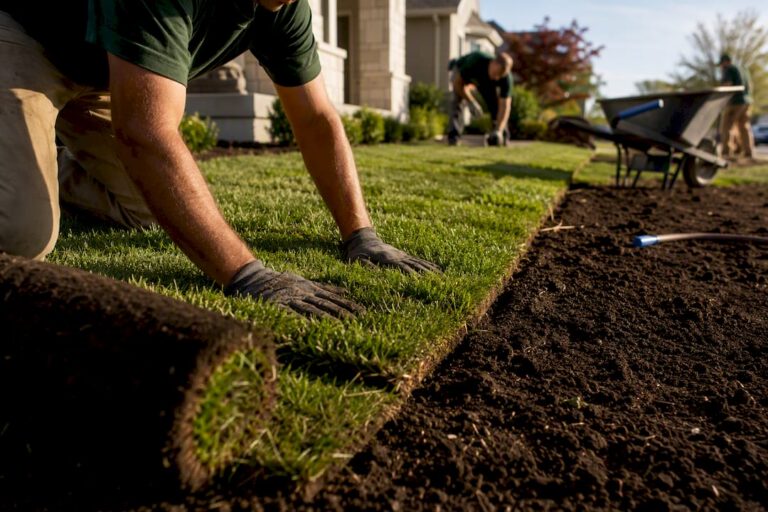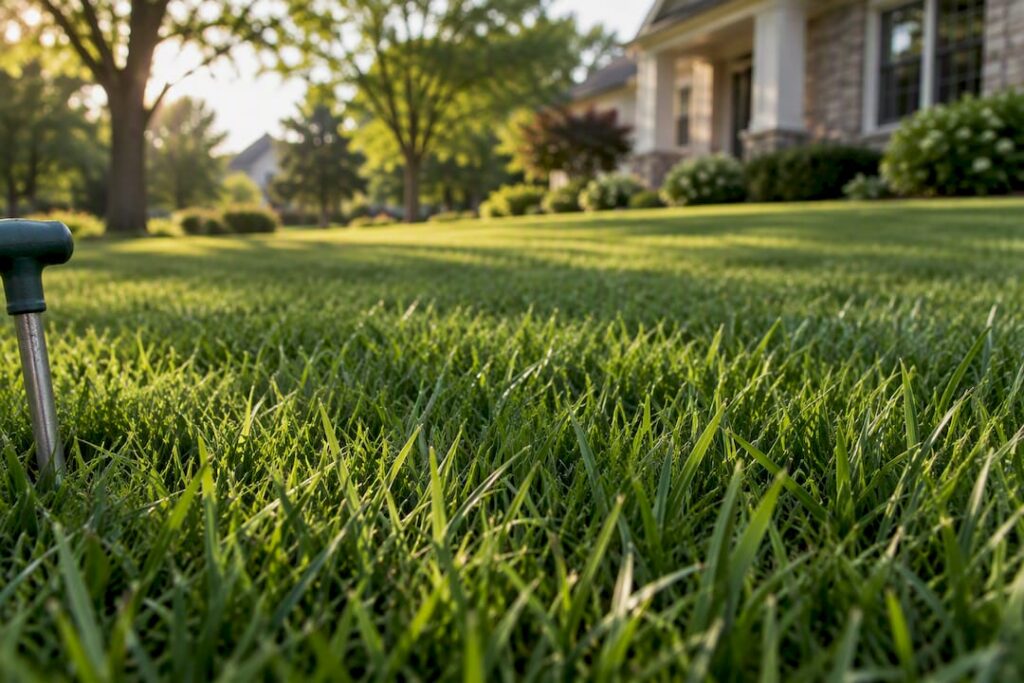
Pick Kentucky bluegrass if you want a dense, self-repairing lawn in a consistently cold northern climate and you’re willing to water and feed it. Pick turf-type tall fescue if you live anywhere in the transition zone, want lower water bills, or have shade. University trials from K-State back fescue’s drought edge, while hybrid bluegrasses close some of that gap. An experienced local landscaper observes this split play out on real McHenry County properties every season.
TL;DR:
- Tall fescue requires less water and tolerates shade better, making it suitable for transition zones and areas with limited irrigation.
- Hybrids of bluegrass and fescue combine drought resistance with self-healing traits, reducing maintenance for mixed lawns.
- Bluegrass’s rapid spread via rhizomes benefits high-traffic, sunny yards, but it is more susceptible to diseases and summer dormancy.
- Proper site preparation, including soil testing and drainage checks, is crucial for successful establishment, especially when choosing sod over seed.
- A recommended lawn mix is roughly 90% tall fescue and 10% bluegrass, balancing drought resilience with repairability for mid-latitude properties.
Table of Contents
- Bluegrass vs Fescue at a Glance: Trait Comparison and Quick Picks
- Appearance and Growth Habit: What Your Lawn Will Look and Feel Like
- Root Systems, Drought, and Heat Tolerance: What It Means for Watering
- Shade, Traffic Tolerance, and Site Constraints That Change the Answer
- Pests, Diseases, and the Failure Modes Homeowners Actually See
- Establishment: Seed vs Sod and What the First Season Looks Like
- Blends and Mixes: When Combining Bluegrass and Fescue Makes Sense
- How to Choose: A Decision Checklist by Climate, Sun, and Effort
- Maintenance and Long-Term Costs: What Each Grass Actually Demands
- Field Tips From Field Tips from a Local Landscaping Expert: What Actually Goes Wrong on Real Lawns
- Soil Type Preferences and pH Adaptability
- Editorial Perspective: Weighing Looks Against Water Use
- Get Professional Help With Sod, Seeding, or Lawn Care
- Sources
- FAQ
Bluegrass vs Fescue at a Glance: Trait Comparison and Quick Picks
The two species solve different problems. Kentucky bluegrass (Poa pratensis) spreads by rhizomes and heals itself after damage, but it needs consistent water and cool temperatures to look its best. Tall fescue grows in bunches, tolerates heat and drought better, and holds up in partial shade, but it won’t fill in bare patches on its own.
Here’s how the two stack up on the traits that actually change your maintenance workload:
| Trait | Kentucky Bluegrass | Turf-Type Tall Fescue |
|---|---|---|
| Best for (site/climate) | Cold northern regions | Transition zone, variable rainfall |
| Water needs | High, especially midsummer | Moderate, deeper roots can reduce demand |
| Shade tolerance | Poor to fair | Fair to good |
| Maintenance level | High (feeding, water, aeration) | Moderate |
| Establishment speed | Slower to germinate | Faster to germinate |
| Self-repair/spreading | Strong, via rhizomes | Weak, bunch-type, needs overseeding |
| Disease/pest risk | Susceptible to some diseases like dollar spot, rust | Susceptible to brown patch in humid heat |
Pick Kentucky bluegrass if:
- You live in a firmly cold, northern climate with reliable rainfall or irrigation.
- You have kids or dogs and want a lawn that heals its own bare spots.
- You want that classic, fine-bladed, deep green look and don’t mind the upkeep.
Pick tall fescue if:
- Your yard gets partial shade under mature trees.
- You want to cut back on watering during summer.
- You live in a transition-zone climate where summers get hot and winters still get cold.
Modern turf-type tall fescue cultivars have narrowed the appearance gap considerably. Older fescue varieties were coarse and clumpy, but breeding programs have produced finer-textured, denser cultivars that pass for bluegrass at a glance. Hybrid bluegrasses, bred from Kentucky bluegrass and Texas bluegrass, are a newer wrinkle worth knowing about too. They’re marketed under names like Thermal Blue and Reveille, aiming to combine bluegrass looks with better heat tolerance.
Appearance and Growth Habit: What Your Lawn Will Look and Feel Like
Kentucky bluegrass has narrow, boat-shaped leaf tips and a soft, dense texture that makes it the gold standard for that manicured, deep-green look most people picture when they think “great lawn.” Tall fescue’s blades run wider and coarser, with a more upright growth habit, though the difference is far less obvious now than it was a generation ago.
The real functional difference isn’t color. It’s how each grass spreads. Kentucky bluegrass grows via underground rhizomes, sending out lateral shoots that fill in thin or damaged areas without any help from you. Tall fescue is a bunch-type grass. Each plant grows in place and doesn’t send out rhizomes, so a bare patch from a dead tree limb or a dog’s favorite path stays bare until you overseed it.

That trade-off matters more than most homeowners realize when they’re shopping for seed. A high-traffic yard with kids and pets benefits from bluegrass’s self-mending habit. A shaded, low-traffic side yard doesn’t need that feature nearly as much, and fescue’s other advantages take over.
Modern turf-type tall fescue cultivars have made this an easier call than it used to be. Breeders have pushed leaf width down and density up, producing varieties that are finer textured and darker green than the pasture-grade fescue your grandparents planted. If you’ve ruled out fescue because of how it looked on an older lawn, it’s worth a second look at current cultivars before you decide.
Root Systems, Drought, and Heat Tolerance: What It Means for Watering
Tall fescue’s biggest structural advantage sits below the soil surface. Its roots commonly reach two to three feet deep, well past where Kentucky bluegrass roots typically stop. That depth lets fescue pull moisture long after the top few inches of soil have dried out, which is why it stays green through stretches of summer that send bluegrass into dormancy.
Kentucky bluegrass takes a different survival strategy. Rather than chasing water deeper, it goes dormant, turning brown and pausing growth until rain or irrigation returns. That’s not the plant dying. It’s a genuine survival mechanism, and most bluegrass lawns green back up within a couple of weeks once watering resumes. But if you want green grass in August without exception, dormancy isn’t an acceptable answer, and that shifts the math toward fescue or a heavier irrigation budget.
The water numbers back this up. Research on drought-susceptible and drought-resistant cultivars found that tall fescue and TF/KBG mixtures needed measurably less irrigation under simulated drought conditions than susceptible Kentucky bluegrass cultivars did. Separate work tracking plant physiology during prolonged dry spells found tall fescue maintained green cover longer and pulled water from deeper soil zones, while Kentucky bluegrass went dormant more quickly once irrigation stopped.
Field trials comparing hybrid bluegrasses, standard Kentucky bluegrass, and tall fescue found that tall fescue established faster and held up better through dry periods in transition-zone testing. Interestingly, growth-chamber work on hybrid cultivars like Thermal Blue found they outperformed both standard bluegrass and tall fescue on photosynthesis and visual quality under high heat and drought stress in controlled testing, hinting at where breeding programs are headed next.
For practical irrigation planning: water deeply and infrequently rather than a little every day. Push moisture down to four to six inches, checking with a screwdriver or soil probe. This trains roots to grow downward instead of staying shallow, and it applies to both species, though fescue rewards the habit more because it can actually use that depth.

Shade, Traffic Tolerance, and Site Constraints That Change the Answer
Most cool-season grass needs at least four to six hours of direct sun daily to hold a dependable stand. Below that threshold, both species thin out, but not at the same rate.
Tall fescue tolerates partial shade noticeably better than Kentucky bluegrass. Its broader leaf blades capture more light per square inch, letting it photosynthesize efficiently even under dappled tree canopy where bluegrass would thin within a season or two. If you’ve got mature oaks or maples throwing shade over part of the yard, fescue is usually the better bet for that zone, even if you plant bluegrass elsewhere on the same property.
Traffic tolerance flips the advantage back toward bluegrass, but with a caveat. Bluegrass recovers from wear because of its rhizomes. Walk a path across it all summer, and it fills back in on its own once traffic eases. Tall fescue doesn’t have that mechanism. A worn path in a fescue lawn stays worn until you overseed it, which means high-traffic fescue areas need a yearly overseeding habit built into the maintenance plan, not an occasional fix.
Before you commit either way, a few site checks should factor into the decision:
- Slope: Steep grades shed water fast, favoring the deeper-rooted fescue, which can chase moisture down before it runs off.
- Topsoil depth: Shallow soil over clay or rock limits how far any root system can grow, which narrows fescue’s drought advantage since it can’t reach the depth it needs.
- Existing tree canopy: Note actual sun hours at ground level in July, not just how open the yard looks in early spring before leaves fill in.
- Current wear patterns: High-traffic zones near doors, gates, and play areas usually favor bluegrass or a fescue/bluegrass blend over pure fescue.
Pests, Diseases, and the Failure Modes Homeowners Actually See
Every cool-season lawn has its own weak points, and knowing them ahead of time saves a lot of guessing later when patches show up.
Kentucky bluegrass is more prone to dollar spot and rust, especially on lawns that are underfed or mowed too short. Necrotic ring spot and summer patch also show up more often in bluegrass than fescue, particularly on compacted soil. These diseases tend to appear as small, irregular brown or yellow patches rather than one dramatic dead zone, which makes them easy to mistake for drought stress at first glance.
Tall fescue’s signature disease risk is brown patch, and it shows up almost exclusively during hot, humid stretches when nighttime temperatures stay warm and leaves stay wet overnight. Extension guidance from NC State flags this as a seasonal, predictable risk tied directly to watering habits, not a random occurrence.
On the insect side, grubs are the shared enemy for both species. White grub damage looks similar regardless of grass type: irregular brown patches that pull up easily like loose carpet because the roots are gone. Bluegrass lawns tend to show grub damage faster since their root systems sit shallower to begin with.
A few cultural habits head off most of these problems before they start:
- Water early in the morning, never in the evening, so leaf blades dry before nightfall.
- Mow at the recommended height for your species rather than scalping for a “neater” look, since short grass stresses roots and invites disease.
- Watch for a fungicide trigger point: repeated brown patch outbreaks in the same humid week each summer usually mean it’s time to treat proactively next year, not just react.
If patches spread fast, show a clear fungal ring pattern, or come back despite watering adjustments, that’s the point to bring in a professional for diagnosis rather than guessing with a bag of generic lawn treatment.
Establishment: Seed vs Sod and What the First Season Looks Like
Germination speed is one of the clearest practical differences between the two grasses. Tall fescue seed typically sprouts in 7 to 14 days under good conditions. Kentucky bluegrass takes considerably longer, often 14 to 28 days, because its seed structure is slower to break dormancy. If you’re seeding in early fall and want visible progress before the weather turns, that three-week difference matters.
Sod sidesteps the germination wait entirely, giving you a finished-looking lawn on day one, though the roots still need three to four weeks of careful watering to knit into the soil underneath. Sod versus seed is really a trade-off between upfront cost and instant results versus a lower price tag and more patience.
Overseeding schedules also diverge by species. Because fescue is bunch-type and doesn’t spread, most fescue lawns need annual or biennial overseeding to stay dense, typically at four to six pounds of seed per 1,000 square feet for thin lawns. Bluegrass lawns, by contrast, usually thicken up on their own through rhizome spread once established, needing overseeding only after serious damage or disease.
Whichever species you plant, the first season follows a similar checklist:
- Keep the top inch of soil consistently moist, watering lightly once or twice daily until germination, then taper to deeper, less frequent watering.
- Make the first mow once grass reaches about one-third taller than your target mowing height, using a sharp blade to avoid tearing new roots loose.
- Apply a starter fertilizer higher in phosphorus at planting to support root development, then switch to a standard feeding schedule after the second mow.
- Avoid heavy foot traffic for the first four to six weeks, longer for shaded or slow-draining areas.
Blends and Mixes: When Combining Bluegrass and Fescue Makes Sense
Plenty of the best-performing lawns in the transition zone aren’t pure stands of either grass. They’re blends, and there’s a good reason extension research keeps recommending them for mid-latitude properties.
A tall fescue and Kentucky bluegrass blend gets you fescue’s heat and drought tolerance paired with bluegrass’s self-repair and finer texture. The bluegrass component fills in wear patterns and thin spots that fescue would leave bare, while the fescue component keeps the lawn functioning through hot, dry stretches that would send pure bluegrass into dormancy.
A common approach uses roughly 90% turf-type tall fescue seed by weight with 10% Kentucky bluegrass mixed in. Because bluegrass seed is smaller and more numerous by weight, that 10% still delivers a meaningful number of bluegrass plants across the lawn. Over a few seasons, the bluegrass spreads into any bare spots the fescue leaves behind.
Maintenance for a blend splits the difference between the two pure approaches. You’ll water and feed on a schedule that suits fescue’s moderate needs most of the year, but you get a bonus: less overseeding than a pure fescue lawn would require, since the bluegrass component handles minor repairs on its own.
If you’re renovating an existing pure fescue lawn and want more self-repair, core aerate in early fall and overseed with Kentucky bluegrass seed directly into the existing turf. It takes a season or two to establish a meaningful bluegrass population, but it’s far cheaper than starting over.
How to Choose: A Decision Checklist by Climate, Sun, and Effort
Start with climate, because it eliminates more options faster than any other factor. If you’re in a consistently cold northern zone with reliable summer rainfall or irrigation infrastructure already in place, Kentucky bluegrass is a reasonable default. If you’re in the broader transition zone, where summers run hot and dry but winters still freeze, tall fescue is the safer long-term bet, and most current research backs that up.
From there, layer in sun exposure and soil depth. A shaded yard over shallow topsoil narrows things toward fescue almost automatically, since bluegrass struggles on both fronts. A wide-open, sunny yard over decent topsoil with irrigation available opens the door to bluegrass, hybrid bluegrass, or a blend.
Then be honest about maintenance willingness. This is where a lot of homeowners talk themselves into the wrong grass.
- If you want the lowest-maintenance option and don’t mind occasional summer dormancy: choose tall fescue and accept some browning during peak heat.
- If you want a lawn that looks great year-round and are willing to water and feed consistently: choose Kentucky bluegrass or a hybrid cultivar.
- If you want a middle path with less risk either way: choose a fescue-dominant blend with 10 to 20% bluegrass mixed in.
- If you have a shaded yard regardless of climate: choose tall fescue, full stop, since shade tolerance outweighs almost every other factor there.
Example scenarios: A sunny, flat yard in a cold northern suburb with an in-ground sprinkler system and kids who play outside daily is a strong bluegrass candidate. A yard with mature trees over half the lot, inconsistent rainfall, and a homeowner who travels frequently in summer points clearly toward fescue. A yard split between full sun and partial shade, with a moderate watering budget, is the textbook case for a blend.
Pro Tip: Before buying seed or sod, dig a small test hole in two or three spots around your yard. If you hit heavy clay or rock within eight inches, that shallow profile favors fescue and blends over pure bluegrass, since bluegrass roots need more depth to perform well long term.
Maintenance and Long-Term Costs: What Each Grass Actually Demands
Mowing height differs meaningfully between the two. Kentucky bluegrass performs best cut to 2.5 to 3.5 inches, while tall fescue prefers a slightly taller 3 to 4 inches, which shades its own root zone and reduces water loss. Cutting either grass shorter than recommended stresses the plant and opens the door to disease.
Nitrogen needs run higher for bluegrass, typically 3 to 4 pounds of nitrogen per 1,000 square feet per year split across multiple applications, versus roughly 2 to 3 pounds for tall fescue. Extension calendars time the heaviest feedings for early fall on both species, when cool-season grasses are actively building root mass rather than pushing top growth.
Water budgets follow the same pattern established earlier. A bluegrass lawn in peak summer heat often needs 1.5 to 2 inches of water weekly between rainfall and irrigation to avoid dormancy. A fescue lawn frequently gets by on 1 to 1.5 inches thanks to its deeper root system, a real difference if you’re on metered water or watching a summer utility bill.
Core aeration and overseeding are the two recurring costs that add up over years, and their frequency again splits by species. Bluegrass lawns typically need aeration every one to two years to relieve compaction, since a dense rhizome mat compacts more than fescue’s bunch-type growth. Fescue lawns benefit from annual aeration paired with overseeding, since that’s also the mechanism for keeping density up in a grass that doesn’t spread on its own.
Field Tips From Field Tips from a Local Landscaping Expert: What Actually Goes Wrong on Real Lawns
Most lawn failures trace back to skipped prep work, not a bad seed choice. Before recommending seed or sod to a homeowner, it’s important to check three things every time: a soil test to see what the pH and nutrient levels actually look like, a drainage check to see where water pools after a heavy rain, and a compaction check with a simple probe to see how hard the soil is a few inches down. Skip any one of those and even the right grass for your climate can struggle.
Sod installation looks simple from the outside, but timing and prep decide whether it takes. The soil underneath needs to be graded, loosened, and often amended before a single roll goes down, and sod needs daily watering for the first one to two weeks regardless of what the weather is doing. Homeowners who assume sod is “instant lawn, no work required” are usually the ones calling a few weeks later asking why sections are browning at the seams.
DIY seeding works fine for small, flat, low-traffic areas where a mistake costs you a bag of seed and a few weeks of patience. Where I’d tell most homeowners to bring in a contractor: large-area sod installation, any yard with drainage or grading problems, and lawns sitting on genuinely difficult soil, like heavy clay or fill dirt from new construction. Getting the grade wrong on a large sod job is expensive to fix after the fact, and it’s the single most common callback we get from other companies’ installs.
Soil Type Preferences and pH Adaptability
Both grasses share a preference for well-drained loam, but they tolerate soil challenges differently. Kentucky bluegrass performs best in a pH range of roughly 6.0 to 7.0 and struggles in compacted or heavy clay soils, since its rhizome network needs loose soil to spread efficiently. Push the pH much below 6.0, and bluegrass thins out even with good watering and feeding, because nutrient uptake drops off in acidic conditions.
Tall fescue tolerates a slightly wider pH range, generally 5.5 to 7.5, and handles clay-heavy or compacted soils better than bluegrass thanks to its deeper, more aggressive root system. That root depth lets it push through soil layers that would stop a shallower-rooted grass from establishing well.
Neither species does well in poorly drained, waterlogged soil for extended periods, though fescue’s deeper roots give it slightly more tolerance for occasional standing water. If a soil test comes back with a pH significantly outside either range, lime or sulfur amendments (depending on which direction you need to move) should happen before seeding or laying sod, not after. Correcting pH on an established lawn takes far longer and delivers weaker results than correcting it during site prep.
Editorial Perspective: Weighing Looks Against Water Use
The old advice to plant Kentucky bluegrass by default in northern lawns is aging poorly. Summers are running hotter and drier in more places than they used to, and a grass that needs consistent irrigation to look its best is a harder sell than it was two decades ago, both for water bills and for water availability in general.
My honest take: for most homeowners outside the coldest, wettest northern climates, a fescue-dominant blend is the more sensible default now, not the fallback option it used to be treated as. You get most of bluegrass’s self-repair through that 10 to 20% blend ratio, and you get fescue’s drought resilience carrying the lawn through the stretches that used to turn pure bluegrass brown for weeks at a time.
Pure Kentucky bluegrass still earns its place on properties where irrigation is reliable and the climate stays genuinely cold and wet through summer. It’s just no longer the automatic right answer it once was. If you’re planting new or renovating this year, ask which grass fits the summer you’re actually going to have, not the summer your neighborhood used to have.
— Chas
Get Professional Help With Sod, Seeding, or Lawn Care
Reading up on bluegrass and fescue only gets you so far. Matching the right grass to your yard’s actual soil, sun, and drainage takes a site visit, which is exactly what Ivanslandscaping’s free estimate covers. We check your soil, note your sun exposure and drainage patterns, and recommend whether seed, sod installation, or a blend fits your property, then give you a straightforward scope and cost range before any work starts.
If your yard just needs consistent upkeep once the right grass is in the ground, our lawn mowing and fertilization programs keep mowing heights and feeding schedules on track through the season. Homeowners across McHenry County rely on us for clean job sites and dependable scheduling rather than guessing at DIY timing.
Ready to find out which grass actually fits your yard? Request a free estimate through Ivanslandscaping and get a site-specific recommendation instead of a generic guess.
Sources
The comparisons in this guide draw on university extension research and controlled field trials, not marketing claims. The University of Kentucky’s AGR-52 guide covers species selection for regional lawns. K-State’s growth-chamber and field trial studies compare hybrid bluegrass, standard Kentucky bluegrass, and tall fescue under real and simulated stress. NC State Extension’s lawn calendar and the Crop Science irrigation study round out the maintenance and drought data. Extension research carries weight because it’s tested across multiple growing seasons and real soil conditions, not a single lab trial.
- AGR-52: Selecting the Right Grass for Your Kentucky Lawn (UKY extension)
- Bremer et al. 2006: Field comparison of hybrid bluegrasses, Kentucky bluegrass, and tall fescue (K-State)
- Tall fescue and Kentucky bluegrass home lawn calendar (NC State Extension)
FAQ
What Are the Downsides of Kentucky Bluegrass?
Kentucky bluegrass needs more water and fertilizer than tall fescue to stay green through summer, and it’s more prone to diseases like dollar spot and rust. It also goes dormant and turns brown during extended dry spells, which some homeowners find unacceptable in peak growing season.
Will Tall Fescue Eventually Take Over a Bluegrass Lawn?
No. Tall fescue is a bunch-type grass without rhizomes, so it can’t spread into bluegrass areas the way bluegrass spreads into open ground. If fescue seed lands in a bluegrass lawn, it stays as isolated clumps rather than merging or taking over.
What Grass Seed Do Professional Landscapers Use?
Most contractors, including Ivanslandscaping, recommend turf-type tall fescue or a fescue-dominant blend with Kentucky bluegrass for the transition zone, since it balances appearance with drought tolerance. The exact choice always depends on the property’s sun exposure, soil, and the homeowner’s watering habits.
How Do I Tell If My Lawn Is Fescue or Bluegrass?
Check the blade width and growth pattern: bluegrass has narrow, boat-shaped leaf tips and grows in a dense, spreading mat, while tall fescue has wider, coarser blades and grows in distinct bunches. If you see isolated clumps rather than a continuous carpet, it’s likely fescue.
Can I Mix Kentucky Bluegrass and Tall Fescue in the Same Lawn?
Yes, and it’s a common recommendation for mid-latitude climates. A blend of roughly 90% tall fescue seed and 10% Kentucky bluegrass by weight gives you fescue’s drought tolerance along with some of bluegrass’s self-repair ability over time.