Choosing the right deicer comes down to one question: what is your pavement temperature? Sodium chloride, calcium chloride, magnesium chloride, acetates and formates, urea, and abrasives each work within a different temperature range, and matching the product to that range determines whether your walkway stays safe or stays icy. Combine the right choice with anti-icing or pre-wetting, and you will spend less on material while getting better results.
TL;DR:
- Rock salt becomes unreliable below 15°F; magnesium chloride works to about -10°F, calcium chloride to roughly -20°F, and sand adds traction beyond chemical limits.
- Pavement temperature, not air temperature, determines performance; sunny and shaded surfaces can differ by 10 to 15°F at the same hour.
- Treat pavement lightly an hour or two before snowfall to prevent ice bonding; prewetting granular salt also reduces scatter and speeds melting.
- Use only enough deicer to break the ice bond, then sweep up residue; chloride runoff can damage concrete, metal, and nearby plants.
- Near wells, ponds, or sensitive plantings, CMA or potassium acetate reduces chloride exposure and steel corrosion, but these alternatives cost more than rock salt.
Table of Contents
- 1. Common Deicer Ingredients and When Each One Makes Sense
- 2. Lowest Practical Melting Temperatures at a Glance
- 3. Solid, Liquid, and Pre-Wetted: Choosing the Right Application Method
- 4. The Hidden Cost of Salt: Corrosion, Concrete Damage, and Runoff
- 5. How to Choose and Apply the Right Deicer
- 6. Protecting Concrete and Pavers Through the Winter
- Why a Temperature-First Approach Wins
- How We Help You Manage Winter Surfaces
- FAQ
- Sources
1. Common Deicer Ingredients and When Each One Makes Sense
Reading a bag of ice melt can feel like reading a chemistry label, but the ingredient list tells you almost everything about how a product will perform on your driveway or sidewalk. Each chemical family has a different practical melting range, a different price point, and a different impact on concrete, metal, and landscaping. Here is what you are actually buying when you pick up a bag.
Sodium chloride (rock salt) is the most familiar deicer and the cheapest per pound. It comes as bagged granules for home use and as brine for liquid application, and it works reliably down to about 15°F before its melting action slows dramatically, according to Minnesota LTAP’s deicing guidance. For most of the country, most of the winter, plain rock salt is the practical default.
Calcium chloride is the cold-weather specialist. Sold as flakes, pellets, or liquid, it releases heat as it dissolves and stays effective down to roughly -20°F, far colder than sodium chloride can handle, per the same Minnesota LTAP data. It acts fast, which is useful during an active storm, but it costs more than rock salt and is more corrosive to metal fixtures, rebar, and vehicle undercarriages.
Magnesium chloride sits in between. Available in flakes, pellets, or liquid brine, it stays practical to about -10°F and is generally considered gentler on concrete and vegetation than calcium chloride, while still outperforming plain rock salt in deep cold.
CMA (calcium magnesium acetate) and potassium acetate or formate are non-chloride options worth knowing about if you have sensitive landscaping, a well, or a storm drain nearby. CMA is practical to about 20°F and potassium acetate down to roughly -15°F, and the EPA’s review of winter maintenance trade-offs notes these alternatives are less corrosive to steel than chloride-based products. They cost noticeably more, which is why they tend to show up near bridges, sensitive wetlands, or water intakes rather than on every residential sidewalk.
Urea, originally a fertilizer, shows up in some “pet safe” and lawn-friendly blends. It melts ice only down to about 25°F, well short of a hard freeze, and it adds nitrogen to runoff, which can feed unwanted algae growth in nearby ponds or streams. It is a mild option for light frost, not a cold-weather workhorse.
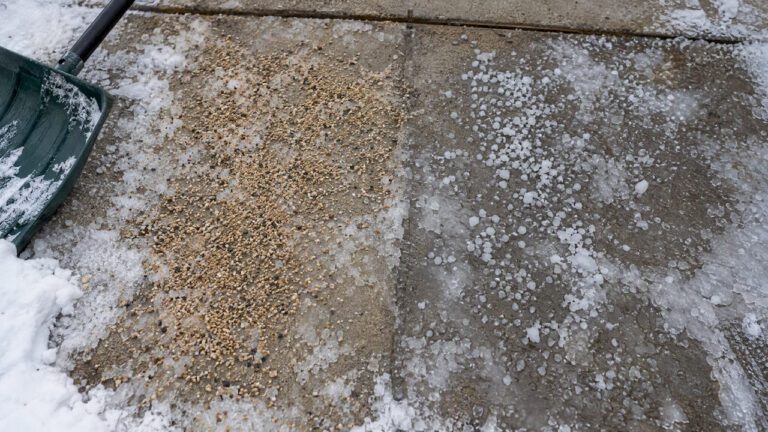
Abrasives like sand do not melt anything. They add traction on ice and packed snow, which makes them useful on steep driveways or steps where a fall is the bigger risk, and they are the right call when temperatures drop below what any chemical deicer can handle.
A quick way to keep these straight:
- Sodium chloride: cheapest, works to about 15°F, the everyday choice.
- Calcium chloride: fastest acting, works to about -20°F, best for deep cold.
- Magnesium chloride: mid-range cost and temperature, gentler on concrete.
- CMA and potassium acetate/formate: non-chloride, pricier, suited to sensitive sites.
- Urea: mild melting power, nutrient runoff concern, limited to light frost.
- Sand and other abrasives: no melting, traction only, works at any temperature.
Marketing language like “pet safe” or “eco-friendly” is not standardized, so the ingredient list and its practical temperature range tell you more than the label does, according to Minnesota LTAP.
2. Lowest Practical Melting Temperatures at a Glance
Marketing copy often quotes a deicer’s eutectic temperature, the lowest point at which the chemical can melt ice under laboratory conditions. Real driveways rarely reach that point before the product stops working efficiently, which is why the practical temperature, the point where melting slows to a crawl in normal use, matters more for planning your winter supplies.
| Ingredient | Lowest practical melting temp | Note |
|---|---|---|
| Calcium chloride (CaCl2) | -20°F | Fastest acting of the common deicers |
| Potassium acetate (KAc) | -15°F | Non-chloride, used near sensitive sites |
| Magnesium chloride (MgCl2) | -10°F | Mid-range cost and corrosion profile |
| Sodium chloride (NaCl) | 15°F | Most widely used, lowest cost |
| CMA | 20°F | Non-chloride, lower corrosion risk |
| Potassium chloride (KCl) | 25°F | Limited practical range |
| Urea | 25°F | Nutrient runoff concern |
Below 15°F, plain rock salt stops being a reliable deicer, according to Minnesota LTAP’s practical temperature data, which is the single most useful number on this list for homeowners stocking a garage shelf. If your region regularly sees nights below that mark, keep a bag of calcium chloride or magnesium chloride on hand rather than relying on rock salt alone. Pavement temperature, not air temperature, is what determines performance, since a sunny driveway and a shaded sidewalk can sit 10 to 15 degrees apart at the same hour.
3. Solid, Liquid, and Pre-Wetted: Choosing the Right Application Method
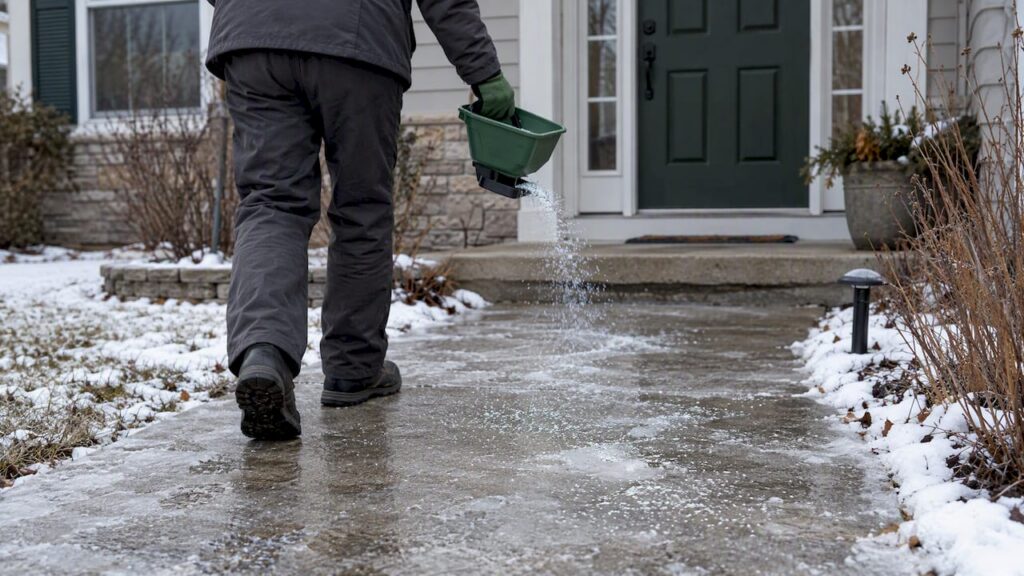
The chemical you choose matters less than how you apply it. Dry granular salt is the easiest to store and spread with a hand or drop spreader, but it tends to bounce off pavement and scatter into grass or garden beds before it has a chance to work. Liquid brine, sprayed ahead of a storm, bonds to the surface and starts working the moment snow hits, which is why many municipal crews apply it before the first flake falls.
Pre-wetted granular salt splits the difference, and it is the easiest upgrade for a homeowner to make. Spraying a light liquid coating onto dry salt before spreading reduces bounce and scatter and speeds up melting, and transportation research on pre-wetting practices found that rates around 8 to 12 gallons of liquid per ton of solid salt deliver the benefit without wasting material. For a driveway or walkway, that translates to lightly misting your bagged salt before spreading it, or buying a pre-wetted product where available.
- Dry granular: easiest to store, prone to scatter and bounce.
- Liquid brine: fastest activation, best applied before a storm starts.
- Pre-wetted granular: less waste, quicker melting, good middle ground for home use.
Pro Tip: If you only own a basic hand spreader, mist your rock salt lightly with water or a small amount of liquid calcium chloride before spreading; it cuts down on salt bouncing into your lawn and gets melting started faster.
Anti-icing, applying a light treatment before snow or ice forms rather than after, prevents that first bond between ice and pavement from forming at all, which means less material and less scraping later. For a typical residential storm, a light application an hour or two before the snow starts beats a heavy application after the fact.
4. The Hidden Cost of Salt: Corrosion, Concrete Damage, and Runoff
Every deicer that melts ice also interacts with whatever it touches next, and that interaction carries a cost. Chloride-based deicers, which includes sodium, calcium, and magnesium chloride, accelerate corrosion in cars, metal railings, and the rebar inside concrete, and the EPA’s review of winter road maintenance points to widespread use of road salt as a driver of both infrastructure corrosion and broader environmental impacts once runoff reaches soil and waterways.
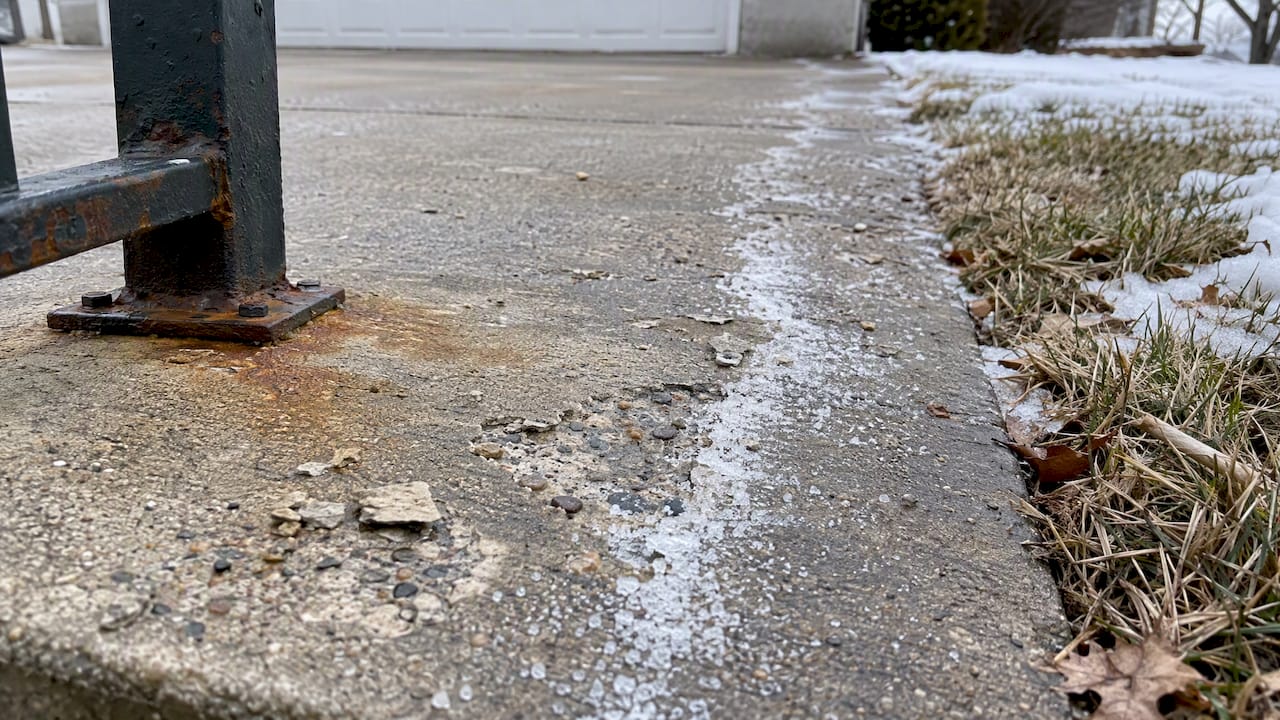
On concrete and pavers specifically, repeated freeze-thaw cycling combined with chloride exposure causes surface scaling, pitting, and in some cases full spalling where chunks of the surface flake away. We cover the mechanics and prevention steps in more detail in our guide to preventing ice-melt damage to concrete, including why newer concrete, which hasn’t fully cured, is especially vulnerable in its first winter.
Vegetation near the edge of a treated walkway can also suffer, since salt-laden runoff draws moisture out of roots and soil the same way it draws moisture out of ice. A few practical habits limit the damage without giving up winter safety:
- Apply only as much as needed to break the ice bond, not a thick, visible layer.
- Sweep up leftover granules once the ice clears instead of letting them sit.
- Keep deicer away from garden beds, tree wells, and grass edges where possible.
- Switch to a non-chloride product like CMA or potassium acetate near wells, ponds, or sensitive plantings.
- Store unused product in a sealed, covered container to keep it from leaching before you even use it.
A garage floor is just as exposed as a driveway, since melting snow tracked in on tires carries the same chlorides indoors; a vetted resource on freeze-thaw protection for garage floors covers sealing options if that is a recurring issue in your household.
5. How to Choose and Apply the Right Deicer
A clear process beats guesswork every time a storm rolls in. Here is the sequence we recommend walking through before you reach for any bag or bottle.
- Check pavement temperature, not air temperature, using an infrared thermometer or by simply noting whether your walkway sits in sun or shade.
- Match the temperature to an ingredient family using the table above: rock salt above 15°F, magnesium chloride down to -10°F, calcium chloride for anything colder.
- Choose a format: dry granular for light, occasional use, pre-wetted granular for better coverage with less waste, or liquid brine applied ahead of a storm if you want to prevent bonding altogether.
- Set your application rate and timing, favoring a light anti-icing pass before the storm over a heavy pass after ice has already bonded to the surface.
State DOT guidance backs up the temperature cutoffs in practice. The Minnesota Snow and Ice Control Field Handbook advises against applying dry sodium chloride below 15°F and recommends switching to calcium chloride or magnesium chloride, or to abrasives, in colder or higher-liability areas. Some crews blend a small amount of calcium or magnesium chloride into rock salt specifically to extend its working range into colder nights, a cost-driven tactic documented in the same DOT guidance. For light residential snow events, field-tested application rate guidance shows combined liquid-plus-solid strategies holding up in pavement temperatures down to 0°F when ratios are adjusted accordingly.
A short equipment checklist keeps the whole process efficient:
- A calibrated spreader, even a basic hand-crank model, so you are not guessing at coverage.
- Gloves and eye protection when handling calcium chloride, since it generates heat and can irritate skin on contact.
- A sealed storage bin, kept dry, since clumped salt is harder to spread evenly.
- A small supply of sand or abrasive for the rare night that drops below any chemical deicer’s working range.
Pro Tip: Keep two products on your shelf rather than one: a bag of rock salt for routine use and a smaller bag of calcium chloride for the handful of nights each winter that drop below 15°F.
Know when the job is bigger than a bag of salt and a hand spreader can handle. Large commercial parking lots, sidewalks with heavy foot traffic and real liability exposure, or a driveway that shows repeated freeze-thaw damage year after year are all signs it is worth calling in a crew with calibrated equipment and the ability to respond before a storm rather than after one.
6. Protecting Concrete and Pavers Through the Winter
Concrete and paver surfaces take the brunt of winter deicing, and small habits make a measurable difference over several seasons. We put together a detailed walkthrough of preventing ice-melt damage to concrete, covering which products to avoid on new concrete and how sealers extend a surface’s working life.
A few things worth doing on any property:
- Use the least amount of deicer that breaks the ice bond, and sweep up the rest once it has worked.
- Check drainage near walkways and patios, since standing meltwater that refreezes causes more damage than the original storm.
- Ask about a sealer application before the first hard freeze if your pavers or concrete are new or already showing wear.
When a property has recurring scaling, a commercial lot with heavy liability exposure, or simply more square footage than a weekend’s worth of shoveling can cover, it is worth booking a professional snow and ice management plan rather than troubleshooting damage every spring.
Why a Temperature-First Approach Wins
The biggest mistake we see homeowners and property managers make is buying one bag of deicer and using it all winter regardless of conditions. A single product cannot cover a range from 25°F down to -10°F, and stretching rock salt past its working temperature just wastes material without melting anything.
The fix is simple: check pavement temperature, match the product, and lean on anti-icing or pre-wetting to use less of it overall. For larger or liability-sensitive properties, pairing that discipline with professional help is the more reliable route.
— Chas
How We Help You Manage Winter Surfaces
Matching the right deicer to the right temperature solves part of the problem; keeping a property clear, safe, and free of ice-melt damage through an entire Illinois winter is the rest of it. We handle both, pairing calibrated application with concrete-protection habits so your pavers and walkways hold up season after season.
- Commercial snow removal for parking lots and shared properties that need consistent, liability-conscious clearing.
- Parking lot snow removal with two-hour response for property managers who need predictable turnaround after a storm.
- Residential snow removal across McHenry County for driveways and walkways homeowners would rather not handle themselves.
If repeated freeze-thaw damage, a large lot, or simple winter workload has you looking for help, request a free estimate and we will put together a plan suited to your property.
FAQ
What type of salt is most effective for deicing?
Sodium chloride (rock salt) is the most widely used deicer because of its low cost, but it only works reliably down to about 15°F, according to Minnesota LTAP. For colder conditions, calcium chloride stays effective to roughly -20°F, making it the more reliable choice on the coldest nights.
What are the main types of deicing salt?
The common deicing agents are sodium chloride, calcium chloride, magnesium chloride, calcium magnesium acetate (CMA), potassium acetate or formate, potassium chloride, and urea, each with its own practical temperature range and cost. Abrasives like sand are sometimes grouped alongside them, though they provide traction rather than melting.
What can I use instead of salt on my icy driveway?
Sand and other abrasives add traction without any chemical melting action, which makes them a reasonable option when temperatures drop below what chemical deicers handle well. Non-chloride products like CMA or potassium acetate also melt ice while causing less corrosion, though they cost more than rock salt.
Do all types of salt melt ice?
All chloride-based salts melt ice, but each one has a different practical lower limit: sodium chloride to about 15°F, magnesium chloride to about -10°F, and calcium chloride to about -20°F, per Minnesota LTAP’s data. Below a product’s practical temperature, melting slows dramatically even though some chemical action still occurs.
Sources
- Smart Winter Salt: Deicing use (Minnesota LTAP)
- Winter maintenance and road salt impacts (U.S. EPA)
- Review and synthesis of pre-wetting practices for winter road maintenance (Rosap/transportation research)
- Minnesota Snow and Ice Control Field Handbook (MnDOT)