For a high-traffic patio or walkway that needs to stay flat and affordable, concrete pavers usually win. For a one-of-a-kind natural look or a low-traffic accent area, flagstone is worth the extra cost. Pavers give you predictable pricing and easy repairs; flagstone gives you variable, natural beauty at a higher labor cost. The right choice comes down to how you use the space, not which material sounds nicer.
TL;DR:
- Flagstone installation is more labor-intensive due to irregular fitting, leading to higher costs and longer installation times compared to pavers.
- Pavers cost between $18 and $30 per square foot and are more predictable in pricing and repairability, especially when cracks or stains occur.
- Both materials require proper base preparation; insufficient depth or compaction significantly shortens their lifespan regardless of material choice.
- Long-term maintenance for flagstone includes sealing and patching mismatched slabs, while pavers need occasional joint sand reapplication and replacement of individual units.
- For high-traffic or furniture-heavy spaces, pavers provide a more stable, even surface, whereas flagstone is better suited for natural-looking garden paths or accents.
Table of Contents
- Flagstone vs Pavers: The Basic Material Difference
- Flagstone: What You Gain and What It Costs You
- Pavers: What You Gain and Where They Fall Short
- Cost of Pavers vs Flagstone: What You’ll Actually Pay
- Installation and Base Prep: The Part That Actually Determines Longevity
- Durability, Lifespan, and What Upkeep Really Looks Like
- Design Fit: Matching the Material to the Project
- Combining Materials: The Practical Middle Ground
- What Ivan’s Landscaping Has Learned From Installing Both
- Get a Professional Patio Estimate From Ivan’s Landscaping
- Sources
- FAQ
Flagstone vs Pavers: The Basic Material Difference
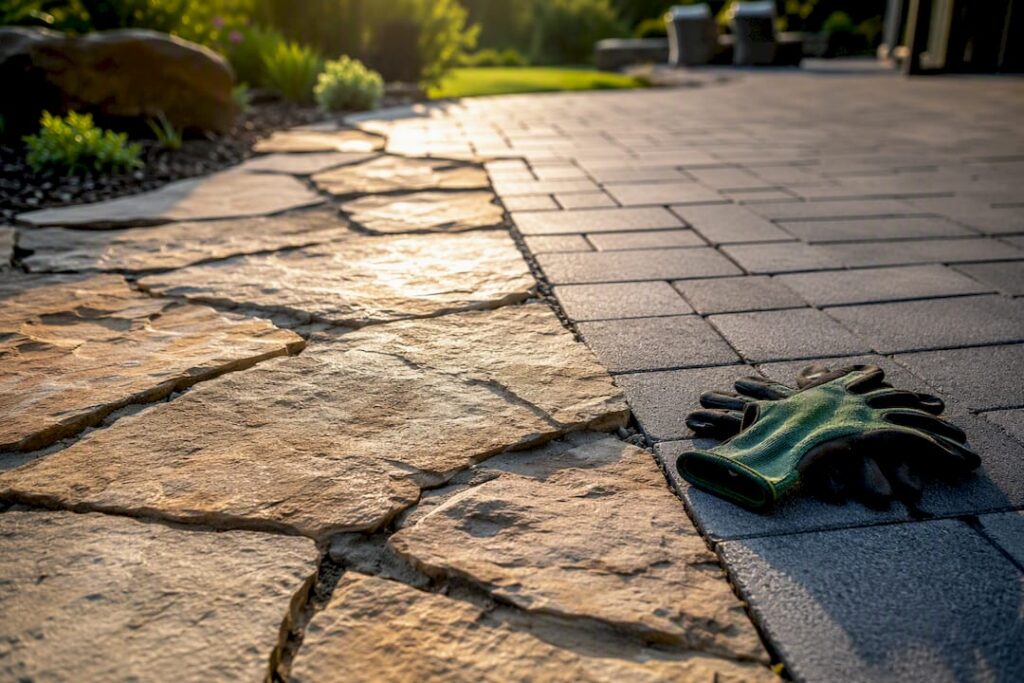
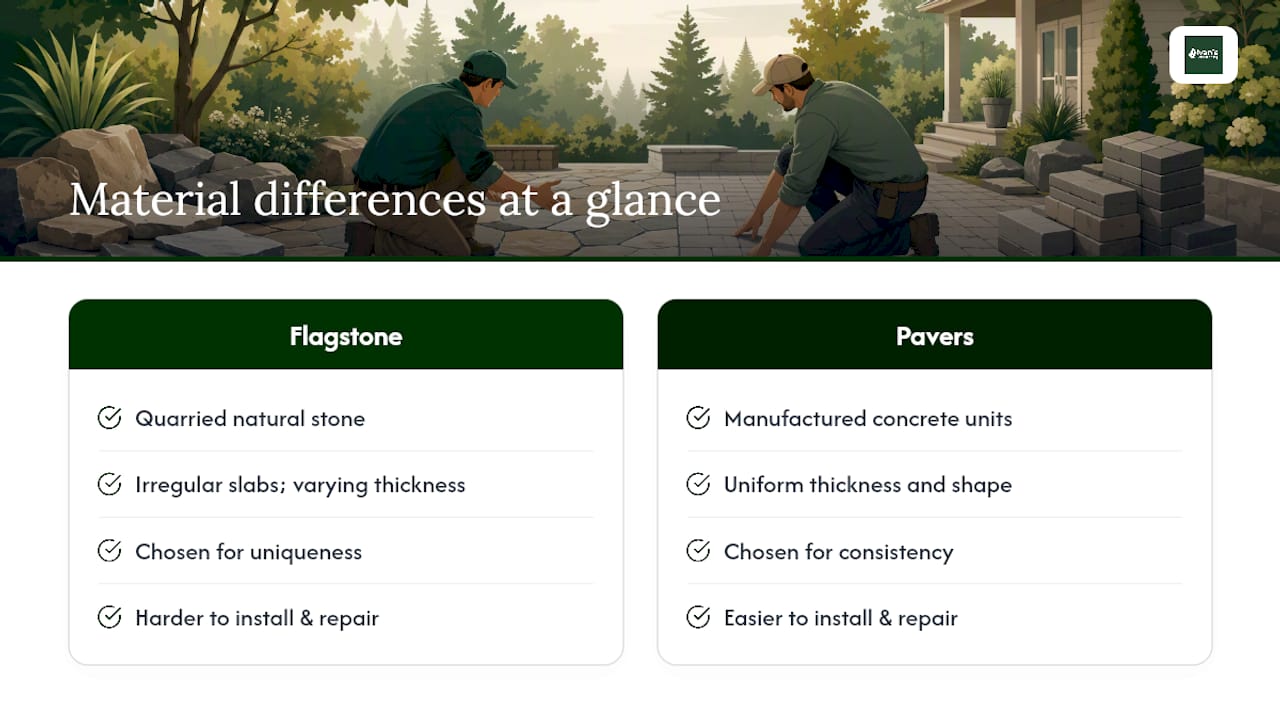
Flagstone is quarried natural stone, typically bluestone, sandstone, limestone, or granite, cut or split into irregular slabs of varying thickness. No two pieces are identical, which is exactly why homeowners choose it.
Pavers are manufactured concrete units, cast in molds to a uniform thickness and shape. That consistency is what makes them easier to install, price, and repair.
The material origin drives almost everything else in this comparison: cost of pavers versus flagstone, how long each takes to install, and how each ages in your yard. Natural stone varies by quarry and batch. Concrete pavers vary only by the style you pick.
Flagstone: What You Gain and What It Costs You
Flagstone’s biggest selling point is that no two patios look alike. The color variation, texture, and irregular shape give a rustic, established look that a lot of homeowners want for a main gathering space or a garden path. That uniqueness comes at a price, and not just in dollars.
Because each slab is a different size and thickness, installers spend more time fitting, leveling, and sometimes cutting pieces to get a stable, walkable surface. That labor adds up fast compared to setting uniform units.
A few practical notes worth knowing before you commit:
- Most flagstone is porous and benefits from periodic sealing to resist staining and water absorption.
- Softer stones like some sandstones can flake or “spall” in freeze-thaw climates.
- Denser stones such as [bluestone and granite] resist spalling and water absorption better(https://www.genest-concrete.com/natural-stone-vs-concrete-pavers/) in cold-weather regions.
- Irregular joints between slabs mean more gaps where weeds and grass can creep in over time.
If you’re in a climate with hard winters, the stone type you pick matters as much as the material category itself.
Pavers: What You Gain and Where They Fall Short
Pavers earn their reputation for predictability. Because every unit is the same thickness and shape, installation moves faster and quotes are easier to compare across contractors. You also get a wide range of colors, patterns, and textures to work with, so “uniform” doesn’t have to mean plain.
The bigger advantage shows up later, when something goes wrong. A cracked or stained paver can be pulled and swapped for a new one without disturbing the rest of the patio. That kind of targeted repair is much harder with natural stone.
What to expect once they’re down:
- Polymeric sand locks the joints and slows weed growth, but it needs reapplication every few years as it wears.
- Occasional spot leveling may be needed if base settling creates a low corner.
- Freeze-thaw performance is generally strong, since manufactured concrete units are engineered for consistent density.
- A flat, even surface makes patio furniture and grills far more stable than on an uneven flagstone surface.
Cost of Pavers vs Flagstone: What You’ll Actually Pay
Flagstone’s price swings widely because it depends on the stone type, grade, and how far it has to travel from the quarry. Natural stone installed cost spans a broad range of roughly $15 to $95 per square foot, depending on the slab quality and installation method. Interlocking pavers land in a narrower, easier-to-budget window.
| Cost factor | Flagstone | Pavers |
|---|---|---|
| Installed cost range | $15–$95 per sq ft | $18–$30 per sq ft |
| Price predictability | Low, varies by stone type/grade | High, consistent unit pricing |
| Main cost driver | Skilled labor for irregular fitting | Material and base prep |
| Long-term cost risk | Sealing, hard-to-match repairs | Sand reapplication, minor leveling |
A few things drive that gap beyond the raw material:
- Flagstone installation takes longer per square foot because every piece needs individual placement and leveling.
- Mortar-set flagstone adds cost versus dry-laid, but improves stability on slopes.
- Pavers benefit from repeatable, modular installation that speeds up labor time significantly.
Over a decade, flagstone’s long-term costs come mostly from sealing and the difficulty of matching stone if a slab cracks. Paver costs come from periodic sand top-offs and the occasional unit swap, which is cheaper and faster than either flagstone fix.
Installation and Base Prep: The Part That Actually Determines Longevity
Both materials start the same way: excavate the area, compact a gravel base, and install edge restraint to keep everything from shifting outward over time, following concrete drilling for repair and restoration work best practices. That shared foundation matters more than which surface material sits on top of it.
From there, the two diverge:
- Flagstone route: Choose mortar-set for a rigid, mortared joint look, or dry-laid over compacted decomposed granite for better drainage, which requires skilled fitting to keep the walking surface level despite varying slab thickness.
- Paver route: Set units on a compacted bedding layer, then sweep polymeric sand into the joints to lock everything in place and resist shifting.
- Either way: Confirm base depth and compaction percentage before signing a contract, since a thin or poorly compacted base undermines both materials equally.
When you’re comparing quotes, ask about minimum base depth, the edge restraint type, and whether workmanship is covered by a warranty. A contractor’s base-prep specification predicts how your patio holds up more reliably than the surface material you chose.
Pro Tip: Ask every contractor to state their base depth and compaction target in writing. A vague answer like “we do it right” on a written estimate is a red flag, not a reassurance.
Durability, Lifespan, and What Upkeep Really Looks Like
Well-installed concrete pavers typically last 25 to 50 years, while flagstone can last 20 to 40 years or more depending on the stone type and how it was set. Both numbers assume solid base prep; skip that step and neither material will hit its potential lifespan.
Routine care differs in frequency and difficulty:
- Pavers need joint sand refreshed every few years and occasional cleaning to prevent staining.
- Flagstone needs periodic sealing, especially on porous stone types, to resist moisture and discoloration.
- Weeding is a factor for both, but wider or irregular flagstone joints tend to invite more growth.
The real gap shows up when something breaks. Pulling and replacing a single paver is a quick, invisible fix. Finding a matching flagstone slab for a cracked one is often difficult, because color, texture, and thickness rarely match perfectly, leaving a visible patch where the repair happened.
Design Fit: Matching the Material to the Project
Pavers make sense for flat, furniture-heavy spaces where consistency matters: main patios, pool decks, and driveways all benefit from a level, predictable surface. High-traffic walkways also favor pavers, since uniform units simplify future repairs and keep the surface stable underfoot.
Flagstone shines in spots where you want the ground to feel less built and more found: garden paths, stepping-stone walkways, or accent borders that tie into planting beds. A unique natural look that integrates with the landscape is flagstone’s whole appeal.
A few practical notes when weighing the two:
- Textured flagstone can be more slip-resistant when wet, but rougher surfaces are harder on bare feet near a pool.
- Dark pavers absorb more heat in direct sun; lighter stone stays cooler underfoot.
- Flat paver surfaces hold furniture and grills far more steadily than uneven flagstone joints.
Combining Materials: The Practical Middle Ground
You don’t have to pick one exclusively. A paver field with a flagstone border is a popular compromise that keeps most of the budget on the cheaper, faster-to-install material while adding natural character where it shows.
Other common combinations:
- Flagstone stepping stones set into a lawn or paver walkway for visual breaks.
- Paver patios with flagstone accent bands near seating areas or fire pits.
- Sand or fine gravel at transition joints to let materials settle independently without cracking.
What Ivan’s Landscaping Has Learned From Installing Both
Base prep and drainage decide whether a patio lasts 10 years or 40, regardless of the surface material on top. That’s the single biggest factor homeowners underestimate when comparing flagstone vs pavers.
Before hiring anyone, ask three things: What’s your minimum base depth? What edge restraint do you use? Does workmanship carry a warranty separate from material warranties? Vague answers on any of those are worth walking away from.
If you’re set on flagstone, hire a crew with masonry experience, not just paver installers, since irregular stone fitting is a different skill than setting uniform units.
— Chas
Get a Professional Patio Estimate From Ivan’s Landscaping
Whichever material you land on, the install quality behind it matters more than the marketing claims about either one. Ivan’s Landscaping has built paver patios across McHenry County since 2008, and every job starts with the same base prep and drainage planning discussed above, not shortcuts that show up as problems in year three.
Our crews handle everything from full paver patio installation to flagstone accent work. You can browse completed work in our project gallery or request a free estimate today to get a real number for your yard, not a generic price range pulled from a guide.
Sources
- Flagstone vs Pavers: Which Is Right for Your Texas Patio? – Outdoor Warehouse Supply
- Patio cost guidance – HomeGuide
- Natural stone vs pavers: which costs more in 2026? | MPP
- Flagstone vs Concrete: How to Choose Pavers for Your Ideal Patio – Genest Concrete
FAQ
Is Flagstone More Expensive Than Pavers?
Yes, usually. Flagstone’s installed cost ranges roughly $15 to $95 per square foot depending on stone type, while pavers run a narrower $18 to $30 per square foot.
Which Lasts Longer, Flagstone or Pavers?
Pavers typically last 25 to 50 years when well installed, while flagstone lasts 20 to 40 years or more depending on stone density and base prep.
Can You Mix Flagstone and Pavers in One Patio?
Yes, a common approach uses a paver field with a flagstone border, or flagstone stepping stones set into a paver or lawn area, balancing budget with natural character.
Which Material Is Easier to Repair?
Pavers are easier to repair since individual units can be pulled and replaced without visible mismatch, while a cracked flagstone slab is often hard to match exactly in color and thickness.
Is Flagstone or Pavers Better for a High-Traffic Patio?
Pavers are generally the better fit for high-traffic patios because their flat, uniform surface holds furniture steady and simplifies future repairs.