Running a healthy landscape year-round comes down to a month-by-month calendar paired with a few measurable rules: keep cool-season turf at 2.5 to 3.5 inches, deliver about 1 inch of water per week, and never remove more than a third of the grass blade at once. Below, we lay out the full calendar, the frequencies behind it, and a template you can hand to a contractor or paste into your own planner.
TL;DR:
- For cool season turf, maintain 2.5 to 3.5 inches and remove no more than one third of each blade per mow, using sharp blades.
- Water about 1 inch per week from rain and irrigation combined, early in the morning rather than in the evening, to reduce evaporation and fungal risk.
- Protect early fall for core aeration and overseeding while turf is actively growing; October or November work leaves less time for recovery before winter.
- Use forsythia bloom, not a fixed date, to time weed prevention treatment, and adjust seeding and fertilization windows for grass type and local climate.
- Annual irrigation audits should inspect every zone for leaks or clogged heads and test backflow protection; drain lines before hard freezes in colder regions.
Table of Contents
- At-a-Glance Month-by-Month Calendar
- Seasonal Task Details: What to Do and Why
- Recurring Frequencies and Maintenance Cadence
- Lawn-Specific Rules: Mowing, Watering, and Fertilization
- Pruning, Mulching, and Plant-Care Schedules
- Irrigation and Equipment Maintenance Checklist
- Customize the Calendar for Your Grass, Climate, and Site
- Turn This Calendar into a Contractor Scope or Template
- Author Perspective and Field Credibility
- What This Calendar Gets Right and What It Doesn’t
- How Ivan’s Landscaping Maps This Calendar to Real Services
- FAQ
- Sources
At-a-Glance Month-by-Month Calendar
A landscape maintenance schedule works best when you can glance at it and know what’s due. Use this as your baseline, then adjust for your climate zone and grass type in the sections below.
- January: Plan the year, order mulch and materials, inspect dormant trees for storm damage (annual).
- February: Sharpen mower blades, service equipment, finish any remaining dormant pruning (annual, seasonal).
- March: Rake and dethatch, start irrigation checks, watch for forsythia bloom as a pre-emergent cue (seasonal).
- April: Begin regular mowing, edge beds, apply mulch, start spring cleanup (weekly mowing begins).
- May: Mow weekly, check irrigation coverage, scout for early pests and weeds (weekly, monthly).
- June: Raise mowing height for heat, water deeply and early, inspect mulch depth (weekly, monthly).
- July: Continue weekly mowing, monitor for drought stress, spot-treat weeds (weekly, monthly).
- August: Keep mowing, prep for fall seeding, check irrigation for leaks (weekly, monthly).
- September: Core aerate and overseed early in the month, fertilize around the Labor Day window (annual, high priority).
- October: Continue mowing as needed, collect leaves, plant trees and shrubs in cooler soil (weekly tapering, seasonal).
- November: Begin dormant pruning, winterize irrigation lines, final leaf cleanup (annual, seasonal).
- December: Store equipment, inspect for winter damage, finalize next year’s plan (annual).
September carries the most weight on this calendar. Core aeration and overseeding timed to early fall, when turf is actively growing, recovers faster than the same work done later in the season, according to USGA agronomist guidance. If you only schedule one intensive lawn task all year, this is the one to protect.
For a deeper look at the spring push specifically, our spring yard cleanup checklist walks through the early-season sequence in more detail.
Seasonal Task Details: What to Do and Why
Each season has its own logic. Knowing why a task falls where it does makes it easier to shift the calendar when your local weather runs early or late.
Spring is about waking the landscape up in the right order. Clean beds and lawns of winter debris first, then restart mowing once grass is actively growing rather than on a fixed date. Pre-emergent herbicide timing matters more than the calendar does here: tracking a visual cue like forsythia bloom, a form of phenological timing, lines up applications with soil temperature better than a date on the wall does, per USGA’s phenology guidance. Irrigation systems should come back online once the freeze risk passes, with a full walk-through of heads and zones before you rely on automatic watering again.
Summer asks for consistency rather than intensity. Mowing frequency often needs to increase to keep pace with growth, but height should actually rise slightly during heat stress to protect roots and shade the soil. Water deeply and infrequently rather than with light daily sprinkles. Delivering roughly an inch of water per week, in the early morning, cuts evaporation loss and lowers the risk of fungal disease compared with evening watering, according to Clemson’s HGIC guidance. Mulch beds need a midseason glance too, since summer sun and rain settle material faster than most people expect, and this is also the season to scout for pests before an infestation gets ahead of you.
Fall is the highest-leverage season on the entire calendar. Core aeration and overseeding should happen while turf is still actively growing, which for most cool-season lawns means early fall rather than October or November. Waiting too long into the season stretches recovery time and weakens the stand going into winter, per the USGA’s aeration research. Fertilizer timing follows a similar logic: many lawn programs anchor a feeding around the Labor Day window to support root development before dormancy. Leaf management becomes a weekly task as trees drop, since a thick mat smothers grass underneath, and fall is also the best window to plant new trees and shrubs while soil stays workable and warm.
Winter is planning and protection season. Dormant pruning for most deciduous trees and shrubs runs from November through March, when leafless branches make structure easy to see and cuts heal without inviting pests, according to Nebraska Extension’s pruning guidance. Spring-flowering shrubs are the exception: prune those right after they bloom, not during winter dormancy, or you’ll cut off next year’s flowers before they ever open. Irrigation lines need to be blown out or drained ahead of hard freezes, equipment goes into storage after a final service, and this is the natural time to review what worked and rebuild next year’s calendar around it.
Recurring Frequencies and Maintenance Cadence
Turning the calendar into a routine means knowing how often each task repeats and who typically handles it.
- Weekly (active season): mowing, edging, and debris or trash removal, usually homeowner or mowing crew.
- Monthly: irrigation inspection, mulch depth check, and spot weed or pest treatment, either DIY or contractor.
- Quarterly or seasonal: pruning cycles, fertilization applications, and targeted pest treatments, typically contractor-managed.
- Annual: irrigation backflow testing, tree health inspections, and full system winterization, almost always a licensed contractor or specialist.
Annual irrigation and backflow testing deserves particular attention since failed components often go unnoticed until a leak or a freeze break causes real damage, a point echoed in the Metro Nashville landscape maintenance guidelines. Treat that one inspection as non-negotiable even if you handle everything else yourself.
Lawn-Specific Rules: Mowing, Watering, and Fertilization
Three measurable rules carry most of the weight in lawn care, and all three come straight from extension research rather than habit.
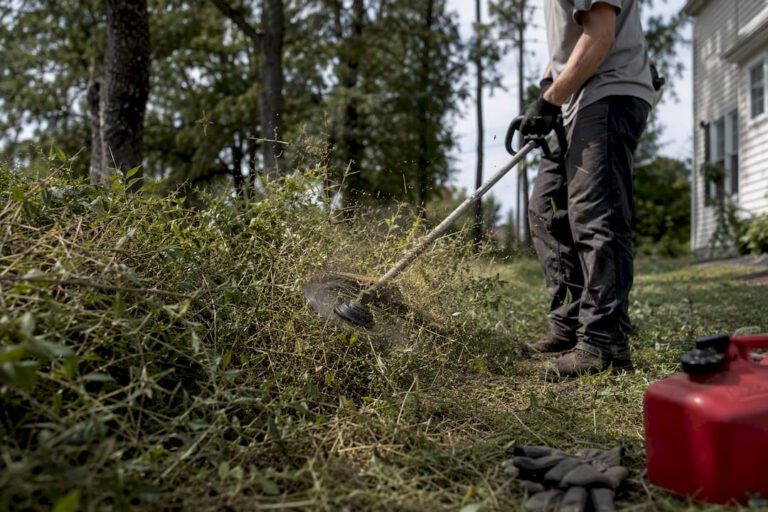
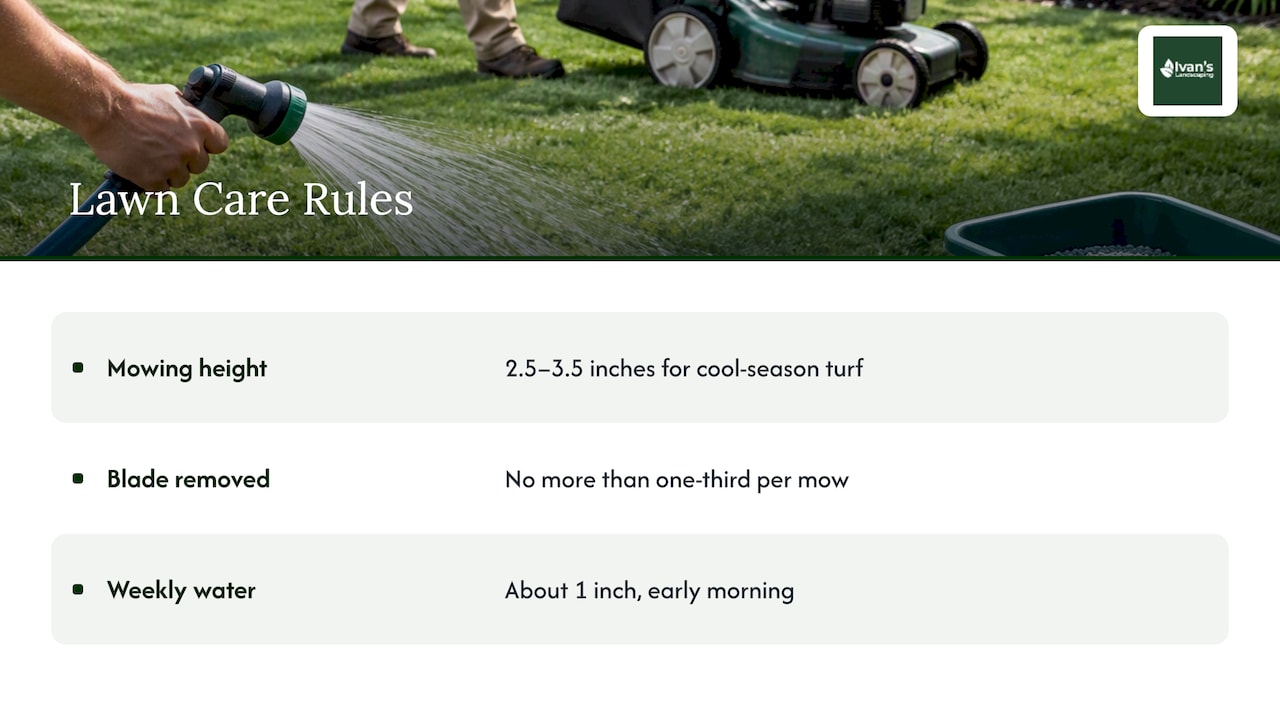
Mowing height for most cool-season turfgrass should stay between 2.5 and 3.5 inches, a range that discourages weed germination and lets roots reach deeper moisture, per Purdue Extension. Pair that height with the one-third rule: never remove more than a third of the blade length in a single mow, and keep blades sharp, which protects turf vigor according to UMass Amherst’s mowing best practices.
Watering follows a similar logic of less-but-deeper: about an inch per week total, from rain or irrigation combined, delivered early in the morning rather than in the evening, which Clemson HGIC ties to lower fungal disease risk. Fertilizer timing works best anchored to holiday markers and growth cycles rather than a fixed monthly schedule, a flexible-calendar approach that Wisconsin Horticulture recommends over rigid dates.
Pruning, Mulching, and Plant-Care Schedules
Pruning and mulching mistakes are some of the most common and most preventable issues we see on properties that otherwise look well kept.
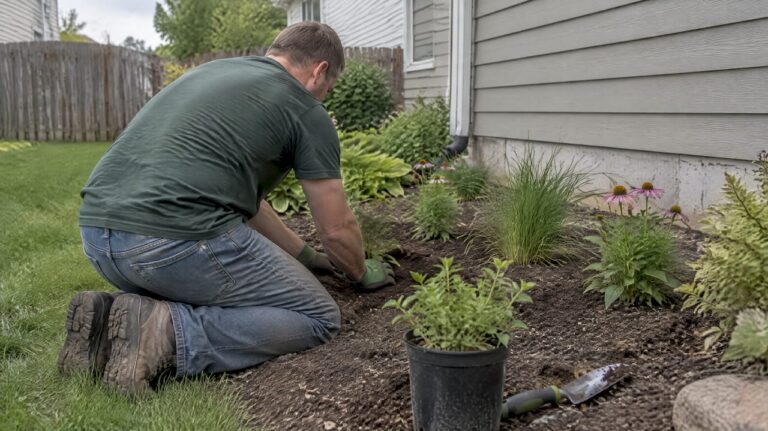
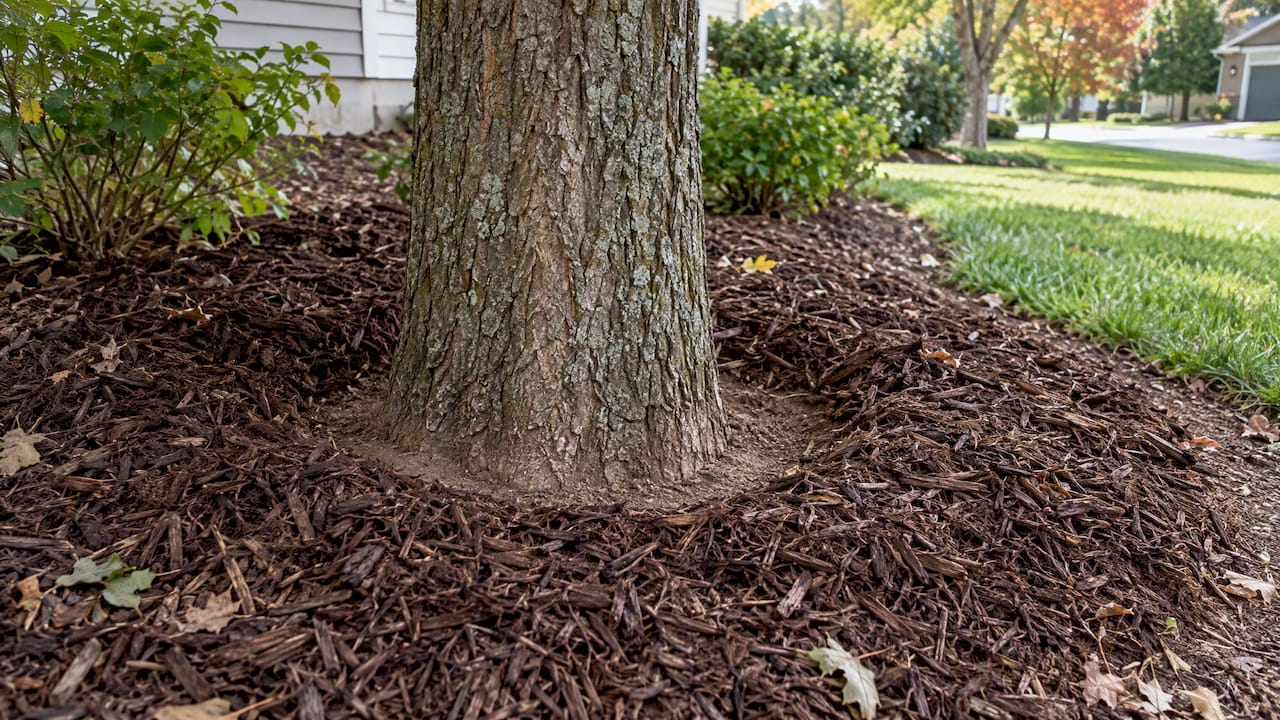
Most deciduous trees and shrubs take dormant pruning best, generally from November through March, while spring-flowering shrubs should wait until right after their bloom fades so you don’t remove next year’s buds, according to Nebraska Extension. Mulch depth matters just as much as pruning timing: aim for roughly 3 inches total, and keep material pulled back from trunks, since piling mulch against bark, often called volcano mulching, invites rot and pests rather than preventing them, per Wisconsin Extension. Seasonal plant-care checks should also include basic integrated pest management scouting and a look at which plantings have outlived their usefulness, an approach reflected in municipal plans like the Maynard, MA landscape maintenance plan. If your property includes trees planted for shade, our guide to landscaping for shade covers root protection during these pruning cycles.
Irrigation and Equipment Maintenance Checklist
Irrigation systems and mowing equipment fail quietly until the day they don’t, which makes a short annual checklist worth keeping.
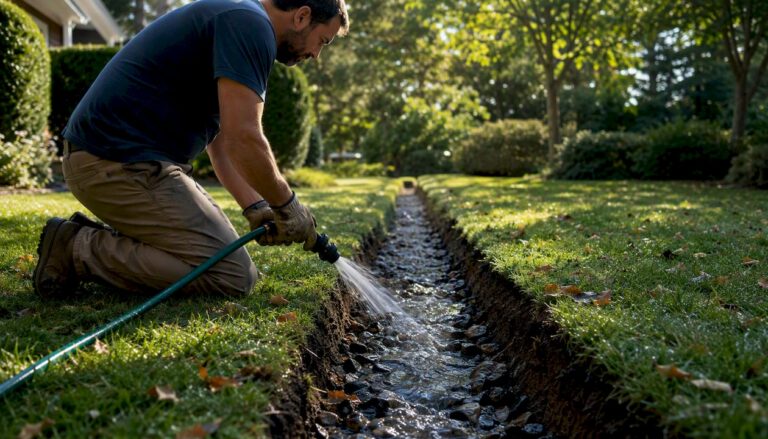
Run a full irrigation audit each year: test the controller, check every zone for leaks or clogged heads, and reprogram run times for the season ahead. Backflow preventers need testing and either insulation or draining depending on your freeze risk, a step Metro Nashville’s landscape manual treats as standard practice. In freeze-prone regions, blow out or fully drain irrigation lines before the first hard frost, and check valves and sensors while you’re at it. Mower maintenance follows the same seasonal logic: sharpen or replace blades, change the oil, and drain or stabilize fuel before storing equipment for winter. If drainage has been a recurring headache on your property, our yard drainage fixes guide addresses the most common soggy-lawn causes.
Customize the Calendar for Your Grass, Climate, and Site
A printed calendar is a starting point, not a rulebook. Cool-season and warm-season grasses respond to entirely different windows for aeration, seeding, and fertilization, so the first adjustment is knowing which type you’re managing. From there, local hardiness zone data and growing degree day tracking, both available through USDA plant hardiness tools, refine the generic dates above into something specific to your yard. Phenology offers a simpler shortcut: forsythia bloom signals the window for pre-emergent herbicide application better than any fixed date does, according to USGA’s phenology research. A simple decision rule works well in practice: if forsythia blooms, use that cue to time pre-emergent application rather than waiting for a date on the calendar.
Turn This Calendar into a Contractor Scope or Template
A maintenance calendar becomes useful when it records each task, its frequency, the responsible party, and relevant notes. That structure turns a list of chores into something you can hand off or hold a contractor accountable to.
- Task: the specific action, such as “mow lawn” or “core aerate.”
- Frequency: weekly, monthly, seasonal, or annual.
- Responsible party: homeowner, property manager, or contractor.
- Notes: timing cues, equipment needs, or special instructions.
When vetting a contractor against this template, ask about scope clarity, how frequency is documented, and what their emergency protocol looks like for storm damage or irrigation failure, standards reflected in plans like the Maynard, MA maintenance plan and in broader sustainable landscaping maintenance guidance. Property managers overseeing shared spaces may find our HOA landscaping maintenance checklist useful as a ready-made version of this exact structure. For a broader checklist format with downloadable options, this extension-backed maintenance checklist offers another practical template to compare against.
Author Perspective and Field Credibility
We built this calendar from the same framework we use on properties across McHenry County, where frequency and timing decide whether a maintenance plan holds up or falls apart by midsummer. We’ve refined our seasonal approach around the same markers covered here: mow height, water volume, and fall-priority aeration. Documenting frequency and task history is not busywork. It gives a property manager a record to point to when a plant fails or an irrigation line breaks, a practice municipal maintenance plans treat as standard rather than optional.
What This Calendar Gets Right and What It Doesn’t
The biggest mistake we see is treating a landscape maintenance schedule as a fixed set of dates rather than a set of triggers. A calendar that says “aerate in September” is a decent starting point, but a calendar that says “aerate once soil temperature and growth rate signal active recovery” will serve a property better in a year when spring runs unusually early or fall arrives late.
Conventional advice tends to overweight mowing frequency and underweight mowing height. Mowing more often feels productive, but a lawn cut too short, regardless of how often it’s mowed, loses root depth and drought tolerance faster than one mowed less often at the right height. If you take one thing from this guide, prioritize the one-third rule and correct mowing height over a stricter schedule.
The second gap in most generic calendars is timing fall work by habit instead of by growth stage. Early fall aeration and overseeding consistently outperform the same tasks done in October, yet many property owners push them later simply because that’s what they did last year. A calendar should bend to the season in front of you, not the one from twelve months ago.
— Chas
How Ivan’s Landscaping Maps This Calendar to Real Services
Every task on this calendar lines up with something we handle directly. Weekly mowing and edging fall under our lawn mowing service, mulch depth checks and replenishment under mulch service, and the heavy seasonal pushes in spring and fall under our spring and fall cleanup work.
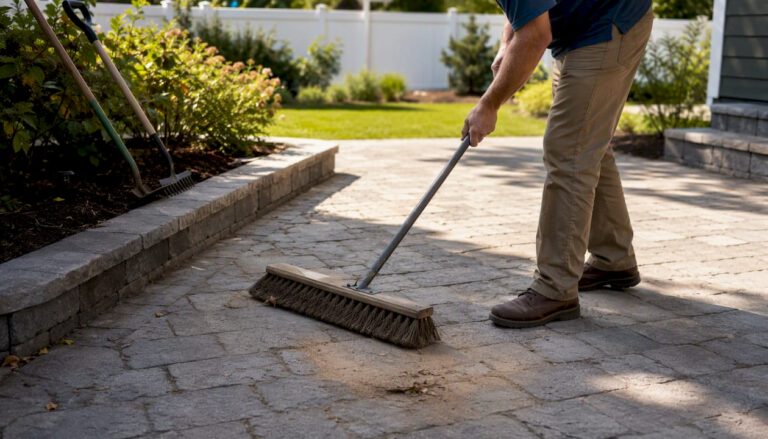
Our annual property maintenance plans help keep properties attractive year-round. If your property needs tree work or paver patio construction alongside routine maintenance, we handle those too.
Request a free estimate and we’ll build a plan around your property’s grass type, microclimate, and the calendar above.
FAQ
What Is a Good Lawn Maintenance Schedule?
A good schedule mows weekly during active growth at 2.5 to 3.5 inches, waters about 1 inch per week, and prioritizes core aeration and overseeding in early fall. Pair those recurring tasks with annual irrigation testing and seasonal pruning for a complete plan.
What Are Three Important Qualities for Landscaping?
Consistency, correct timing, and documentation stand out as the three qualities that separate a healthy landscape from a struggling one. Tasks performed on a reliable cadence, timed to growth stage rather than a fixed date, and tracked over time give a property the best chance of staying healthy year-round.
What Is the One-Third Rule for Lawn?
The one-third rule means never removing more than a third of the grass blade’s height in a single mow. Following this rule, as recommended by UMass Amherst, protects root depth and overall turf vigor.
How Much Does a Landscaper Charge Per Yard?
Pricing varies widely based on property size, service type, and location, and we don’t publish flat per-yard rates since every property’s scope differs. We provide free estimates so you can see exact pricing for your specific lawn or landscape before committing to a plan.
Sources
- Extension
- Hgic
- 8. Mowing : Center for Agriculture, Food, and the Environment (CAFE) at UMass Amherst
- METROPOLITAN NASHVILLE LANDSCAPE GUIDELINES AND BEST MANAGEMENT PRACTICES