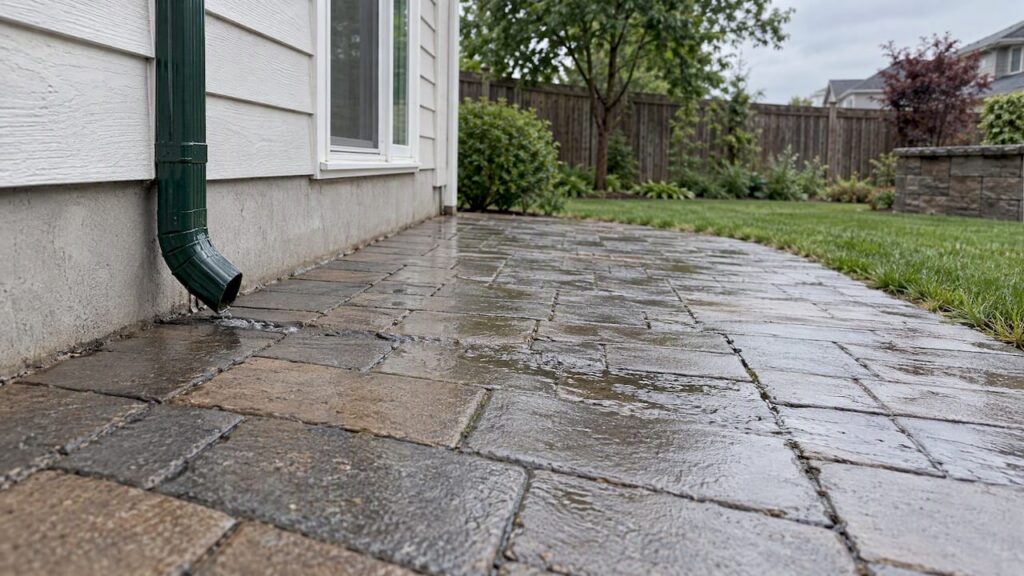
A patio should fall away from your house at about 1/4 inch per foot, and the ground beside it should do the same. When it doesn’t, rain runs toward the foundation and sits there. Most fixes come down to three things: restore the slope, move roof water farther out, and add a drain where the slope can’t be fixed. This guide explains how to tell which one you need.
TL;DR
- Target a 2% slope, which is 1/4 inch of drop per foot, for any hard surface within 10 feet of the foundation (PNNL Building America guide).
- Patios that once drained often fail because the backfill beside the house settled and reversed the fall.
- Downspouts and the soil grade matter as much as the patio surface. Fix the whole path from roof to yard.
- If you can’t get the slope, a swale, French drain or dry well carries water away. Never send it to a neighbor’s yard.
Table of Contents
- Why water collects on a patio and against the foundation
- How much slope a patio needs
- Check your slope in ten minutes
- Fix 1: Regrade the soil and the surface
- Fix 2: Send roof water away first
- Fix 3: Add a drain when slope isn’t possible
- Our perspective
- When to call a landscaper
- FAQ
- Sources
Why water collects on a patio and against the foundation
The usual cause is movement. The soil backfilled against a house after construction compacts over the years, and that can reverse a patio’s original fall, so water that once ran off now runs back to the wall. A patio poured tight against the house can also pass that movement along instead of relieving it at the joint, as this overview of patio settlement explains.
Not every puddle is a defect. The American Concrete Institute notes that even a 1/4-inch-per-foot slope can leave shallow “birdbaths” after rain because of construction tolerances and normal surface changes over time (Concrete Institute Q&A). Textured or stamped surfaces hold water longer in their pattern indentations (Concrete Network). A film of water that dries within a few hours is cosmetic. Water that stays against the foundation is not.
The stakes are real. Poor water management can lead to water intrusion, structural problems, pests, mold and indoor air quality issues (PNNL). If you already see damp basement walls or water pooling against the foundation after storms, treat the patio as one part of a larger grading question.
How much slope a patio needs
The guidance is consistent across sources:
| Source | Guidance |
|---|---|
| PNNL / ENERGY STAR guidance | 2% slope away from the house for hard surfaces within 10 feet, at least 0.25 inch per foot |
| Concrete Institute | 1/4 inch per foot is the common standard; wet climates may need 3/8 inch per foot |
| This Old House | A landscape contractor there advises a pitch of at least 1/8 inch per foot |
A 2% grade equals a 1/4-inch drop for every foot (Concrete Network). Over a 10-foot patio, that is 2.5 inches of total drop. The PNNL guide frames the target around the ground too: maintain the slope for 10 feet from the house or to the edge of the surface, whichever is less, which works out to about 6 inches of fall within that 10 feet.
We design to the 1/4-inch figure. Our McHenry County clay soils and freeze-thaw winters give a patio little tolerance for the minimum, so we don’t aim for the lowest number a source allows. For paver specifics, see our guide to paver patio drainage.
Check your slope in ten minutes
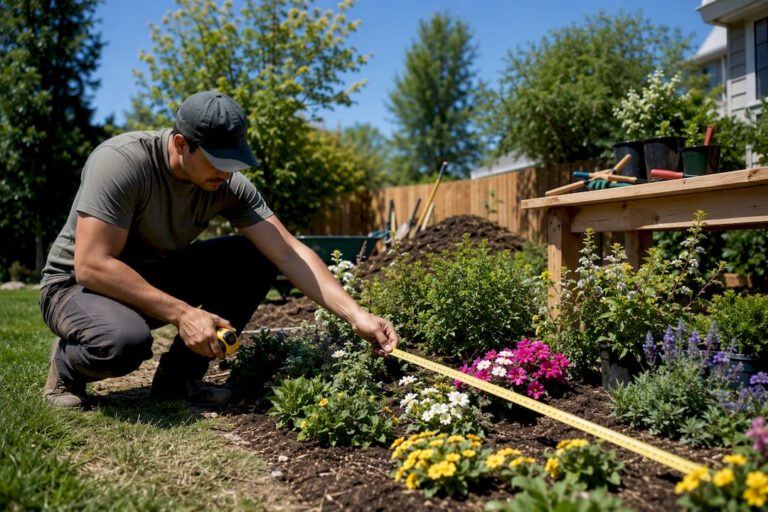
- Lay a straight 2×4 on the patio, perpendicular to the house, with a level on top.
- Raise the outer end until the bubble centers, then measure the gap under the board.
- Divide the gap by the board’s length in feet. You want at least 1/4 inch per foot, falling away from the house.
- Repeat on the soil beside the patio. If the ground rises toward the foundation, you have negative grade.
Our walkthrough on measuring negative grade around a house covers the soil side in more detail.
Fix 1: Regrade the soil and the surface
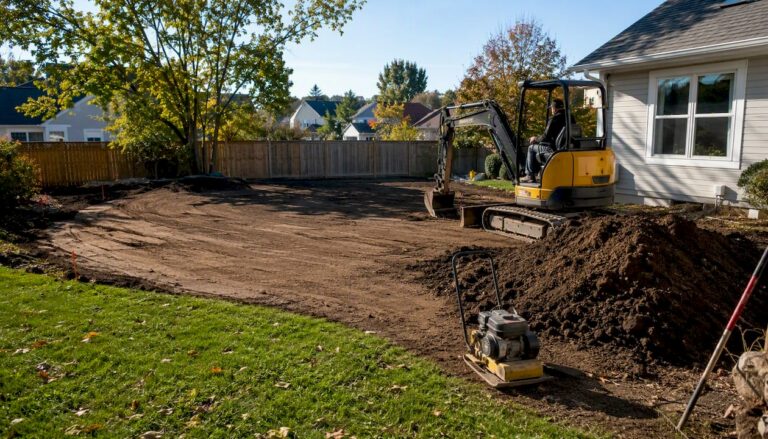
When the patio surface itself is sound and only the adjacent soil has settled, regrading is the cheapest repair. The soil next to the house is built up so it falls away, and a layer of topsoil is not enough: it needs to be compacted so it doesn’t settle again. Our page on grading around a foundation lays out the slope standard we work to.
When the patio slab itself slopes toward the house, the options are less pleasant. Pavers can be lifted, the base rebuilt and the pavers relaid at the right pitch. Poured concrete usually has to be replaced, or in some cases raised. The PNNL guide is blunt that retrofitting proper drainage after construction can be difficult and expensive, and lists footing drains, dampproofing or a moisture barrier, swales and other drainage systems as the options. That is why the slope is worth getting right when a patio is first built.
If you are comparing what a new surface should be, pavers versus concrete covers the trade-offs, including how each handles repair. For a general view of how much grading work matters on an uneven lot, the principles in this write-up on patio slope and grading near the foundation apply regardless of region.

Fix 2: Send roof water away first
A patio can be graded perfectly and still sit in a pond if the downspout empties beside it. Effective water management needs a continuous path from roof to foundation, including site grading, roof drainage and foundation drainage (NAHB technical note). That note says roof drainage must carry water at least 5 feet from the foundation where soils are expansive or collapsible.
The U.S. Department of Energy’s building science guidance suggests connecting downspouts to piping that discharges to a sloping final grade more than 5 feet from the foundation, or to an underground catchment more than 10 feet away that is not tied into the foundation drain (DOE). See our downspout drainage options for pipe size and slope. If you also run a sump pump, the same distance logic applies to where the discharge pipe ends.

Fix 3: Add a drain when slope isn’t possible
Sometimes a door threshold, a fence line or a neighbor’s lot makes a full 6 inches of fall impossible. In that case the PNNL guide says to provide drains or swales to carry water away from the structure. The main choices:
- Swale. A shallow, broad, grassed channel that guides surface water around the patio. It needs room and a place for the water to go. See how to design a drainage swale.
- French drain. A gently sloped trench of gravel and perforated pipe. Better Homes & Gardens advises sloping the trench 1/4 inch per foot and joining pipe sections with fittings, not glue (BHG).
- Dry well. A buried gravel-filled chamber that absorbs water when it can’t be moved elsewhere on your property. Check local code first, as BHG notes.
- Channel drain. A grated trench along the patio edge. Concrete Network describes sloping a slab toward a central channel drain in situations like a pool deck (Concrete Network).
Which one fits depends on soil and space. Our swale vs French drain comparison includes a simple sponge test for McHenry County yards, and three weekend drainage fixes covers lighter-duty options.
Before you dig
Pick a discharge point where the water won’t cause trouble, and never aim it at a neighbor’s yard. Call 811 to have underground utility lines marked before you excavate, and check local codes for dry-well rules (BHG). For work close to the foundation, or if water is already entering the basement, bring in a licensed professional before you start digging. A trench cut too close to a footing can create a new problem.
Our perspective
Most patio drainage calls we get are not about the patio. The slab or pavers are fine, and the real problem is a downspout dumping at the corner, or soil that has sunk 2 inches beside the wall over a decade. So we start by walking the whole path: roof, gutters, soil, patio, and where the water ends up. Fixing only the visible puddle often moves it a few feet.
We also push for the cheapest sound fix first. Regrading and extending a downspout cost far less than trenching, and they work more often than people expect. When a drain is needed, we size it to the water it will actually receive and put the outlet somewhere that won’t create a complaint next door. And we leave the site clean, because a drainage job should not leave a ruined lawn behind it.
— Chas
When to call a landscaper
The DIY checks above are useful, but call a contractor when the patio slopes toward the house, water is touching the foundation after most storms, you need a drain that runs more than a few feet, or you want a new patio built to the right pitch from the start.
Ivan’s Landscaping has served McHenry County homeowners and property managers since 2008. We build pavers and patios with drainage planned into the base, and we handle drainage and grading work for existing yards. We offer free estimates, a satisfaction guarantee and carry insurance. Contact us through our site and we will look at where your water actually goes.
FAQ
What is the proper slope for a patio to drain away from a house?
About 1/4 inch per foot, or a 2% grade, away from the house. Some professional guidance accepts 1/8 inch per foot in dry climates and calls for 3/8 inch in wetter ones. For a 10-foot patio, 1/4 inch per foot means roughly 2.5 inches of total drop.
How do I grade the ground away from my house?
Build the soil so it falls about 6 inches over the first 10 feet from the foundation, using compacted fill rather than loose topsoil. Keep mulch and planting beds from raising the level against the wall. A stake-and-string or board-and-level check shows where you are today.
What are the drains outside a house called?
The common types are swales, French drains, channel (trench) drains and dry wells, plus the gutters and downspouts that feed them. For patios, a swale or a French drain is the usual choice, and a gravel-lined trench around the edge is another option.
Can I fix a patio that slopes toward the house without replacing it?
Sometimes. If the problem is settled soil, regrading beside the patio may be enough. If the slab itself tilts toward the house, a drain or swale can intercept water, but concrete often needs replacement, and pavers can be relaid on a rebuilt base.
Sources
- Patio Slabs, Porch Slabs, Walkways, and Driveways Slope Away from House (PNNL)
- Concrete Patio Slope (American Concrete Institute)
- Foundation Drain, Gutters, Downspouts (U.S. Department of Energy)
- Rain & Groundwater Management (NAHB)
- How to Install Drainage Around a Patio (Better Homes & Gardens)
- Concrete Slope for Exterior Slabs (Concrete Network)
- Patio Settlement: When It Becomes a Water Problem
- How To Install a Patio Drainage System (This Old House)