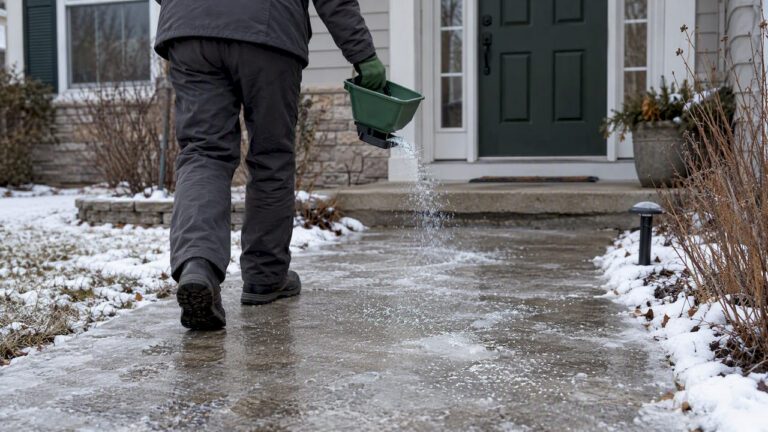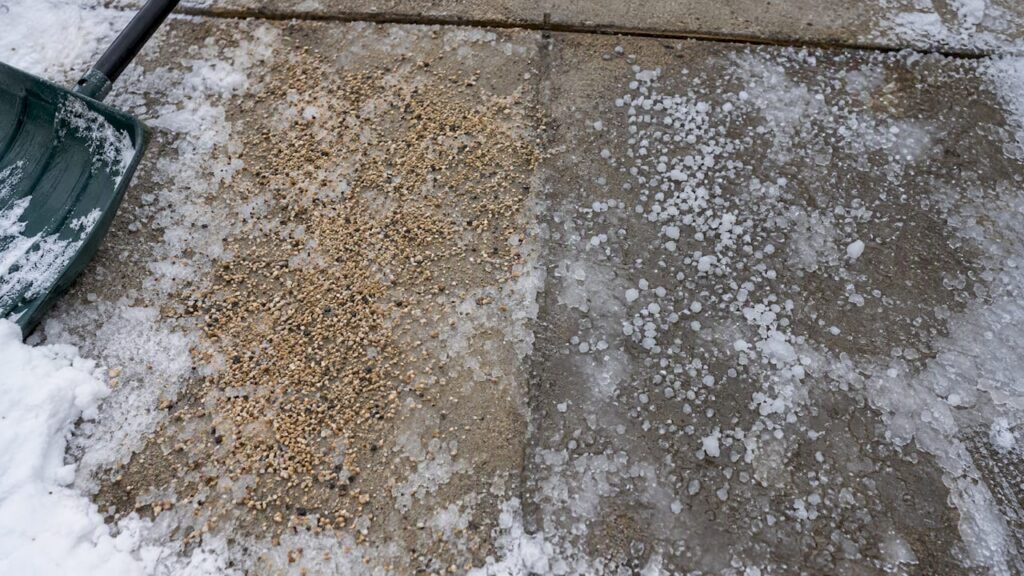
Salt melts ice and sand does not. Salt lowers the freezing point of water, so it can break down snow and ice that has already formed. Sand is an abrasive that gives your tires and boots something to grip. It never melts anything. For most McHenry County driveways, sidewalks and parking lots, the best answer is to plow first, then use the least salt that gets the job done. Sand is a short-term backup for the coldest days.
TL;DR
- Salt melts ice and prevents bonding. Sand adds temporary traction only, and it never melts ice.
- Choose by pavement temperature, not the air temperature on your weather app. Plain salt slows sharply as pavement approaches 15°F.
- Both products have costs. Salt runs off into groundwater and corrodes surfaces. Sand clogs drains and has to be swept up.
- Timing and plowing matter more than the product. Ask a contractor how they monitor storms and when they dispatch.
- Mixing sand and salt is not automatically better, because the two can work against each other.
Table of Contents
- How salt and sand work
- Why pavement temperature decides
- When sand makes sense
- When salt makes sense
- Is a salt and sand mix better?
- Plowing and timing matter more than the bag
- Which to choose for your property
- Our perspective
- Snow removal from Ivan’s Landscaping
- FAQ
- Sources
How salt and sand work
The two materials solve different problems, which is why “sand or salt for ice” has no single answer.
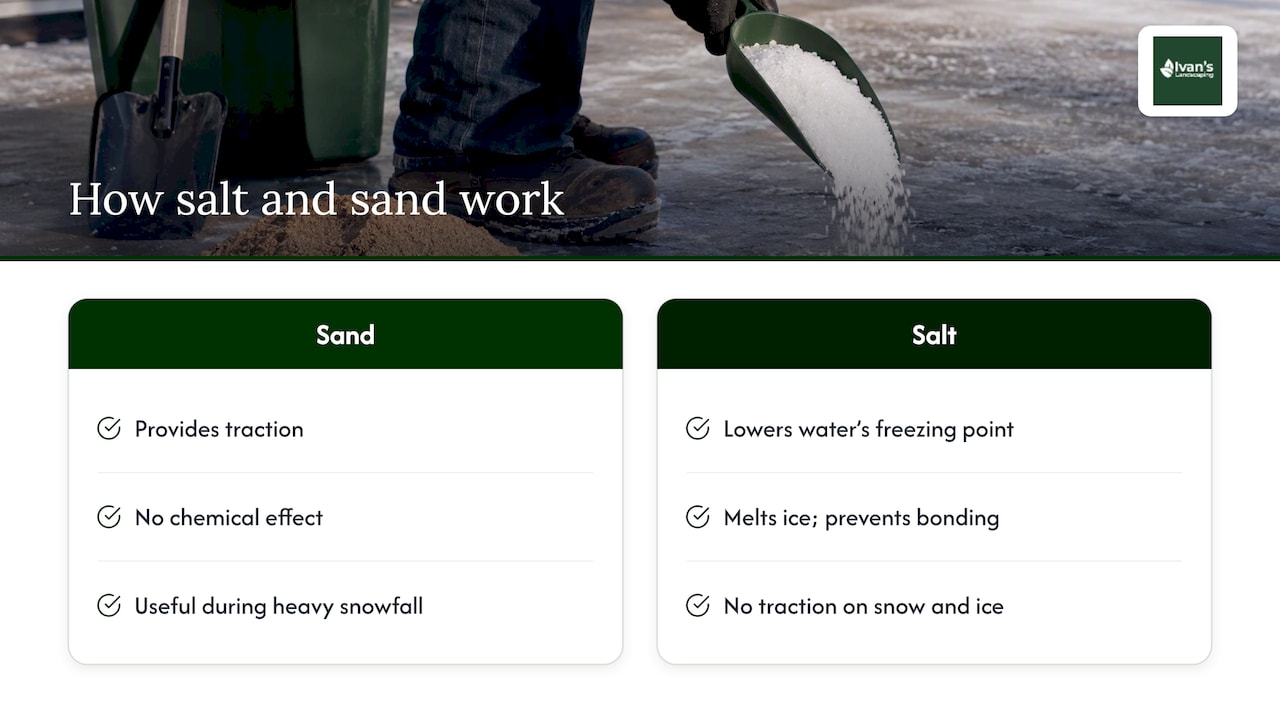
According to the Illinois Department of Transportation, road salt lowers the freezing point of water. That can keep snow from forming a bond with the pavement and melt snow and ice that is already there. IDOT mostly uses rock salt, along with liquids such as salt brine or beet juice that help the salt stick. It may use sand for traction during heavy snowfall until pavement temperatures rise.
Sand does nothing chemically. The Minnesota Pollution Control Agency says it provides traction only. Deicers, in turn, give no traction on top of snow and ice. So the real question is whether you need to melt or only need grip.
Why pavement temperature decides
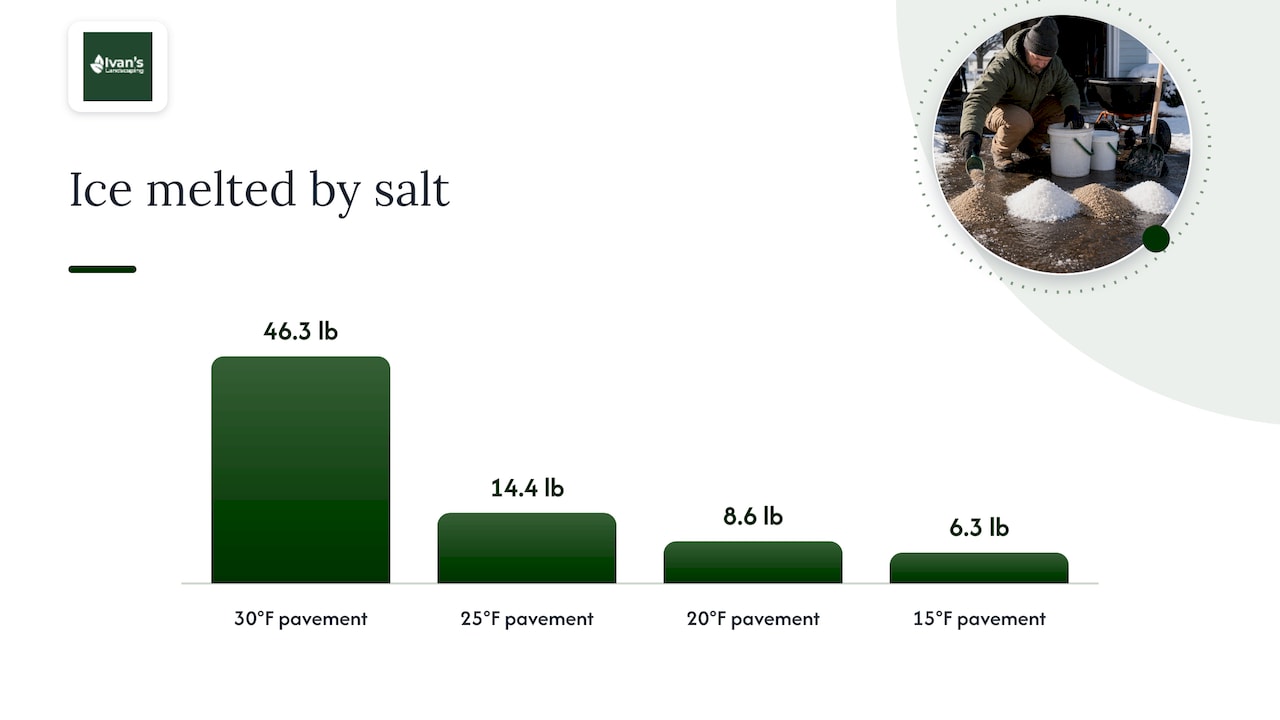
Salt gets slower as the surface gets colder. The same Minnesota guidance lists how much ice one pound of salt can melt:
| Pavement temperature | Ice melted by 1 lb of salt | Time |
|---|---|---|
| 30°F | 46.3 lb | 5 minutes |
| 25°F | 14.4 lb | 10 minutes |
| 20°F | 8.6 lb | 20 minutes |
| 15°F | 6.3 lb | 1 hour |
At 10°F, the guidance describes dry salt as ineffective. IDOT’s practice lines up with this: it spreads salt when pavement is at or above 15°F and adds other chemicals below that.
The key word is pavement. Wisconsin DOT notes that pavement and air temperatures can differ by as much as 20°F. A shaded concrete walk, an exposed lot or a bridge deck can be far colder than the forecast suggests. We cover this in more detail in our guide to deicing salt types.
When sand makes sense
Sand earns its place in a few situations:
- Very cold pavement. When salt has stopped working, grip is the only thing you can add quickly.
- Spot traction. Wisconsin and Minnesota guidance both describe sand as most useful in very cold conditions or for temporary traction. An Idaho Transportation Department research report also cautioned that sand can give meaningful traction at intersections and curves, such as a steep drive or the top of a ramp.
- Heavy snowfall in progress. This is when IDOT itself may fall back on sand until temperatures rise.
The downsides are practical. Traffic scatters sand quickly, so it needs repeat passes. Wisconsin DOT warns that higher application rates, reapplication, sweeping and disposal can make sand cost more overall. EPA’s stormwater guidance adds that sand can pile up in stormwater inlets and raise sediment and turbidity in nearby water.
When salt makes sense
Salt is the better tool when you need bare pavement, which is the usual goal on commercial lots, apartment walks and HOA entrances. The Federal Highway Administration separates two uses:
- Anti-icing: applying a freezing-point depressant before or at the start of a storm, so a strong bond never forms between pavement and ice.
- Deicing: breaking an existing bond after snow and ice have accumulated.
Anti-icing makes plowing easier and can leave pavement wet or slushy instead of icy. The downside is environmental. EPA says excess salt can harm aquatic life, pollute drinking-water sources and damage infrastructure. The McHenry County parking-lot handbook describes chloride as something that dissolves, moves downhill with the water and stays in the water cycle. That matters in a county that relies on groundwater.
Salt also attacks concrete, metal and landscaping. If you own a new patio or driveway, read our steps on preventing ice melt damage to concrete.
Is a salt and sand mix better?
Not by default. The McHenry County handbook points out that the two work by different mechanisms and can work at cross-purposes. Salt can melt the snow that was holding sand in place, and traffic can push sand into slush. A blend makes sense only when the site needs both melting and temporary traction, for example a sloped lot on a day when pavement is hovering near 15°F.
Plowing and timing matter more than the bag
The most effective approach is mechanical removal plus correctly timed treatment. The Minnesota guidance says deicing works best if you plow before applying material. Local practice follows the same order: Lake in the Hills crews plow accumulated snow first and salt right after, and Cary aims to have village streets plowed and salted within 10 hours after a storm ends under regular conditions.
FHWA’s decision-support guidance frames the same point for managers: treatment strategies work as part of a coordinated system, and early action keeps ice from bonding. Whether a proposal says “salt” tells you little. How the contractor monitors weather, when crews dispatch and how they sequence plowing tells you much more.
Which to choose for your property
| Property | Usual approach |
|---|---|
| Home driveway and walks | Shovel or plow first, then a light salt application when pavement is above roughly 15°F. Keep a small amount of sand for steep or very cold spots. |
| Retail or office lot | Plow, pre-treat before storms where possible, and salt after clearing. |
| Apartment community or HOA | Prioritize entrances, walks and stairs. Pair plowing with targeted treatment and cleanup. |
| Extreme cold (near or below 10°F) | Rely on plowing and spot traction rather than plain salt. |
If you manage several buildings, the way you buy the service also matters. Our comparison of seasonal and per-push snow contracts explains how each handles repeat visits.
Our perspective
We don’t think “salt is bad, sand is good” holds up, and neither does the reverse. EPA guidance points to chloride and corrosion risks with salt and sediment and cleanup risks with sand. So the goal we work toward is the least material that delivers the safety result the property needs.
In practice, that means a scope that is written down: what gets plowed, what gets treated, when crews arrive, and what cleanup follows. A seasonal contract should cover calibrated application and post-storm cleanup, not only the spreading. We serve homeowners, businesses and property managers in McHenry County, and the properties that go smoothly are the ones where those expectations were set before the first storm. We also keep job sites clean, which matters when sand and salt residue could otherwise end up in drains and on walkways.
— Chas
Snow removal from Ivan’s Landscaping
If you would rather not make these calls at 5 a.m., we handle snow removal for homes and commercial properties across McHenry County. Property managers can look at our parking lot snow removal and commercial snow removal pages. For a free estimate, start from our home page.
FAQ
Can I use sand to melt snow?
No. Sand never melts snow or ice. It only adds traction on top of it. If you need the ice gone, you need a deicer such as salt, and you should plow or shovel first.
Is sand or salt better for ice on a driveway?
Salt is better when you want bare pavement and the surface is above about 15°F. Sand is better as a short-term grip aid when it is too cold for salt to work well. Many homeowners keep both and use each where it fits.
Is sand basically salt?
No. Salt is a chemical compound that dissolves in water and lowers its freezing point. Sand is inert mineral grit that does not dissolve, which is why it ends up as sediment instead of runoff.
What temperature is too cold for salt?
Performance drops steadily as pavement cools. Minnesota guidance lists dry salt as ineffective at 10°F, and it says one pound melts 6.3 pounds of ice in an hour at 15°F. Check pavement temperature, not just the forecast.
Sources
- Illinois Department of Transportation: Winter Road Conditions
- Minnesota Stormwater Manual: Winter Parking Lot and Sidewalk Maintenance
- Wisconsin DOT: Winter maintenance FAQ
- Idaho Transportation Department research report
- EPA: Deicing Material Application and Storage
- EPA: Salt
- McHenry County parking lot handbook
- FHWA: How Do Anti-Icing Methods Work?
- FHWA: Decision Support, Control and Treatment
- Village of Cary: FAQ