If a tree’s trunk sits closer to your foundation than roughly one mature-height, or it shows decay, a lean past 15 degrees, or root damage to drains and slabs, treat it as a hazard and schedule a professional assessment now. Most trees near homes are perfectly safe. The ones that aren’t rarely give you much warning beyond what’s listed below, so document what you see and call an ISA-certified arborist if any red flag applies to your tree.
TL;DR:
- Trees within one mature height of your foundation, showing decay, or leaning more than 15 degrees require urgent professional assessment.
- Roots tend to cause foundation and sewer line damage through soil moisture loss and soil movement rather than physically pushing through concrete.
- Distance guidelines suggest keeping small trees 8 to 10 feet away, medium trees 15 to 20 feet, and large trees at least 20 to 30 feet from your house, adjusted for species and soil type.
- Visible signs like cracks, heaving, or overhanging limbs indicate potential risks, but soil-based issues from healthy trees can also cause long-term foundation problems.
- Managing issues typically involves pruning, root barriers, or targeted repairs; removal is only necessary for severe decay, instability, or extensive structural damage.
Table of Contents
- Warning Signs a Tree Near Your House Is a Real Risk
- How Close Is Too Close? Practical Distance Guidelines
- How Trees Actually Damage Foundations and Utility Lines
- Assessing the Tree: DIY Checks and When to Call a Professional
- Weighing Your Options: Pruning, Barriers, Removal, and More
- Planting Smart: How to Avoid Repeating the Problem
- Ivan’s Landscaping’s Approach to Trees Close to a Home
- Get a Tree Assessment From a Professional Landscaping Company
- Sources
- FAQ
Warning Signs a Tree Near Your House Is a Real Risk
Not every tree growing close to a house is a problem. The ones that are tend to show at least one obvious signal, and you don’t need any special training to spot most of them.
Walk the yard and check the trunk, canopy, and ground around the base:
- Dead branches, thinning foliage, mushroom-like fungal growth on bark, or visible cavities in the trunk
- A lean greater than 15 degrees from vertical, especially if it’s new or getting worse
- Cracks running through the trunk or major limbs
- Lifted sidewalk slabs, exposed roots pushing up soil, or heaving near the base of the trunk
- Large limbs hanging directly over the roofline, gutters, or siding, particularly ones that rub against the house in wind
- Gutters or floor drains that clog repeatedly with root fragments or fine roots
Pro Tip: A tree doesn’t need to be dying to be dangerous. A perfectly healthy oak with one large, poorly attached limb over your bedroom roof is often a bigger near-term risk than a stressed but structurally sound tree ten feet farther away.
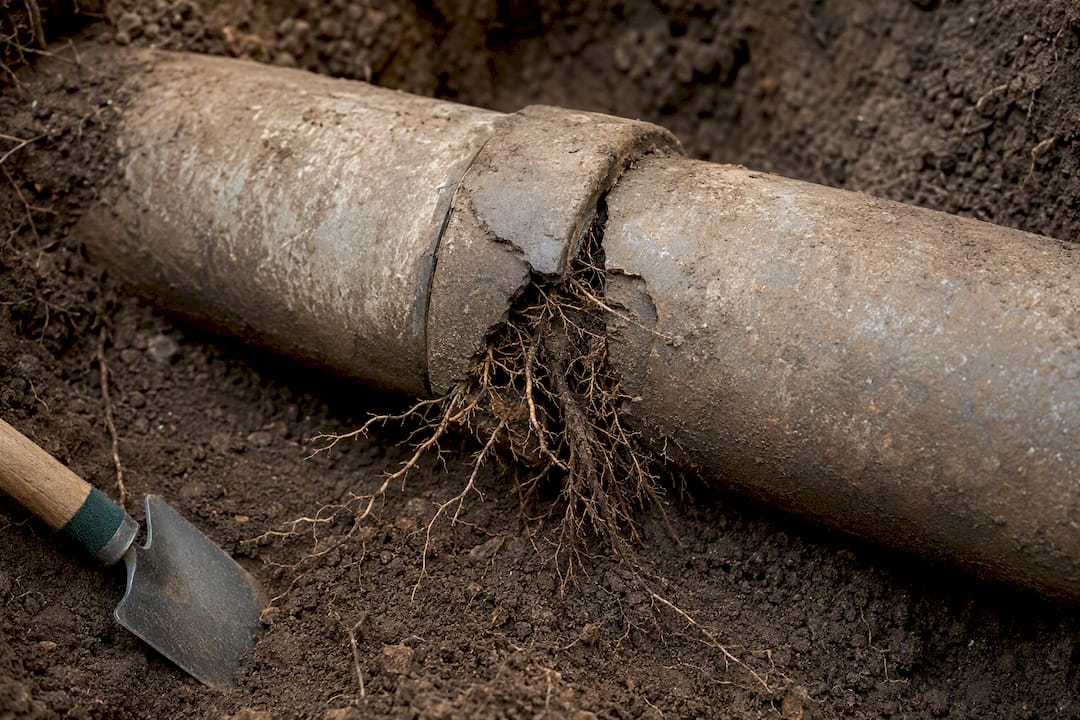
Roots commonly work their way into old or already-cracked sewer joints rather than breaking through sound pipe, which is why a drain that clogs once a year deserves attention before it clogs every month. If you see active root intrusion in plumbing, a rapidly worsening lean, or limbs that have already started dropping, that’s an “act today” situation, not a wait-and-see one.
How Close Is Too Close? Practical Distance Guidelines
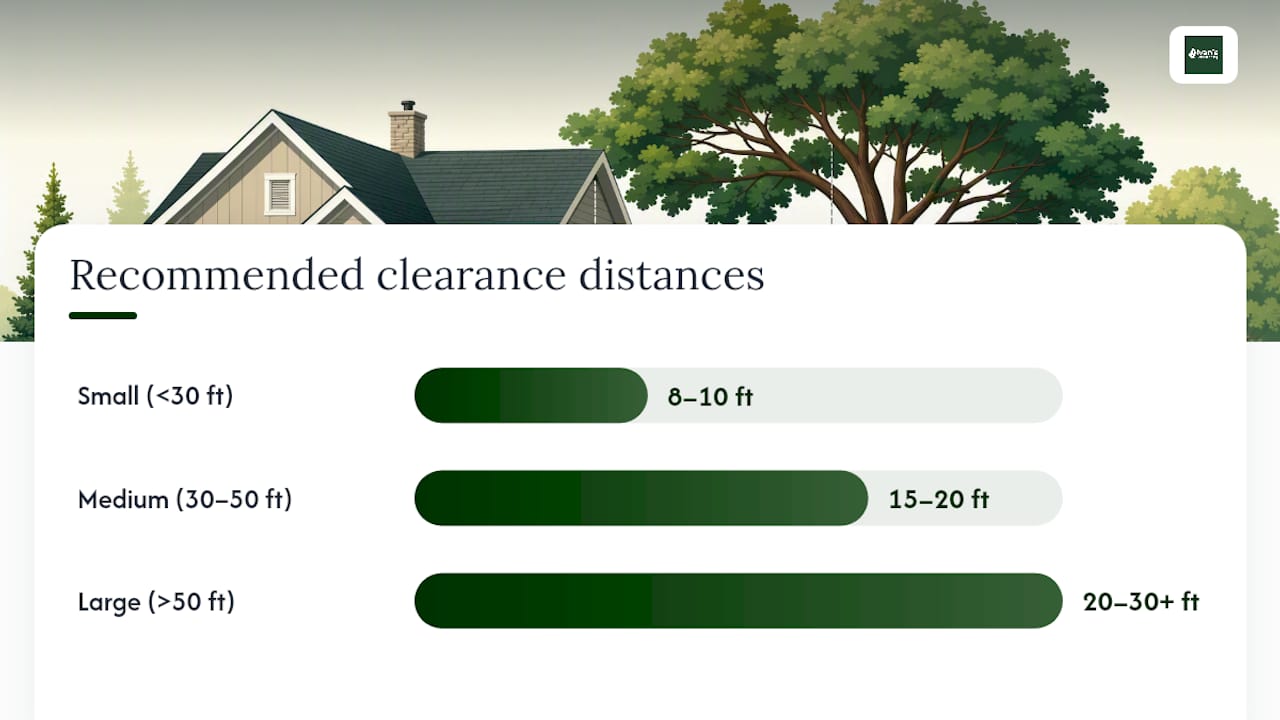
The safe distance between a tree and your house depends almost entirely on how big that species gets at maturity, not how big it looks today. Urban forestry guidance from the Arbor Day Foundation sets out rule-of-thumb bands that hold up well across most climates:
- Small trees (mature height under 30 feet): keep the trunk 8 to 10 feet from the foundation
- Medium trees (30 to 50 feet mature height): keep 15 to 20 feet of clearance
- Large trees (over 50 feet mature height): keep 20 to 30 feet or more
These numbers aren’t arbitrary. A tree’s root system, and its influence on soil moisture, can extend roughly as far as the tree is tall for thirsty species growing in shrinkable clay soil. That means a 60-foot silver maple sitting 25 feet from your house may still be close enough to affect soil moisture near the foundation.
Soil type shifts the math further. Clay-heavy soil amplifies the risk of foundation movement because it expands and contracts with moisture. Sandy soil holds less moisture and often reduces that risk, but it drains less around roots and can increase the odds of a tree tipping over in high wind. Willows, poplars, and several maple varieties are known for aggressive, water-seeking roots and generally warrant distances at the high end of their size category or beyond it.
How Trees Actually Damage Foundations and Utility Lines
Most homeowners picture a root physically shoving through a foundation wall like a battering ram. That’s rarely what happens. Healthy roots almost never push through intact concrete; the damage that does occur is usually driven by something less dramatic but just as costly.
Large trees draw huge volumes of water from the soil around them. On shrinkable clay, that moisture loss can cause the ground to contract and settle unevenly, a process that can move a foundation over months or years without a single root ever touching it. Ironically, removing a mature tree too abruptly can flip the problem: the soil rehydrates, swells, and the same foundation can heave in the opposite direction. That’s one reason arborists and structural engineers coordinate on these calls rather than working in isolation.
| Damage type | Typical cause | Usual severity |
|---|---|---|
| Foundation cracking | Soil moisture change from large roots or sudden tree removal | Slow, progressive |
| Sewer or drain blockage | Roots entering old or damaged pipe joints | Recurring, worsens over time |
| Sidewalk or patio heave | Surface roots lifting thin concrete | Cosmetic to moderate |
| Storm impact damage | Limb or whole-tree failure in wind | Immediate, can be severe |
Surface-level heave under a patio or walkway is common and usually cosmetic. Real structural movement under a house is a slower, quieter problem, which is exactly why it goes unnoticed until doors stop closing right.
Assessing the Tree: DIY Checks and When to Call a Professional
Start with a walk-around you can do in fifteen minutes. Stand back far enough to see the whole canopy and note whether the tree leans toward the house, has dead or bare sections, or has limbs directly over the roofline. Then get close to the trunk and root flare, looking for cavities, cracked bark, or fungal growth. Finally, check the concrete closest to the tree, sidewalks, the patio, the foundation itself, for new cracks, and check whether any interior doors or windows have started sticking.
- Photograph everything with context. Include a tape measure or a known object for scale, note the date, and shoot the full canopy plus close-ups of any decay, cracks, or root heave.
- Measure the distance from the trunk to the nearest foundation wall and compare it against the size-based ranges above.
- Call an ISA-certified arborist if you see decay, cavities, major overhang, suspected root intrusion in drains, or if the tree sits within one mature-height of the house.
- Call a structural or geotechnical engineer if you notice progressive cracking, sloping floors, or doors and windows that suddenly stop closing properly, since these point to foundation movement rather than a tree problem alone.
Pro Tip: Keep your photos and notes even after the issue is resolved. Extension resources and horticultural societies recommend periodic tree surveys near buildings, and a dated record of past decay or corrective pruning is genuinely useful for insurance conversations or if you sell the house later.
Removal isn’t always the answer. Case reports and professional commentary consistently show that assessment-first decisions that pair an arborist’s tree evaluation with an engineer’s structural read often land on pruning or targeted repair instead of taking the tree out entirely.
Weighing Your Options: Pruning, Barriers, Removal, and More
Once you know what’s actually wrong, the fix should match the problem, not overshoot it. A tree with one heavy limb over the roof doesn’t need to come down; it needs that limb gone.
- Crown reduction and pruning: Lowers the odds of limb failure and clears overhang from the roof and siding. Works well on structurally sound trees but needs repeating every few years.
- Root barriers and engineered fixes: Physical barriers can redirect roots away from slabs and pipes when installed correctly, though costs vary by depth and length required, and utility locating is mandatory first.
- Root pruning with pipe repair: Addresses localized root intrusion into a specific pipe run quickly, but cutting roots can trigger regrowth toward the same water source and stress the tree if done aggressively.
- Chemical growth regulators: Can modestly slow root or canopy growth in some situations but won’t fix an existing structural problem on their own.
- Transplanting: A realistic option only for young, smaller trees with a manageable root ball; mature trees rarely survive the move.
- Removal: Warranted when decay is severe, the lean is unstable, or root-driven structural damage is already extensive and repair costs would exceed the tree’s value.
Isolating just the pipe without addressing the root source is a common mistake. Extension guidance notes that pairing plumbing repair with root management, rather than fixing one and ignoring the other, is what actually keeps a drain clear long term.
Planting Smart: How to Avoid Repeating the Problem
If you’re planting new trees or replacing one you removed, mature size should drive placement, not how big the sapling looks in the pot. Use the same small, medium, and large distance bands from earlier, and push toward the higher end for any species known for aggressive roots.
- Confirm mature height and root habit before you dig, and site accordingly using nursery and planting guidance.
- Call 811 before digging, every time, and map irrigation lines and shallow utilities on your property first.
- Choose species with non-invasive roots and moderate water needs for anything going within 20 feet of the house.
- Set a maintenance rhythm: periodic pruning, canopy clearance from the roofline, and an arborist check every few years once the tree matures.
A quick drainage test, digging a 12-inch hole and watching how fast it empties, tells you a lot about whether that spot will encourage roots to travel toward your foundation looking for water.
Ivan’s Landscaping’s Approach to Trees Close to a Home
Our crews treat every close-to-house tree the same way: inspect first, document what we find, and recommend the least invasive fix that actually solves the problem. That usually means conservative pruning or root management. Removal only comes up when decay, lean, or root damage genuinely calls for it. Every estimate includes a written recommendation you can keep, compare, and act on at your own pace.
Get a Tree Assessment From a Professional Landscaping Company
A one-time trim from a random crew fixes what you can see today. It doesn’t tell you whether that same tree is quietly working on your foundation or your sewer line three years from now. A professional landscaping company may build tree work into full property care plans, so the same team that prunes an overhanging limb one season can return for follow-up inspections and maintenance, offering continuity and familiarity with your property. We offer on-site inspections, pruning, tree removal when it’s truly warranted, root management, and ongoing maintenance plans for homeowners across McHenry County. Estimates are free and quick to schedule, and our satisfaction guarantee stands behind the work. If you’re in the area and want a documented, no-pressure look at that tree by your foundation, request your free estimate from Ivan’s Landscaping and get a clear next step instead of a guess.
Sources
For deeper technical background, consult the foundation damage research on soil moisture and tree removal, and RHS advice on trees near buildings for periodic survey guidance. Always loop in a structural engineer when damage is suspected.
- Do trees really cause so much damage to property? (Journal paper)
- Planting right tree in the right place (Arbor Day Foundation)
- Tree growing close to house #914920
- Tree roots in your sewer line & foundation (arborist resource)
FAQ
Should I remove a tree that’s too close to the house?
Not automatically. Removal is only necessary for severe decay, an unstable lean, or extensive root-driven structural damage; many close trees are safely managed with pruning or root work instead.
How close is too close for a tree to be to a house?
As a rule of thumb, small trees need 8 to 10 feet of clearance, medium trees 15 to 20 feet, and large trees 20 to 30 feet or more, adjusted upward for thirsty species and clay soils.
What happens if you plant a tree too close to a house?
Over time, the tree’s water demand can shift soil moisture around the foundation, and its roots may eventually intrude into aging drain or sewer joints, leading to cracking or recurring blockages.
What can I do if my neighbor’s trees are too close to my house?
Document the tree’s condition and any damage with photos, then raise the concern directly with your neighbor before escalating; many jurisdictions allow you to trim overhanging branches at the property line, but cutting roots or limbs beyond that requires care and, in some cases, professional or legal guidance.