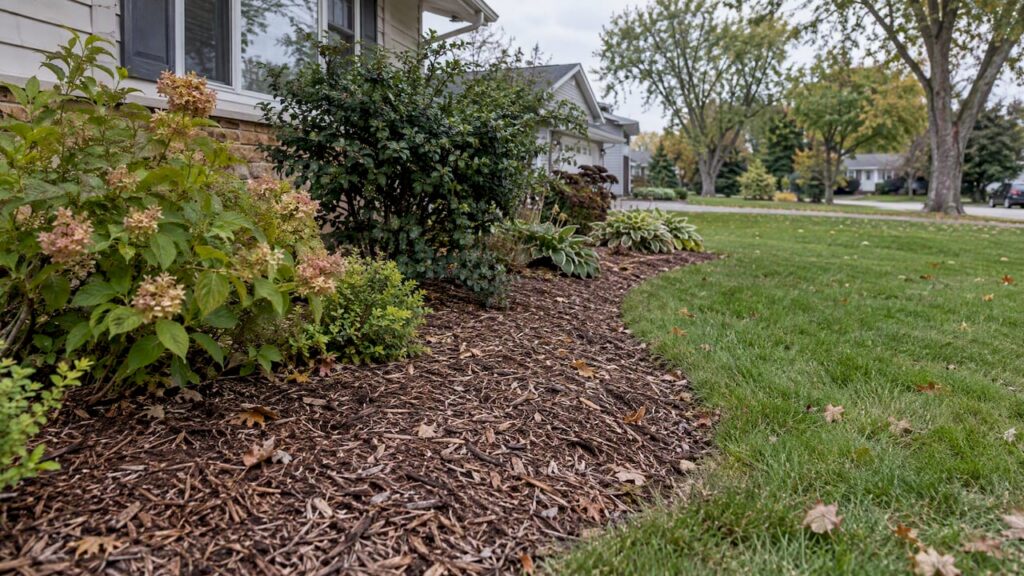
Mulch falls into three families: organic (wood, bark, pine needles, compost), inorganic (rock and gravel) and synthetic (rubber). For most beds in McHenry County, shredded hardwood or bark is the practical default. It feeds the soil, suppresses weeds and looks tidy. Rubber and rock earn their place only in specific spots. Below we explain how each type behaves, how to pick between the common ones, and how to spread mulch so it helps your plants instead of harming them.
TL;DR
- Organic mulch (shredded hardwood, bark, wood chips, compost) is the best choice when plant and soil health is the goal.
- Rubber mulch is the most flammable option in the research, so keep it away from the house. Rock needs yearly cleanup to stay weed-free.
- Spread 2 to 4 inches and keep mulch several inches back from trunks and stems.
- Color (brown, black, red) is mostly a look and soil-warmth decision. Cedar and hardwood differ mainly in how fast they break down.
- Bulk delivery usually beats bags once a project gets large enough.
Table of Contents
- The three families of mulch
- Comparing the common types
- Rubber vs. wood mulch
- Rock vs. mulch
- How to apply mulch correctly
- Our perspective
- Bagged or bulk
- Have us install it
- FAQ
- Sources
The three families of mulch
University extension guides sort mulch into organic, inorganic and synthetic materials. Each can vary a lot in size, shape and texture.
- Organic: wood chips, hardwood and softwood bark, pine needles, cocoa hulls, leaves and compost mixes, as the Illinois Department of Natural Resources lists them. These break down over time and add to the soil.
- Inorganic: crushed stone, gravel and similar. They decay slowly if at all, so they are low maintenance on paper.
- Synthetic: shredded rubber is the usual example.
University of California researchers explain that organic mulches mimic the forest floor. That is why they offer nutrient cycling and better soil structure that rock and gravel cannot.
Comparing the common types
| Type | Best for | Watch out for |
|---|---|---|
| Shredded hardwood | Most flower beds, shrubs, foundation beds | Fades in sun and needs a refresh |
| Cedar | Beds where you want slower breakdown | Often costs more than hardwood |
| Pine bark and pine needles | Acid-loving plants, a natural look | Needles and bark are flammable near buildings |
| Arborist wood chips | Large areas, tree rings | Looks rougher than bagged mulch |
| Compost | Vegetable and perennial beds | Fine texture, so use a thinner layer |
| Rubber | Playground-style surfaces away from structures | Flammability, no soil benefit |
| Rock and gravel | Next to structures, dry zones | Weeds grow in debris on top |
Hardwood vs. cedar
Both are shredded wood and both do the main jobs: weed suppression, moisture retention and a finished look. Cedar generally breaks down more slowly, so you may go longer between top-ups. Hardwood breaks down a little faster, which means it feeds the soil sooner. If your beds are large, the price gap matters more than the small performance difference.
Brown, black and red
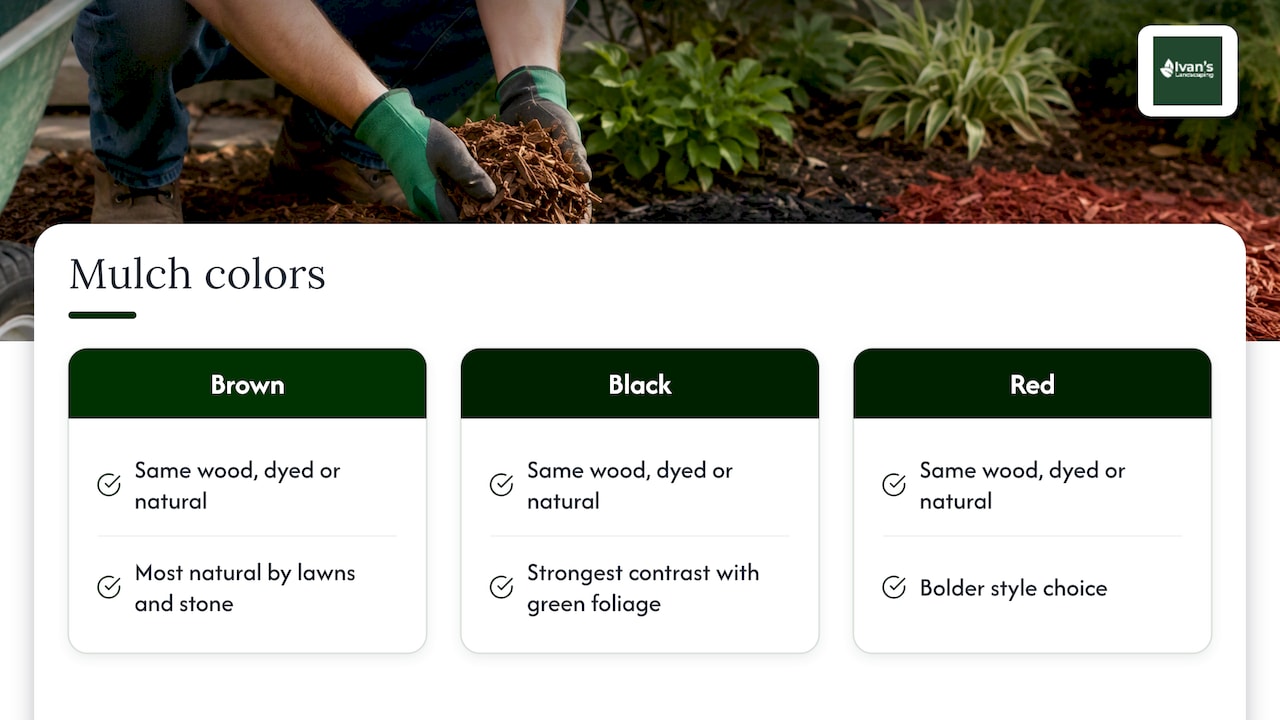
These are dyed or naturally colored versions of the same wood. Color changes the look of the bed and can change how much heat the soil picks up. We compare it in detail in our guide to brown vs. black mulch. If you are wondering whether dyed products are worth it, our page on dyed vs. natural mulch covers that. Brown reads as the most natural next to Illinois lawns and stone, black gives the strongest contrast with green foliage, and red is a bolder style choice.
Pine straw vs. wood mulch
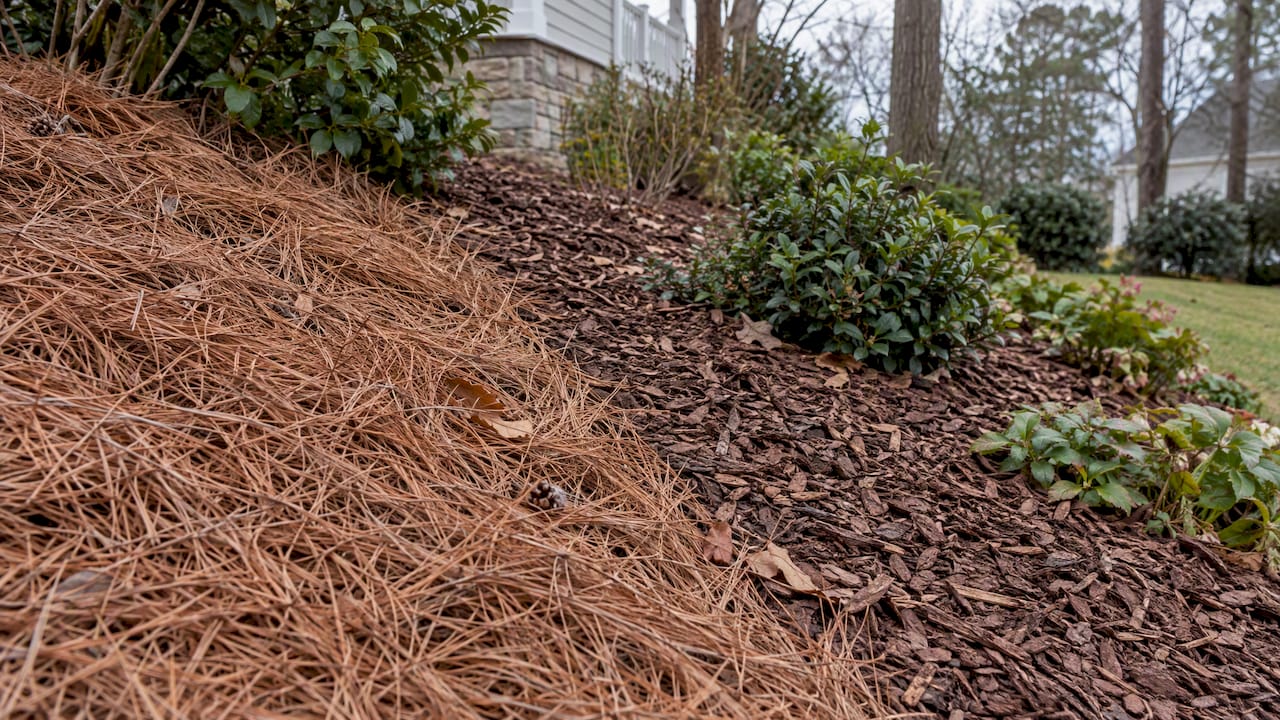
Pine straw is light, airy and common in the South. In our area, shredded wood is easier to source and tends to stay put on slopes better. If you are weighing the two, read pine straw vs. wood mulch.
Rubber vs. wood mulch
Rubber lasts a long time and does not rot, which is why people consider it. It also brings drawbacks. A study of 13 landscape mulches found that rubber mulch is the most flammable, while composted wood chips had the least hazardous combustion among organic options. Fire guidance from the University of California notes that rubber burns very hot and is hard to extinguish, and advises non-combustible materials such as gravel or pavers right against structures.
Rubber also gives your soil nothing back. For planting beds, wood is the better fit. We cover safety standards and long-term cost in rubber vs. wood mulch.
Rock vs. mulch
Rock looks permanent, but it is not set-and-forget. Leaves, twigs and grass settle on top and form a soil-like layer where weeds grow, so rock beds need annual blowing or raking. Rock does make sense in a narrow strip along a foundation. Elsewhere, organic mulch is usually the better value for plants. We explain how that plays out locally in why mulch beats rock in McHenry County.

How to apply mulch correctly
The type matters less than the way it goes down.
- Depth: the Illinois DNR recommends 2 to 4 inches. Use the low end for fine material such as compost, and 3 to 4 inches for coarse chips. Deeper than 4 inches can restrict oxygen and lead to root rot.
- Leave a gap: piling mulch against a trunk, the so-called volcano, traps moisture and invites rot and pests. Keep a 3 to 6 inch gap around the trunk so the root flare stays visible.
- Keep it off siding: termites eat cellulose, but extension guidance finds no evidence that wood chip mulch increases termite damage. The practical step is moisture management and a clear gap between mulch and the house.
- Break up big mulched areas: near buildings, fire specialists suggest separating large mulched areas with concrete or gravel within roughly 5 to 30 feet of a structure.
Timing matters too. See the best time to mulch in McHenry County.
Our perspective
We have spread mulch on McHenry County homes and commercial properties since 2008, and the same pattern shows up often. Most mulch problems are depth and placement problems, not product problems. A 6-inch pile of premium mulch against a maple does more harm than 3 inches of ordinary shredded hardwood spread properly.
For most homeowners, we recommend natural or dyed shredded hardwood in a color that suits the house, applied at 2 to 3 inches and refreshed as it thins. For property managers, a consistent product and a set schedule matter more than the brand. Uniform beds across a site look cared for and are easier to scope. We would use rock only where mulch is a poor fit, and rubber we rarely suggest for beds.
One more thing: a clean job site is part of the work. Edges are cut, excess is removed, and walkways are left swept.
— Chas
Bagged or bulk
Bags suit a few small beds. Once you need several cubic yards, bulk delivery is usually the cheaper route per yard, and it is easier to spread evenly. Our breakdown of bagged vs. bulk mulch shows where the crossover sits. We do not publish fixed prices because they depend on the product, bed size and access, so a quick look at your property is the honest way to quote.
Have us install it
If you would rather not haul and spread it yourself, our mulch service covers McHenry County homes, businesses and HOA properties. We can pair it with a spring or fall cleanup so beds are cleared before the new layer goes down. Request a free estimate and tell us the bed sizes, the look you want and anything near the house we should know about.
FAQ
What is the best type of mulch for landscaping?
For most planting beds, shredded hardwood or bark. It suppresses weeds, holds moisture and breaks down into the soil. Choose the color and wood type that fit your budget and the look of the house.
Is brown or black mulch better?
Neither is better for plants. Both are wood, and the difference is appearance and, to a degree, how much heat the bed holds. Pick the one that suits your siding, stone and plantings.
Is rubber mulch a good idea?
It lasts, but it is the most flammable mulch in the study cited above and adds nothing to the soil. Keep it away from buildings, and choose wood for planting beds.
How much mulch should I spread?
Two to four inches. Go thinner with fine materials like compost and thicker with coarse chips, and keep it several inches back from trunks and stems.
Sources
- Proper Mulching Techniques, Illinois DNR
- Defensible Space Landscaping: Mulches, UC ANR
- Mulches for Landscapes, UC ANR Publication 8672
- Impact of Mulches on Landscape Plants and the Environment: A Review
- Using Mulches in Managed Landscapes, Iowa DNR
- The Combustibility of Landscape Mulches, UC ANR