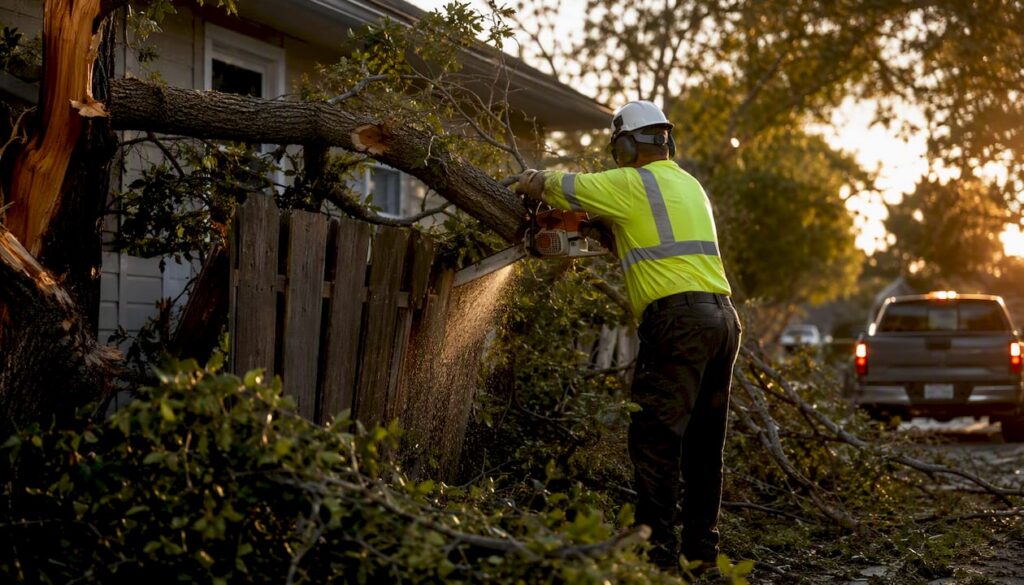
If a tree has fallen on your home, garage, vehicle, or a shared driveway, stop reading past this paragraph and act. Call 911 first if anyone is trapped, injured, or if the tree has torn into a structure people are inside. If there’s a threat to safety but no immediate life danger, your next call goes to a licensed 24/7 emergency tree service that can dispatch a crew and start stabilizing the site.
Do this in order:
- Get everyone, including pets, away from the tree, the area beneath it, and any hanging limbs.
- If you see downed power lines anywhere near the tree, treat every line as live and call your utility company before doing anything else.
- Photograph the damage from a safe distance once you’re clear, but don’t approach for a better angle.
- Call a certified emergency tree crew and describe exactly what happened: what fell, what it hit, and whether wires are involved.
Pro Tip: Save your local utility’s emergency line and a trusted tree company’s after-hours number in your phone now, before a storm hits. Fumbling for a number during an active hazard costs you minutes you don’t have.
Most established emergency tree services aim to reach an active hazard site within one to two hours when conditions and call volume allow, though a major regional storm can push that timeline back as crews triage the worst threats first. That’s the realistic window to plan around: not instant, but fast enough that securing the immediate area yourself in the meantime matters more than you might think.
Key Takeaways
Emergency tree removal works best when you call the right people in the right order: 911 for life threats, the utility for downed wires, then a 24/7 certified tree crew for the hazard itself.
| Point | Details |
|---|---|
| Safety comes first | Clear the area around the tree and keep people and pets away until help arrives. |
| Call 911 for life threats | Any injury or trapped person means emergency services before any other call. |
| Utility company handles live wires | Never approach a tree touching a power line; let the utility de-energize it first. |
| Document everything | Timestamped photos and a written crew report speed up insurance claims significantly. |
| Ivan’s Landscaping offers 24/7 response | Insured McHenry County crews provide free estimates, crane access, and cleanup for emergency tree hazards. |
Table of Contents
- How do you know if a tree is a true emergency?
- What should you do while you wait for help?
- What happens when the emergency crew arrives?
- How much does emergency tree removal cost, and what will insurance cover?
- Why is DIY removal so dangerous after storm damage?
- How do you choose the right emergency tree service on the phone?
- How Ivan’s Landscaping handles emergency tree removal in McHenry County
- What documentation actually speeds up your insurance claim?
- A note from Ivan’s Landscaping on emergency response
- Call Ivan’s Landscaping for immediate emergency tree removal
- Where to learn more about storm safety and tree care standards
- Sources
How do you know if a tree is a true emergency?
Not every damaged tree needs a crew tonight. A true emergency involves a tree or limb that is actively threatening people, a structure, a vehicle, or your only way in or out of the property.
The clearest signs:
- A tree or large limb has fallen onto a house, garage, shed, or vehicle.
- A limb is hanging, cracked, or partially attached and could drop at any moment.
- The trunk is visibly split or has a fresh crack running through it.
- A tree that wasn’t leaning before is now leaning, especially with lifted or exposed roots at the base.
- The tree or debris is blocking a driveway, front door, or the only exit from the property.
- Any part of the tree is touching, resting on, or tangled with a power line.
A leaning tree with root lift is different from a tree that’s simply dropping a few dead branches after a windy week. The first is a structural failure in progress; the second is routine yard cleanup that can wait for a scheduled visit. If you’re not sure which one you’re looking at, describe it to a tree service on the phone. A trained dispatcher can usually tell from your description whether this needs an emergency dispatch or a next-day appointment.
Never approach a tree that’s touching a power line, even if the tree looks stable. Contact your utility company immediately and let them de-energize the line before anyone, including a tree crew, gets near it. Ready reinforces this: staying clear of downed lines and unstable storm debris is a life-safety issue, not a judgment call you make on the spot.

What should you do while you wait for help?
Once you’ve made the right calls, there’s a short window before the crew arrives where a few careful actions protect both your family and your insurance claim.
- Confirm everyone, including pets, is out of the affected area and stays out.
- If anyone is injured or trapped, call 911. This takes priority over every other call.
- If wires are down or tangled in the tree, call your utility company before anything else.
- Call a 24/7 emergency tree service and give them a clear description of the hazard and its location.
- From a safe distance, photograph the damage: the tree, the point of impact, and any visible structural harm.
- Note the time the tree fell or was discovered, along with any details about the storm or conditions involved.
What you should not do matters just as much as what you should. Don’t attempt to cut through a fallen tree or split limb yourself. Storm-damaged wood often holds stored tension that releases unpredictably the moment a cut is made, and that kind of failure is one of the reasons emergency removal is discouraged as a DIY project. Don’t climb onto a roof or vehicle to inspect closer. Don’t try to move heavy limbs off a car or structure on your own; you could shift a load that’s currently stable into one that isn’t.
Pro Tip: When you photograph the damage, capture wide shots showing the whole tree and its position, then closer shots of the point of impact, any structural penetration, and anything unusual like exposed roots or split wood. Note the date and approximate time in your phone’s notes app immediately, since photo metadata alone doesn’t always transfer cleanly to insurance portals.

What happens when the emergency crew arrives?
A qualified crew doesn’t start cutting the second they pull up. The first move is a hazard assessment, walking the site to understand what’s under tension, what’s likely to shift, and where the safe work zone needs to be roped off. This kind of structured risk evaluation is close to what arborists call a TRAQ (Tree Risk Assessment Qualification) approach, and it’s the difference between a controlled removal and a second accident waiting to happen.
The typical sequence looks like this:
- Dispatch confirms the job and sends the nearest available crew, often within one to two hours under normal storm conditions.
- On-site assessment: the crew evaluates the tree, the load, nearby structures, and utility exposure before touching anything.
- Stabilization: if there’s a hole in a roof or a wall, crews often tarp the opening immediately to stop further weather damage while the tree work continues.
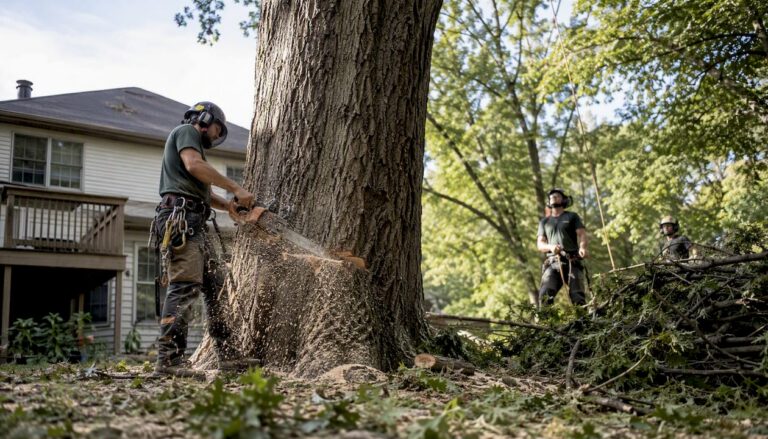
- Staged removal: limbs and sections come down in a controlled order, using rigging, ropes, and sometimes a crane or bucket truck depending on height and access.
- Debris removal and site cleanup, including hauling away logs, branches, and chipped material.
- A final walkthrough with you to confirm the hazard is fully cleared and the site is safe.
The equipment on a real emergency job tends to include chainsaws for cutting, a wood chipper to process brush and smaller limbs on-site, a bucket truck for elevated work, and a crane for oversized trees or tight-access situations where rigging alone isn’t safe. Crews working after dark often bring portable lighting, and tarps are standard for any job involving roof or structural damage. During major storms, call volume spikes fast, and emergency providers typically triage by severity, moving life-safety and occupied-structure threats to the front of the line ahead of cosmetic damage.
Ask for photos, an itemized work report, and a copy of any temporary tarping documentation before the crew leaves. You’ll want all three for your insurance claim.
How much does emergency tree removal cost, and what will insurance cover?
Emergency pricing runs higher than a scheduled removal, and that’s a function of risk and timing rather than markup for its own sake. A crew responding at 2 a.m. to a tree resting on a roof is managing active hazards, working with tighter safety margins, and often pulling in equipment like a crane on short notice. Several factors drive the final number:
- Tree size and how entangled it is with a structure or vehicle.
- Whether a crane or bucket truck is required for safe access.
- After-hours, weekend, or holiday timing.
- The complexity of the rigging needed to remove the tree without further damage.
- Local demand during a widespread storm event, when many properties need help at once.
Exact rates vary by market and by the specifics of the job, so treat any number you hear as a starting point for a conversation, not a fixed quote until a crew has actually assessed your property.
Homeowners insurance usually enters the picture when a tree damages something the policy covers. A standard homeowners policy commonly covers removal of a tree that has damaged a covered structure, though coverage limits and deductibles differ by policy and insurer, so confirming your specific terms matters before you assume full reimbursement. Documenting the damage thoroughly, with photos and a professional report, tends to support a faster, cleaner claim, while a tree that simply fell in the yard without hitting anything insured is a much less certain claim.
Pro Tip: Call your insurer while the crew is still on-site if you can. Have them note the claim while you can also get the crew’s on-site report, photos, and any tarping details logged in the same conversation window. Insurers respond faster to claims backed by documentation gathered close to the actual event.
Why is DIY removal so dangerous after storm damage?
A fallen or partially fallen tree looks like a cleanup job. It behaves like a loaded spring. Storm-damaged wood, split trunks, and hung-up limbs frequently hold stored tension, meaning the wood is bent or compressed in a way that releases violently and unpredictably the moment someone cuts into it or shifts its weight.
That’s the core hazard behind most serious DIY tree removal injuries: a limb that appears stable rolls, kicks back, or drops the second a chainsaw bites into the wrong spot. Add a chainsaw, an unstable footing on wet ground, and no rigging equipment to control the fall, and the risk compounds fast. Electrocution is the other major danger. Any tree in contact with a power line should be treated as energized until your utility company confirms otherwise, and that call takes priority over everything else on your list.
There’s also a paperwork trap. Some jurisdictions still require permits even for emergency removals, and skipping that step can create complications later, whether with your municipality or your insurer. A licensed crew knows the local requirements and handles that piece for you; a well-meaning DIY attempt usually doesn’t.
How do you choose the right emergency tree service on the phone?
You’re often making this decision under pressure, sometimes at night, sometimes with a tree actively resting on your roof. A short, direct checklist keeps you from hiring the wrong crew in a hurry.
Ask these questions before you commit:
- Are you available 24/7, and how quickly can a crew reach my address?
- Do you carry general liability insurance and workers’ compensation coverage?
- Are your climbers or crew leads ISA-certified or TRAQ-qualified?
- Do you have access to a crane or bucket truck if the job requires one?
- Can you provide tarping for storm damage and documentation I can hand to my insurer?
Certifications like CTSP (Certified Treecare Safety Professional) and TRAQ signal that a crew has gone through structured safety and risk-assessment training rather than learning rigging on the job. That distinction matters most on the exact kind of job you’re calling about: an unstable tree over a structure.
Watch for these red flags:
- A demand for full payment upfront, especially in cash, before any work starts.
- No proof of insurance when you ask, or a vague, evasive answer.
- Uncertainty or hesitation about roof damage, crane work, or utility-adjacent removals.
- Refusal to walk the site with you or document the damage before starting.
During a widespread storm event, expect some hold time even with a good provider, since most reputable emergency services triage calls by severity and put occupied-structure and life-safety threats ahead of yard cleanup. A crew that’s upfront about that triage process, rather than promising instant arrival no matter what, is usually the more trustworthy one.
How Ivan’s Landscaping handles emergency tree removal in McHenry County
Ivanslandscaping runs a 24/7 emergency response for hazardous trees across McHenry County, IL, with insured crews trained to handle storm-damaged and structurally unstable trees safely. When you call, dispatch gathers the details of your hazard, sends a crew to assess the site in person, and provides a free estimate before work begins, so you know what you’re agreeing to before any cutting starts.
On a typical emergency call, the crew brings:
- On-call dispatch and rapid on-site assessment of the hazard.
- Equipment suited to the job, including bucket truck and crane access for larger or harder-to-reach trees.
- Debris hauling and full site cleanup, not just removal of the immediate hazard.
- Documentation support, including photos and a written report you can hand to your insurer.
- Follow-up services like stump grinding once the immediate danger is cleared.
Ivanslandscaping backs its work with a satisfaction guarantee and a commitment to leaving job sites clean, both signs the company built its reputation on more than just showing up fast. If your emergency removal uncovers other issues, a split root system, invasive growth, or a yard that needs restoration once the debris is gone, the same team that handled your tree removal can also help with yard cleanup and site restoration afterward.
Pro Tip: Ask any emergency crew, including ours, to walk the property with you after the tree is down. A five-minute walkthrough catches secondary issues, like a cracked retaining wall or a damaged sprinkler line, before you close out an insurance claim.
What documentation actually speeds up your insurance claim?
Insurance adjusters move faster when the paperwork is already organized, and the best time to build that file is in the hours right after the tree comes down, not weeks later when details have blurred.
Follow this sequence:
- Secure the scene and make sure it’s safe before documenting anything further.
- Photograph the damage from multiple angles, including wide shots of the tree’s position and close-ups of any structural penetration, and timestamp each one.
- Write a running list of everything affected: roof, siding, fencing, vehicles, and any measurable damage.
- Request a written, on-site assessment from the emergency crew describing what happened and what work was performed.
- Save every receipt and invoice connected to the emergency response, tarping, and cleanup.
- Contact your insurer with the full package: photos, the crew’s report, and your own notes, as soon as it’s assembled.
A useful damage-documentation checklist covers:
- Wide shots showing the tree’s full position relative to your home or vehicle.
- Close-up shots of roof penetration, siding damage, or structural cracks.
- Photos of any downed power lines or utility involvement, taken from a safe distance.
- Rough measurements of the tree’s size and the affected area.
- A copy of the crew’s written assessment and any tarping documentation.
In most cases, emergency mitigation work, like tarping a roof to stop further water damage, can proceed without waiting for prior insurer approval, since insurers generally expect homeowners to prevent further damage rather than let it worsen while waiting on a claim decision. Just keep every receipt and note connected to that mitigation work; it becomes part of your claim, not a separate expense you eat alone.
A note from Ivan’s Landscaping on emergency response
Storm damage doesn’t wait for business hours, and neither should the response to it. We built our emergency service around that reality: insured crews who know McHenry County’s trees, its storm patterns, and the difference between a hazard that needs immediate action and one that can wait until morning. Safety comes first on every call, followed by transparent billing and a straight answer about what the job actually requires, not an inflated estimate meant to capitalize on a stressful moment.
We serve homeowners and property managers throughout McHenry County, and our promise is simple: show up, assess honestly, work safely, and leave the site clean.
Call Ivan’s Landscaping for immediate emergency tree removal
A hazardous tree doesn’t leave room for shopping around, and Ivanslandscaping built its emergency service so you don’t have to. Insured crews, a 24/7 dispatch line, and free on-site estimates mean you get a real assessment and a straight answer fast, not a voicemail and a callback tomorrow.

When you call, you get:
- 24/7 dispatch with crews familiar with McHenry County properties and storm patterns.
- Insured, trained teams equipped for crane and bucket truck work when the job requires it.
- Documentation support, including photos and written reports, to help your insurance claim move faster.
Visit the McHenry County services page to see the full range of tree and storm-damage work Ivanslandscaping handles, or head straight to the tree removal page to request your free estimate now.
Where to learn more about storm safety and tree care standards
Trusted resources give you a way to double-check safety advice and verify professional standards beyond what any single company tells you.
- Ready covers what to do during and immediately after severe weather.
- The Tree Care Industry Association’s CTSP program explains the safety certification standards behind qualified arborists and crews.
- Policygenius’s guide to tree removal coverage walks through documentation practices that support a stronger insurance claim.