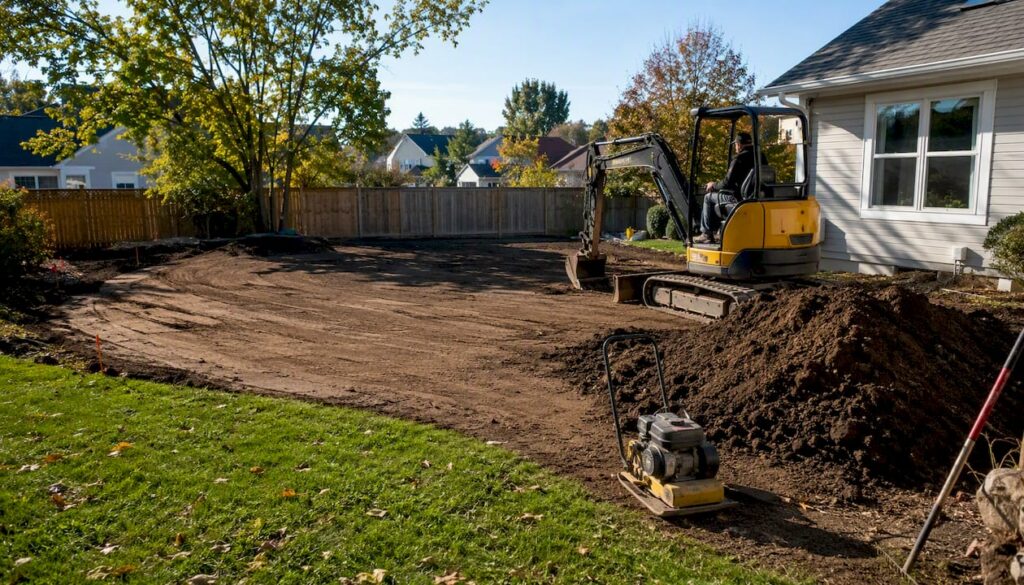
Expect to pay between $1,000 and $3,330 for most residential yard grading jobs, with a U.S. national average around $2,180. That range covers standard leveling work: correcting minor slope problems, smoothing low spots, and improving drainage away from the house. Full-scale regrades that add French drains, retaining walls, or significant imported fill push the total past $10,000, sometimes well past it on larger lots.
The low end of that range typically covers a small yard with mild unevenness and easy equipment access. The high end almost always includes one of three things: a steep slope that needs real engineering, a drainage problem that requires more than surface smoothing, or a yard that’s hard to reach with standard machinery.
Three factors drive the price more than anything else:
- Yard size and slope severity — a flat quarter-acre costs a fraction of what a steeply pitched half-acre runs.
- Drainage and retaining work — French drains and retaining walls are the single biggest line-item jumps on a grading invoice.
- Accessibility, soil type, and fill needs — a gated backyard that blocks a skid-steer, or clay-heavy soil that needs amendment, adds labor hours fast.
We’ll walk through the math for your specific yard size, every line item a contractor will bill you for, and the questions that separate an accurate bid from a lowball one.
Key Takeaways
Correct slope, proper compaction, and a written drainage plan determine whether a grading job holds up for decades or needs to be redone within two years.
| Point | Details |
|---|---|
| Know your baseline | Budget $1,000 to $3,330 for typical residential grading, with a national average near $2,180. |
| Use the per-square-foot rule | Plan on $1 to $2 per square foot, or $0.80 for simple flat-ground leveling. |
| Watch the big three drivers | Yard size, slope severity, and site access move the price more than anything else. |
| Budget for add-ons separately | French drains, retaining walls, and sod typically add $1,000 or more each on top of base grading. |
| Get itemized bids from three contractors | Compare per-unit pricing and written compaction specs, not just bottom-line totals. |
| Call a local expert for a site-specific number | Ivan’s Landscaping offers free McHenry County site visits to turn national averages into an actual quote. |
Table of Contents
- Grading Yard Cost Broken Down by Project Size
- What Actually Drives Yard Grading Prices
- Add-Ons That Show Up on the Final Invoice
- How to Estimate Grading Yard Cost in 3 Steps
- What Happens On Site and How Long It Takes
- Can You Grade Your Own Yard, or Do You Need a Pro?
- How to Get an Accurate Grading Quote
- Ways to Lower Grading Costs Without Cutting Corners
- A McHenry County Yard Grading Job, Start to Finish
- Why Paying for the Right Grading Job Beats the Cheapest Bid
- How Ivan’s Landscaping Handles Grading and Drainage in McHenry County
- Sources
Grading Yard Cost Broken Down by Project Size
Most contractors price grading one of three ways: per square foot, per acre for larger sites, or hourly for small touch-up jobs. Per-square-foot rates typically run $1 to $2, though simple surface leveling on easy terrain can come in as low as $0.80 per square foot. Hourly labor generally runs $50 to $100 per hour, and a typical residential leveling project takes 12 to 24 labor hours from start to finish.
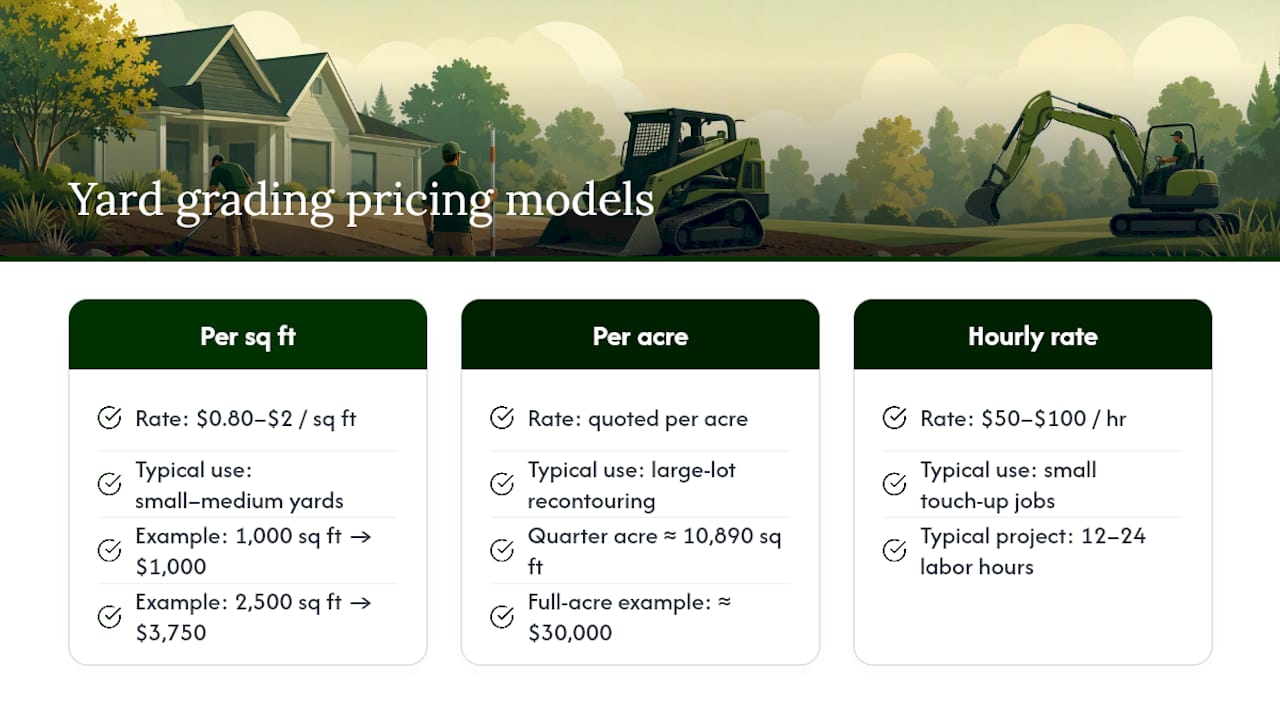
Here’s how that math actually works. Take a 2,500 square foot backyard with moderate unevenness. At $1.50 per square foot, you’re looking at roughly $3,750 for grading alone, before any drainage or fill add-ons. A flatter 1,000 square foot side yard at the low end of $1 per square foot might run closer to $1,000. Scale that up to a quarter acre (about 10,890 square feet), and you’re multiplying by a much larger number, which is exactly why large-lot grading quotes sometimes get quoted per acre instead of per square foot. Some published estimates put full-acre grading around $30,000 when the site needs significant recontouring, though most suburban lots never approach a full acre of grading work.
Those top-end figures aren’t the norm for a typical suburban yard. A homeowner correcting minor drainage or leveling a play area will land closer to the $1,000 to $3,330 range that Modernize and HomeAdvisor both report as the typical residential band, with HomeAdvisor’s data centering around $2,179. It’s the yards with steep grades, foundation drainage problems, or serious fill needs that climb into five figures.
What Actually Drives Yard Grading Prices
Every number on your invoice traces back to one of five categories: labor, materials, site conditions, permits, and equipment. Here’s how each one adds up.
-
Labor. Crews typically charge $50 to $100 per hour, and a standard grading job runs 12 to 24 hours of labor depending on yard size and complexity. A two-person crew working a full day on a 2,500 square foot yard might log 16 hours total, putting labor alone somewhere between $800 and $1,600.
-
Fill dirt and topsoil. Basic fill dirt runs $5 to $30 per cubic yard, with the price swinging based on quality and how far the supplier hauls it. Topsoil, which you’ll need for the finish layer before seeding or sodding, costs more at $12 to $55 per cubic yard. A typical backyard fix might need 5 to 15 cubic yards combined, depending on how much low-spot filling the site requires.
-
Slope severity. A yard with a mild grade problem is a straightforward regrade. A yard with a steep pitch, especially one draining toward the foundation, often needs engineered fill and more precise compaction, which adds both material cost and labor hours.
-
Site accessibility. This is the cost driver homeowners underestimate most. If a skid-steer or mini-excavator can’t fit through a gate or around a fence line, crews either bring in smaller (and slower) equipment or shift to manual labor. Either way, hours climb fast.
-
Tree roots, brush, and underground utilities. Clearing vegetation or working around buried lines adds time before grading even starts. Utility locates are typically free through your local utility marking service, but scheduling them adds a few days to your timeline.
-
Surveys and permits. Larger regrades, especially those altering drainage flow toward neighboring properties, sometimes require a land survey, running $375 to $750, plus a local permit that can cost $100 to $500 depending on your municipality. McHenry County homeowners should check with their township before assuming a permit isn’t needed.
-
Disposal fees. Excess soil, sod, and debris removed from the site typically get hauled away for a fee, which contractors either fold into the quote or itemize separately. Ask which one you’re getting.
Pro Tip: Before you get quotes, walk your property and measure the width of every gate, side yard passage, and gap between your house and fence line. Standard skid-steers need roughly 36 to 48 inches of clearance. If your access is tighter, tell every bidder upfront, because equipment access problems are one of the most common reasons a final invoice comes in higher than the initial estimate.
Add-Ons That Show Up on the Final Invoice
Grading rarely stands alone. Most projects that start as “level my backyard” end up including at least one of these extras, and they’re worth budgeting for before you get sticker shock on the final bill.
French drains run roughly $1,000 to $4,000 depending on length and depth, and they become necessary whenever grading alone can’t move water away from the foundation fast enough. If your yard has a low spot that holds water for more than a day after rain, expect your contractor to recommend one.
Retaining walls vary enormously, from a few hundred dollars for a short decorative wall to several thousand for a structural wall holding back a steep slope. Any regrade that creates a sudden elevation change between two areas of the yard usually needs one to prevent erosion.
Sod installation typically costs $1,050 to $2,800 for a standard residential lawn once grading is finished. If your project is really about fixing bare patches or an uneven lawn, budget for sod as part of the total, not as an afterthought. Ivan’s Landscaping’s sod installation service is a common next step after a regrade for exactly this reason.
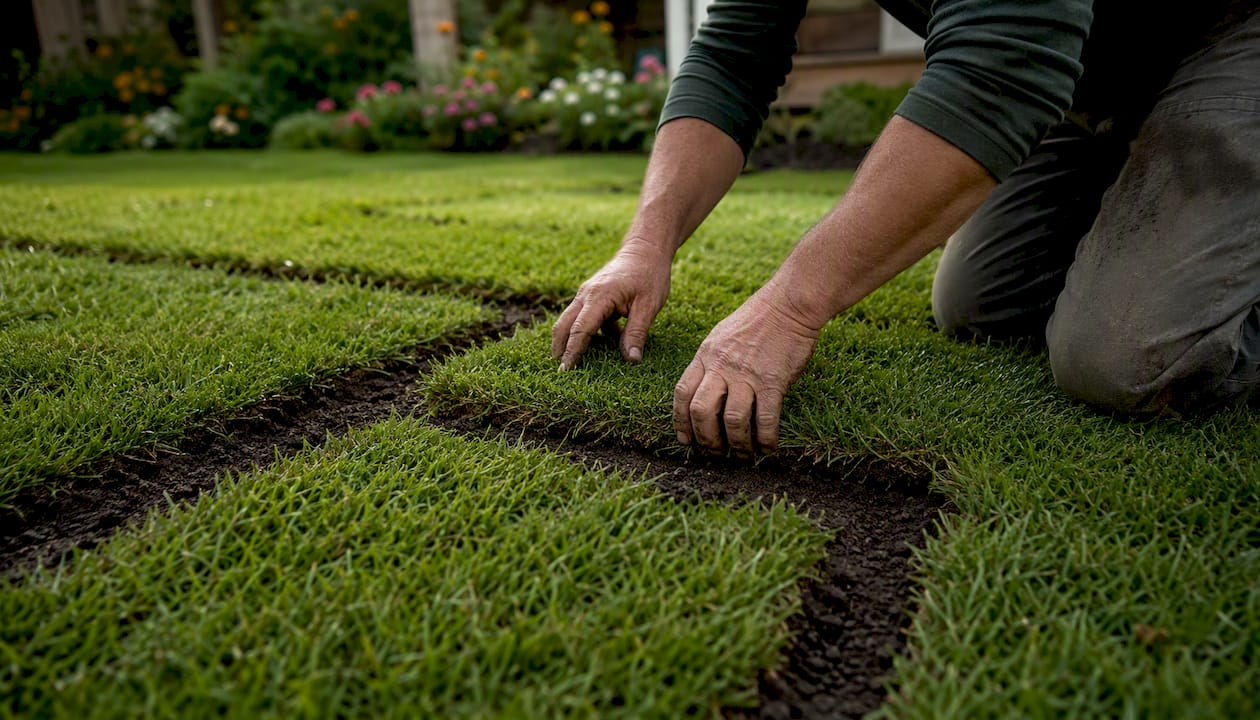
Topsoil delivery, separate from the topsoil used during grading itself, adds $12 to $55 per cubic yard if you’re finishing with new planting beds or reseeding.
Consider the difference between two real scenarios. A simple regrade on a flat quarter-acre lot with no drainage issues might land at $2,500 total. Add a French drain because water was pooling near the garage, and that same job jumps to $5,000 or more. The scope looks similar from the street. The invoice does not.
How to Estimate Grading Yard Cost in 3 Steps
You don’t need a contractor on-site to build a rough budget before you start calling around. Here’s a homeowner-friendly way to get a working number.
-
Measure your yard, or the section that needs work. Multiply length by width for a rectangular area. For irregular shapes, break the yard into two or three rough rectangles and add them together, or triangles if the border is angled. If your slope problem is severe or spans property lines, a professional survey ($375 to $750) is worth the cost before you commit to a number.
-
Pick a per-square-foot rate based on your slope and soil. Use $0.80 to $1 per square foot for mild leveling on easy-access flat ground. Use $1.50 to $2 per square foot if you’ve got moderate slope, clay soil, or tight access. Multiply your square footage by that rate for a base estimate.
-
Add fixed costs and a contingency. Tack on permit and survey costs if your municipality requires them, add a rough figure for any drainage work you already know you need, and then add 15 to 20 percent contingency on top of everything. Grading jobs uncover surprises, buried debris, unexpected clay pockets, softer soil than expected, more often than most other landscaping work.
Here’s the math in action: a 3,000 square foot backyard with moderate slope at $1.50 per square foot comes to $4,500. Add a $400 permit and a $1,500 French drain you already suspect you’ll need, and you’re at $6,400. Add 20 percent contingency, and your working budget is $7,680. That’s the number you bring into contractor conversations, not as a target price, but as a sanity check against the bids you receive.
What Happens On Site and How Long It Takes
A grading job follows a fairly predictable sequence, and knowing it helps you understand what you’re paying for at each stage.
Crews start by clearing the site, removing debris, cutting back brush, and marking any obstacles. Rough grading comes next: heavy equipment moves the bulk of the soil to establish the general slope. Compaction follows, which is where a skipped step causes the most long-term problems, since loose fill settles unevenly over the following year if it isn’t properly compacted in layers. Finish grading smooths the surface to its final contour, and then topsoil, sod, or seed goes down last, followed by site cleanup.
Small jobs, a single low spot or a minor slope correction on a standard suburban lot, typically wrap in one to two days. Medium jobs involving a full backyard regrade with some drainage work usually take three to five days. Large-scale regrades with retaining walls, extensive fill import, or multiple drainage systems can stretch to one to two weeks. Weather delays are common with grading specifically, since wet soil compacts poorly and heavy rain can undo rough grading overnight. Permit approval delays and utility locate scheduling can also push a start date back by several days before work even begins.
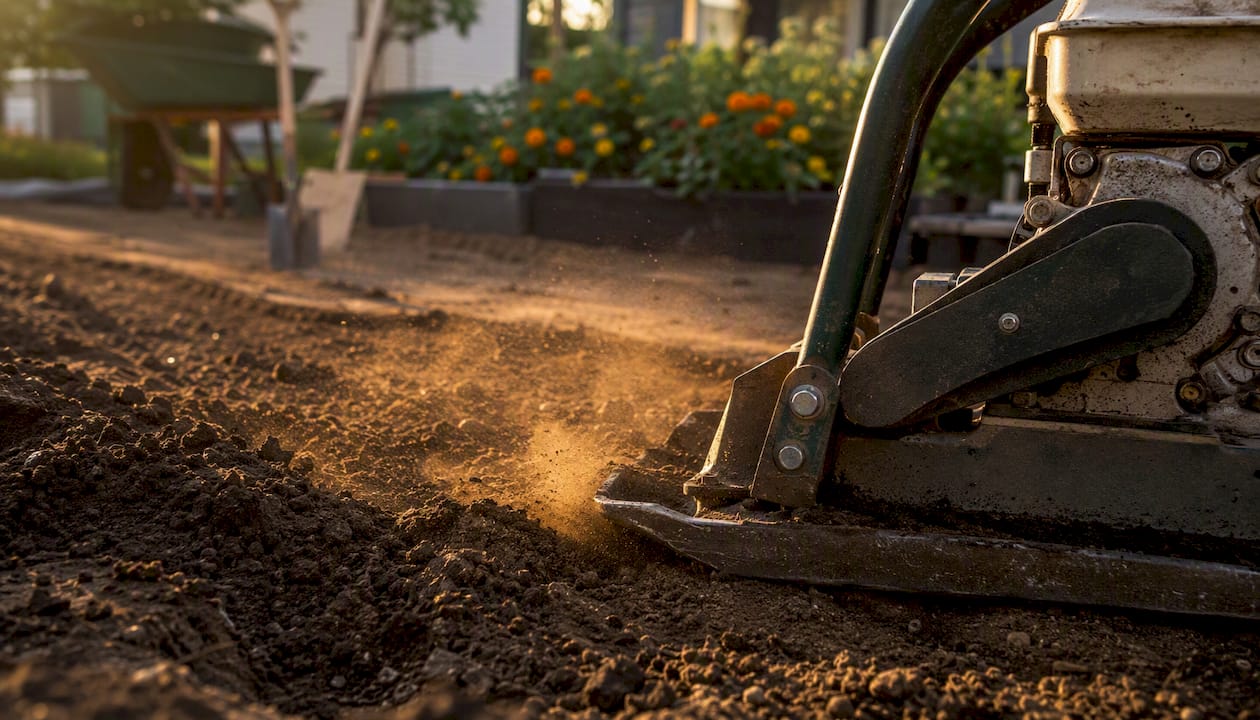
Typical equipment includes a skid-steer for moving and spreading soil, a mini-excavator for digging drainage trenches or working in tighter spaces, and a plate or roller compactor for the compaction stage. If your contractor skips the compactor entirely, ask why. Uncompacted fill is one of the leading causes of a yard that looks great in October and has new low spots by spring.
Can You Grade Your Own Yard, or Do You Need a Pro?
Some grading work is genuinely reasonable to handle yourself. Other work carries enough risk, to your foundation, your neighbor’s property, or your own safety, that hiring a contractor is the only sensible move.
DIY makes sense for minor smoothing of a small low spot, topping off a sunken area with a few bags of topsoil, or filling in small settling around a new planting bed. These are jobs where a mistake costs you an afternoon and a bag of topsoil, not a foundation repair.
Hire a professional for anything involving major slope changes, grading near your foundation, or installing French drains or retaining walls. These jobs require getting the 2% slope standard right, roughly a 6 inch drop over the first 10 feet away from the house, and getting it wrong risks water intrusion into your basement or crawl space. Utility locates matter here too: hitting a buried line with a rented skid-steer is a homeowner’s expensive mistake, not a contractor’s.
- DIY pros: Lower upfront cost, works fine for small cosmetic fixes, no scheduling wait.
- DIY cons: No compaction equipment or expertise, real risk of uneven settling within a year, no warranty if something goes wrong near your foundation.
- Professional pros: Proper compaction and slope calculation, drainage expertise, typically includes a follow-up for settling fill.
- Professional cons: Higher upfront cost, requires scheduling and possibly permits.
The math that matters here isn’t just the invoice. A DIY regrade done without proper compaction often needs to be redone within a year or two once the soil settles unevenly, and by then you’ve spent money twice on a job a contractor would have gotten right once.
How to Get an Accurate Grading Quote
The biggest risk in this process isn’t overpaying. It’s accepting a bid that looks cheap because it leaves out half the scope. Here’s how to keep bidders honest.
Ask every contractor these questions before you sign anything:
- What’s the exact scope, in writing, down to square footage and depth of fill?
- Will you import fill, and if so, what type and how much per cubic yard?
- What compaction standard will you use, and will you document it?
- What’s your plan for drainage, and does it meet the standard 2% slope away from the foundation?
- Who’s responsible for pulling permits, you or me?
- What’s the realistic timeline, including weather contingency?
- Is site cleanup and debris disposal included in the quote?
- Do you offer any follow-up or warranty on settling fill?
Watch for these red flags. A bid that comes in dramatically lower than the others you’ve collected usually means something’s missing, often compaction, often disposal fees, sometimes the fill itself. A vague scope that says “grade backyard” with no square footage or depth specified gives the contractor room to cut corners later. Any contractor who brushes off utility locates or won’t put a compaction spec in writing is one to avoid. As one industry resource on comparing landscaping proposals notes, the details of a bid matter more than the bottom-line number, since two quotes for “the same job” can represent very different scopes of actual work.
To compare bids fairly, convert every quote to the same scope and ask for a per-unit breakdown, so many dollars per square foot, so many dollars per cubic yard of fill. That way you’re comparing apples to apples instead of guessing at what each contractor actually included.
Ways to Lower Grading Costs Without Cutting Corners
You can trim your total without gambling on the quality of the work. The trick is knowing which cuts are smart and which ones cost you more down the road.
- Focus the budget on the actual problem area instead of regrading the entire yard when only the back corner floods.
- Ask your contractor whether soil already on-site can be reused for fill instead of purchasing new material, which cuts both material and hauling costs.
- Agree on a written compaction standard upfront so there’s no ambiguity, and no rework bill, later.
- Buy sod or seed yourself if you’re comfortable managing that step, letting the contractor’s invoice cover grading and drainage only.
- Schedule work during a contractor’s slower season if your timeline has flexibility, since demand affects pricing.
The tradeoff to watch: skipping compaction or using unscreened, low-quality fill dirt to save a few hundred dollars upfront is the single most common reason homeowners end up paying for a second regrade within two years. Engineered, compactable fill costs more per cubic yard than common fill, but it’s the material that actually holds its shape.
A McHenry County Yard Grading Job, Start to Finish
A recent project in McHenry County involved a homeowner whose backyard sloped toward the house instead of away from it, a common issue in older subdivisions where original grading wasn’t done to modern drainage standards. Water had been pooling near the foundation after every heavy rain, and the homeowner was starting to see minor cracking in the basement wall.
The scope covered roughly 2,800 square feet of backyard regrading, plus a French drain running along the section closest to the foundation. Site access was straightforward, a wide side yard allowed standard equipment through without issue, which kept labor hours on the lower end of typical estimates. The crew imported a modest amount of fill to reestablish proper slope, compacted it in stages, and finished with new sod to match the existing lawn.
Total cost landed in the $4,500 to $6,000 range, consistent with a mid-size regrade that includes drainage correction rather than a bare-minimum leveling job. The project took four days from prep to sod, with one additional day built in for a rain delay mid-project. Six months later, the pooling problem was gone and the basement wall showed no new cracking.
Homeowners dealing with a similar drainage problem can request a local quote to get a site-specific estimate rather than relying on national averages alone.
Why Paying for the Right Grading Job Beats the Cheapest Bid
Correct slope and proper compaction aren’t cosmetic details. They’re the difference between a yard that holds up for decades and one that needs a second visit within two years.
The savings-first approach, skip the compactor, use whatever fill is cheapest, skip the drainage plan, tends to show its cost about a year later, right when the soil has had time to settle unevenly and the low spots reappear. I’ve seen the pattern often enough in cost breakdowns and industry data to call it what it is: a deferred expense, not an avoided one. A contractor who compacts fill in proper lifts and grades to a real drainage plan costs more upfront because that work takes longer and uses better material. It also tends to be the last time you pay for that particular problem.
How Ivan’s Landscaping Handles Grading and Drainage in McHenry County
Getting the slope right the first time is the difference between a yard that drains properly for the next twenty years and one that needs a second contractor visit before the sod even takes root. Ivan’s Landscaping handles grading, French drain installation, retaining walls, and sod work as part of one coordinated job, so you’re not managing separate crews or guessing whether the drainage plan and the finish work actually line up.

A free estimate starts with a site visit where we walk the property, check existing slope and drainage patterns, and talk through what’s actually causing the problem, whether that’s standing water, a sunken patch, or a slope that’s been bothering you since you bought the house. From there, you get a written scope with real numbers, not a rough verbal guess. Every job comes backed by a satisfaction guarantee and a clean job site when the crew leaves, which matters more than most homeowners expect until they’ve dealt with a contractor who doesn’t do that. Ivan’s Landscaping has served McHenry County homeowners since 2008, which means the crew showing up at your house has seen the drainage patterns specific to this area before.
If your yard has a low spot, a slope that’s sending water the wrong direction, or you’re planning a regrade before a patio or paver project, check out the full range of grading and drainage services or request a free quote to get a site-specific number this week.
Sources
The cost ranges in this article come from a combination of national cost-guide data and industry pricing research, cross-checked against each other to build realistic averages rather than relying on a single source.
- Lawn Leveling & Yard Grading Costs in 2026 | Modernize
- How Much Does It Cost to Level a Yard? 2026 Data | Angi
- How Much Does a Lawn Leveling Service Cost? (2025 Data)
National averages are built from aggregated project data across many regions, so your local quote will vary based on McHenry County labor rates, soil conditions, and site access. For a number specific to your property, the Ivan’s Landscaping services page is the fastest way to get a local, itemized estimate.