A rain garden is a planted, shallow basin that holds runoff at the surface and lets it soak in. A dry well is a buried, stone-filled pit that takes roof water through a pipe and releases it into the ground. The right choice for your McHenry County property depends on where the water comes from, how fast your soil drains, and how much room you have. Both need the same thing to work: soil that actually absorbs water. If you want that settled before any digging, we handle drainage and grading for homeowners and property managers across the county.
TL;DR
- Choose a rain garden when you have open space, want plants, and the water comes from a downspout, patio or lawn runoff path.
- Choose a dry well when you need the water out of sight, the source is mostly a roof, and space is tight.
- Both depend on permeable soil. Slow-draining soil calls for a different design or an underdrain (a perforated pipe that carries excess water away).
- Keep either feature at least 10 feet from a foundation.
- Large projects that disturb 5,000 square feet or more can trigger a McHenry County stormwater permit.
Table of Contents
- How each one handles water
- Side-by-side comparison
- Dry wells: when they work and when they do not
- Rain gardens: siting and sizing
- Rain garden vs bioswale
- Rain garden vs French drain
- Upkeep you should plan for
- What McHenry County requires
- Our perspective
- Getting it designed and installed
- FAQ
- Sources
How each one handles water
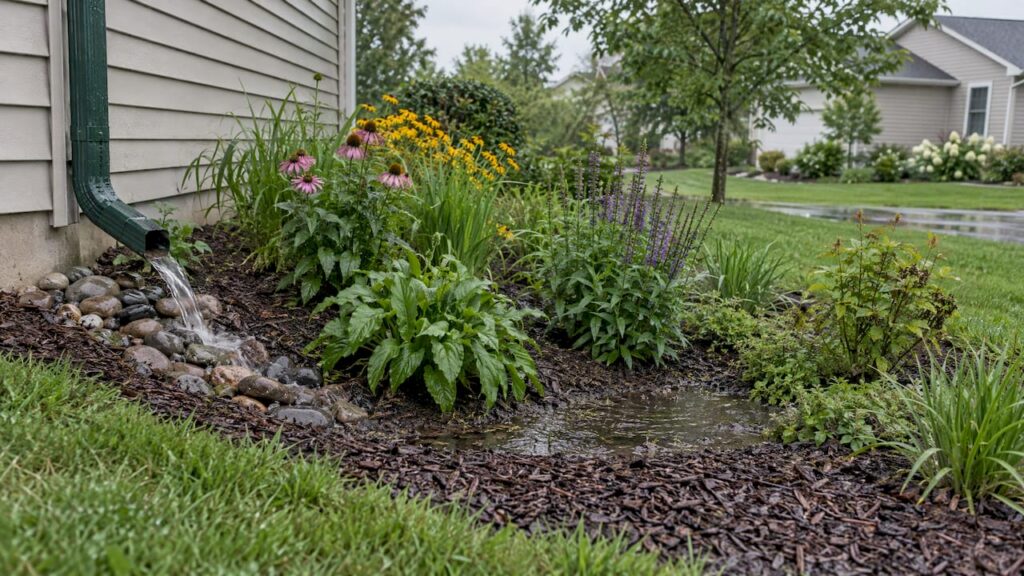
A rain garden is a shallow, flat-bottomed, bowl-shaped feature that collects runoff from roofs and pavement and filters it through a prepared soil mix, compost, tolerant plants and mulch. It works at the surface. Water ponds briefly, then soaks in. According to Maryland’s environmental agency, that ponding should clear within 24 to 48 hours after a storm.
A dry well works vertically and underground. The same WSU publication describes it as a small stone-filled chamber that receives runoff through buried piping and lets it infiltrate into the surrounding soil. Dry wells are sized by the volume of water they must manage and by how permeable the soil is, and they are commonly used for cleaner sources such as roofs.
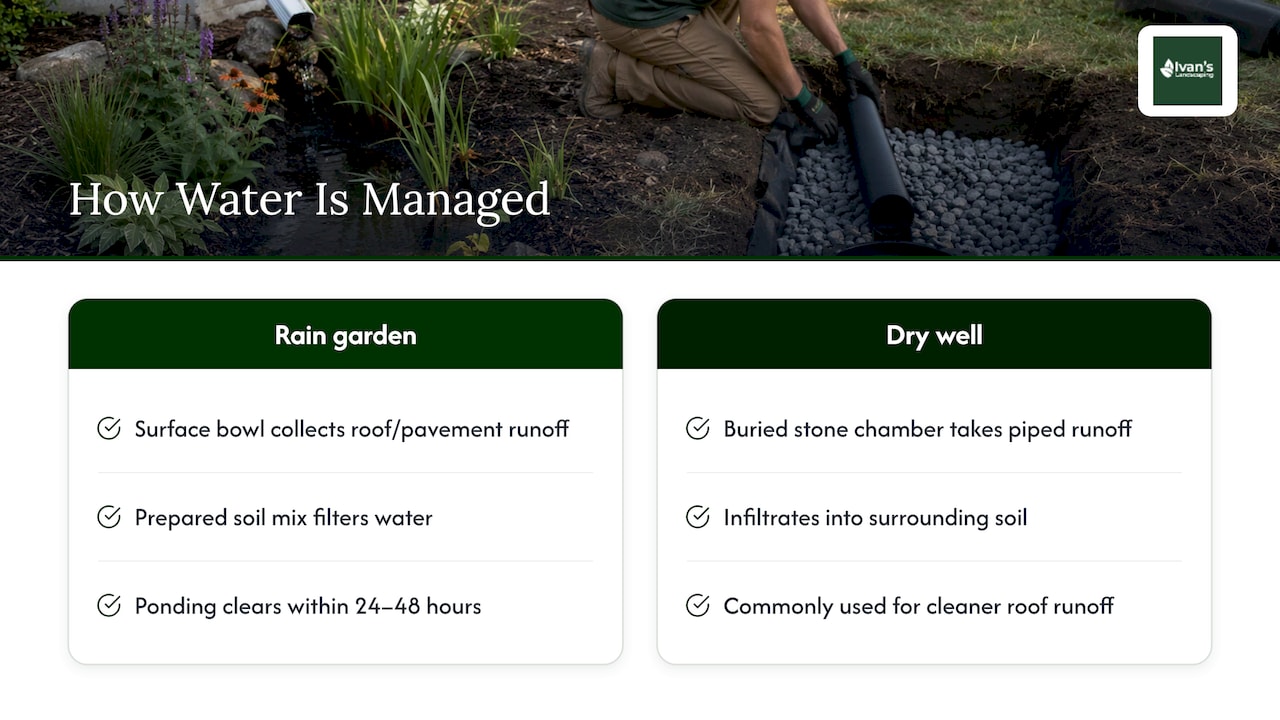
The Minnesota stormwater manual adds that a dry well is a smaller version of an infiltration trench, a subsurface stone-filled structure that stores runoff temporarily and serves smaller drainage areas. That is why people sometimes use “dry well” and “French drain” loosely for the same family of buried solutions.
Side-by-side comparison
| Question | Rain garden | Dry well |
|---|---|---|
| Where the water goes | Pools in a shallow basin, then soaks in | Flows by pipe into a buried stone pit |
| What you see | Plants, mulch, a shallow dip | Usually a lid or nothing at all |
| Best water source | Downspouts, patios, lawn runoff paths | Roof water |
| Space needed | Typical home gardens run 100 to 300 square feet | A small footprint |
| Soil need | Permeable soil, or an underdrain | Permeable, well-drained soil within reach of the excavation |
| Upkeep | Weeding, trimming, mulch, debris removal | Keeping the inlet pipe and any filter clear |
Dry wells: when they work and when they do not
The Central Illinois stormwater guide says dry wells need permeable, well-drained soils, are not recommended on slopes steeper than 15%, should sit back from ravine edges, and must be at least 10 feet from building foundations. Fairfax County’s guidance makes the same point from another angle: a dry well is only a good option if a permeable layer lies within a reasonable depth of the excavation.
In practice, a dry well suits a downspout that dumps water beside a patio or walkway where there is no room for a garden. If a hole filled with water drains slowly, the well will fill during a storm and back up. That is the first thing to find out, and it is why we start with the soil rather than the structure. Our sponge test guide for swales and French drains shows a simple way to read how your yard absorbs water.
Rain gardens: siting and sizing
Illinois sets practical numbers for rain gardens. The Illinois Urban Manual’s rain garden standard calls for drainage areas under 2 acres, a flat bottom, ponding depths of 3 to 9 inches (12 at most), side slopes of 3:1 or flatter, and drawdown within 48 hours. It also asks for at least 2 feet of soil between the garden bottom and bedrock or the high water table. It advises against sending continuous sump-pump discharge into a rain garden, and recommends pretreatment when runoff carries salt, oil or heavy sediment. That last point matters on driveways and parking areas that are salted in winter.
Illinois Extension recommends placing a rain garden at least 10 feet from a foundation, sloping away from the building, with an overflow outlet set below the top edge so heavy storms have a safe exit. The Colorado State guide adds that you should place it where runoff naturally flows and avoid planting it directly under trees.
If your soil drains poorly, the Northern Virginia conservation district notes that an underdrain may be needed and that the soil should be replaced or amended with a sand, topsoil and compost mix at least 18 inches deep. The EPA says soils in hydrologic groups A and B suit infiltration best, while groups C and D may require an underdrain.
Rain garden vs bioswale
A bioswale is the linear cousin of a rain garden. Illinois Extension describes it as a sloped channel that captures and conveys stormwater while infiltrating it along the way, usually for larger volumes, with an engineered soil base. The Missouri Botanical Garden notes swales are used in narrow spaces, on steep slopes, or to link several small rain gardens.
The rule of thumb: a basin for a spot, a channel for a path. A long side yard that carries runoff from the street toward the back is a swale candidate. A low corner under a downspout is a rain garden candidate. Our drainage swale design guide walks through the soil test before any digging.
Rain garden vs French drain
A French drain is a trench with a perforated pipe that moves water from where it collects to where it can leave. A rain garden holds and absorbs water in place. If the problem is a soggy strip along a wall or lawn, a trench often fits. If you want the water to soak in and add landscaping at the same time, a rain garden does that. For the trench side of the decision, see French vs. trench drain and our yearly French drain checklist.
Upkeep you should plan for
Planted features need attention. The EPA notes that bioretention needs periodic trimming and debris removal, and sediment may need clearing from the bottom if clogging becomes a concern. Mulch refresh and spring and fall cleanup fit naturally here. Native plants help because their deep roots create pore space that improves infiltration.
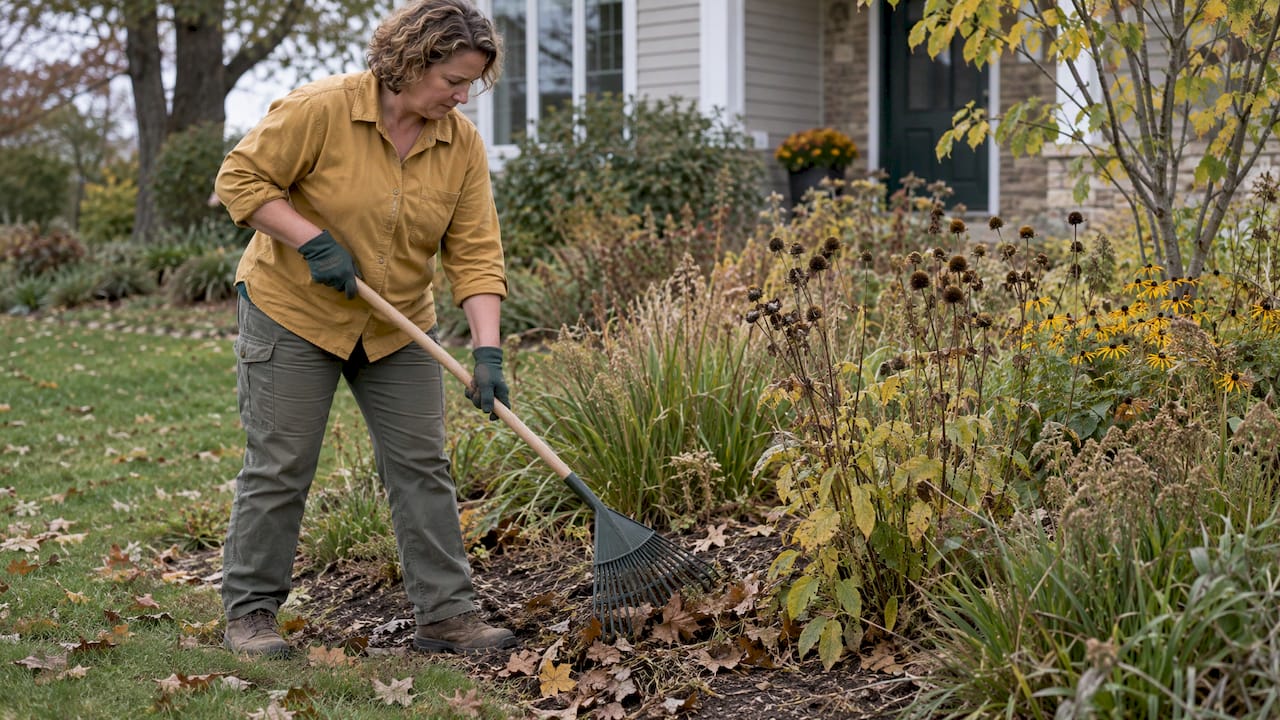
Standing water that lingers beyond two days is the clearest sign a basin is not draining. Dense low-growing cover also protects the soil around the edges; a low-maintenance meadow seed mix is one way to keep the surrounding turf low-effort.
What McHenry County requires
McHenry County’s code defines a rain garden as a small, shallow planted depression, typically under 300 square feet and less than 12 inches deep. A Stormwater Management Permit is required for work in a flood hazard area or wetland, work that disturbs 5,000 square feet or more or 50% of a parcel, or projects adding 20,000 square feet of impervious surface. Gardening and landscaping without filling, grading or berm construction is exempt. Because a rain garden involves excavation and a berm, check with the county’s Planning & Development department before starting, especially on commercial lots, HOA common areas and apartment sites where drainage areas are larger.
Our perspective
Most drainage calls start with the question “which feature should I buy?” The better question is “where does this water come from, and where can it go?” Once the roof, grade and soil are mapped, the answer usually becomes obvious.
We build drainage and grading solutions alongside landscape design and planting, so a rain garden is a planted, finished part of the yard rather than a hole in it. A dry well is the right tool when space is tight and the source is a roof. A swale or trench is right when water has to travel. We would rather match the feature to your site than push one answer.
For property managers, the same thinking applies to year-round upkeep: a drainage feature that is mulched, trimmed and cleared each season keeps doing its job. Our annual maintenance plans are built around that kind of routine.
Chas
Getting it designed and installed
Ivan’s Landscaping has served McHenry County since 2008. Drainage and grading, landscape design and install, and tree and shrub planting are all part of what we do for homeowners, HOAs and commercial properties. We respond quickly with free estimates, document the scope of work, and keep job sites clean. Start with our yard drainage solutions overview, or contact us for a free estimate.
FAQ
Is a rain garden better than a dry well?
Neither is better in general. A rain garden suits open space and visible landscaping, while a dry well suits tight spaces and roof water. Soil permeability decides whether either one will work on your lot.
Can a dry well and a rain garden be used together?
Yes. A rain garden can take everyday runoff while an overflow pipe sends excess storm water to a buried chamber. The overflow should be sized so the garden still holds a calculated amount for infiltration, as Illinois Extension recommends.
How close to the house can I put either one?
Keep both at least 10 feet from a foundation. The Illinois Urban Manual also specifies 25 feet from private sewage systems and wells for rain gardens.
Do I need a permit in McHenry County?
Small landscaping without filling, grading or berm construction is exempt. Projects that disturb 5,000 square feet or more, or work in flood hazard areas and wetlands, need a Stormwater Management Permit.
Sources
- Options for Managing Surface Water Drainage, WSU Extension
- Facts About Rain Gardens, Rainwater Harvesting, and Dry Wells, Maryland MDE
- Stormwater infiltration BMPs overview, Minnesota Stormwater Manual
- Rain Gardens and Bioswales, Colorado State University
- Central Illinois Guide to Stormwater BMPs
- Control Heavy Runoff, Fairfax County Soil and Water Conservation
- Rain Garden, Illinois Urban Manual Code 897
- Soak it up: rain gardens and bioswales, Illinois Extension
- EPA stormwater best management practice fact sheet
- Rain Garden Elements, Missouri Botanical Garden
- McHenry County Code, Appendix 12 definitions
- McHenry County Planning & Development stormwater permit information