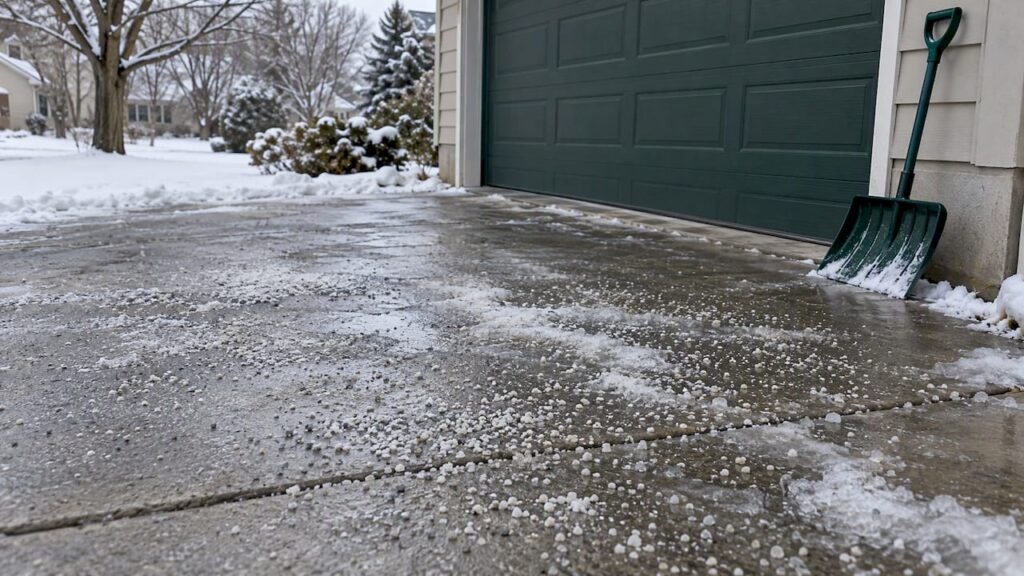
Calcium chloride works at lower temperatures and acts faster in deep cold. Magnesium chloride is gentler on concrete and metal and works well in a typical Illinois winter. For most McHenry County driveways and walkways, magnesium chloride is the safer everyday choice. Calcium chloride is the stronger tool for lots, steps and spots that stay below roughly 10°F. Neither is harmless to plants if you over-apply it, so how you spread it matters as much as which one you buy.
TL;DR
- Calcium chloride is rated down to about -20°F to -25°F depending on the source. Magnesium chloride is rated down to about -10°F to -13°F, and K-State puts its practical limit nearer 5°F.
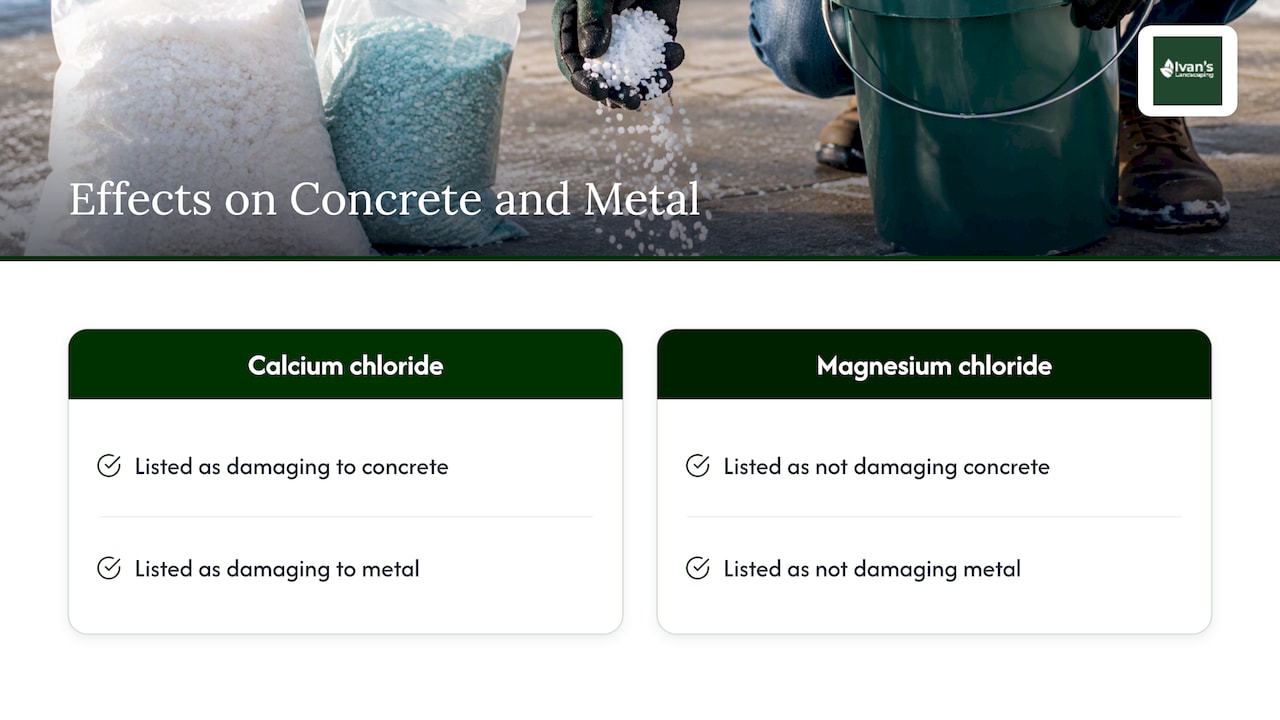
- Calcium chloride is listed as damaging to concrete and metal. Magnesium chloride is not, according to University of Maryland Extension.
- Both can stress lawns and shrubs when over-applied. Spread thinly, before ice bonds, and keep salty snow piles off plant beds.
- Below the working range of either product, sand or grit gives traction.
- Match the product to the surface and the temperature, not to the label’s laboratory number.
Table of Contents
- How the two compare at a glance
- Temperature and speed: what the numbers really mean
- Concrete, metal and hardware
- Lawns, shrubs and trees
- Pets and people
- Calcium chloride vs. sodium chloride
- How to apply either product
- Which should you choose?
- Our perspective
- Let us handle winter for your property
- FAQ
- Sources
How the two compare at a glance
| Factor | Calcium chloride | Magnesium chloride |
|---|---|---|
| Lowest working temperature | About -22°F (University of Maryland Extension) | About -13°F (University of Maryland Extension) |
| Concrete and metal | Listed as damaging | Listed as not damaging |
| Plants | Listed as harmful | Listed as moderately harmful |
| Pets | Can irritate paws if used heavily | Generally considered safe for pets (K-State) |
| Best fit | Extreme cold, commercial lots, shaded stairs | Everyday residential walks and driveways |
The temperatures differ a little between universities because each tested or rated products under slightly different conditions. The pattern is the same everywhere: calcium chloride reaches colder, magnesium chloride is milder on surfaces.
Temperature and speed: what the numbers really mean
University of Maryland Extension lists calcium chloride as working down to -22°F with fast action, and magnesium chloride down to -13°F with very fast action. Minnesota’s winter salt guide uses practical figures of -20°F for calcium chloride and -10°F for magnesium chloride, and it warns that some labels print eutectic temperatures. Those are laboratory values, not field conditions, so choose by the practical melting temperature instead.
K-State recommends calcium chloride for very low temperatures, down to -25°F. It puts magnesium chloride’s useful range down to 5°F.
For northern Illinois, that works out simply:
- 20°F to 32°F: either product works. Magnesium chloride is usually the better pick for surfaces you care about.
- 10°F to 20°F: magnesium chloride still works, but slowly on thick ice. Calcium chloride is quicker.
- Below 10°F: calcium chloride is the one that keeps working. At these temperatures, sand for traction is often the more realistic tool.
The same Minnesota guide says to use sand or grit when pavement is too cold for deicers to work well. We cover that choice in more detail in our guide to sand vs. salt in McHenry County.
Concrete, metal and hardware
University of Maryland Extension lists calcium chloride as damaging to concrete and metal, and magnesium chloride as not damaging to either. It also notes that correct application can minimize damage with any product.
This matters most on new concrete, stamped or decorative surfaces, and on pavers. Salt damage often shows up in spring as flaking or pitting after repeated freeze and thaw cycles. If you have a new patio or walkway, magnesium chloride at a light rate is the usual choice. Our walkthrough on preventing ice melt damage to concrete lists the steps we take on our own jobs, and our paver patio maintenance schedule shows when to rinse and inspect.
If you do use calcium chloride near railings, gates or vehicles, rinse metal surfaces when temperatures rise.
Lawns, shrubs and trees
Neither product is plant-safe in an absolute sense. The EPA position, as summarized by University of Maryland Extension, is that calcium and magnesium chloride will not harm vegetation when used as recommended. Magnesium chloride carries more chloride ions per percentage than some other salts. Iowa State University adds that magnesium chloride is less damaging to plants than rock salt but can still cause damage, especially when over-applied. K-State calls calcium chloride gentle on plants when used as directed.
The practical rules are the same for both:
- Keep product off the lawn edge and out of planting beds.
- Do not pile salt-laden snow and ice around trees and shrubs. Iowa State advises against it.
- In early spring, water affected areas heavily to flush salt from the root zone.
Before the first hard freeze, it also helps to winterize outdoor faucets and clear beds, so you know where snow will be pushed. Our fall yard cleanup guide covers the rest of the pre-winter checklist, and our spring cleanup checklist covers the flush-and-inspect step.
Pets and people
K-State describes magnesium chloride as generally safe for pets, which is one reason it is common on residential walks. Any ice melt can irritate paws and upset a stomach if eaten, so store bags sealed and out of reach, and wipe paws after walks. Wear gloves when handling calcium chloride, which releases heat as it dissolves. If a pet swallows a large amount or shows signs of illness, call your veterinarian.

Calcium chloride vs. sodium chloride
Many readers also ask how calcium chloride compares with ordinary rock salt. Minnesota’s guide says calcium chloride works down to -20°F, while sodium chloride is practically ineffective below 15°F. Sodium chloride is inexpensive and readily available, while calcium chloride is most effective in very cold weather. For a closer look at the full range, see our overview of deicing salt types for property owners.
How to apply either product
University of Maryland Extension advises spreading deicers thinly and evenly before ice forms, following the manufacturer’s directions, and using less than recommended if you can while still covering the surface evenly. Pre-treating, also called anti-icing, takes less product than breaking up bonded ice.
- Shovel first. Deicer works best on a thin layer of packed snow, not a thick one.
- Use a hand or drop spreader for an even pattern. Piles and clumps do the most harm to concrete and plants.
- Wait before reapplying. Brine needs time to work.
- Sweep up leftover granules once the surface is clear.
The EPA’s stormwater guidance for municipalities recommends calibrated, electronically controlled spreaders to avoid using more deicer than necessary. The same principle applies to a contractor’s equipment on a commercial lot.
Which should you choose?
Choose magnesium chloride for home driveways, walkways, new concrete, pavers, and properties with pets or landscaping close to the pavement.
Choose calcium chloride for the coldest stretches, for shaded steps that refreeze, and for commercial entrances where speed and safety come first. Plan on careful rates, and rinse metal and protect adjacent beds.
Skip chemical melt and use sand when pavement is colder than either product can handle.
Note on cost: magnesium chloride is often described as needing more product by weight to melt the same amount of ice, so a bag that costs less is not always cheaper per use. Check the label’s coverage rate.
Our perspective
Most of the ice melt damage we repair is not caused by choosing the wrong chemical. It is caused by too much of any chemical, applied late, on surfaces and beds that were not prepared for winter.
On the properties we serve in McHenry County, we think in terms of pavement temperature, surface type and what sits next to the pavement. A new paver patio, a shaded stoop and a retail parking lot each need a different plan, and a written scope for the season keeps everyone clear on what will be applied and where.
That is why we pair snow removal with seasonal cleanup and customized maintenance plans. Beds are edged and cleared in fall, snow is stacked away from trees and shrubs, and spring cleanup flushes and inspects what winter left behind.
Chas
Let us handle winter for your property
If you manage a commercial lot, an HOA or a home in Crystal Lake, McHenry, Algonquin, Lake in the Hills, Cary, Huntley or Woodstock, we can plan snow and ice management around your pavement and landscaping. Read about our McHenry County snow removal or our commercial snow removal service, then request a free estimate.
FAQ
Is magnesium chloride or calcium chloride better for ice melt?
It depends on temperature and surface. Calcium chloride works at lower temperatures and acts faster in deep cold. Magnesium chloride is listed as not damaging to concrete and metal, so it suits most residential walkways and driveways.
What is the safest ice melt to use?
No ice melt is risk-free, but magnesium chloride is generally considered safe for pets and gentler on concrete, and it is less damaging to plants than rock salt. Whatever you choose, spread it thinly and keep it out of planting beds.
Can calcium chloride damage my lawn?
University of Maryland Extension lists calcium chloride as harmful to plants, while K-State calls it gentle when used as directed. The difference is mostly in the amount. Avoid piling salty snow on the lawn, and water the area well in early spring.
What should I use when it is too cold for ice melt?
Use sand or grit for traction when pavement is colder than your product can handle. Sand does not melt ice, but it gives footing until temperatures rise.
Sources
- Melting Ice Safely, University of Maryland Extension
- Choosing the Best Ice Melt Product, K-State
- Using Deicing Salts in the Home Landscape, Iowa State University Extension
- Winter Salt Guide: Pavement Temperatures and Deicing Use, Minnesota LTAP
- Stormwater Best Management Practice: Deicing Material Application and Storage, EPA