Yes, you can put a fire pit on pavers, as long as the flame never touches the pavers themselves. Ordinary concrete, brick and natural stone pavers are fine around a fire. The pit needs a fire-rated lining (fire brick or a steel ring) and a proper base so heat does not crack the surface or wash out the joint sand. Before any of that, check your city’s fire rules, because in McHenry County towns they decide where the pit can go and how it must be built.
TL;DR
- A fire pit can sit on a paver patio if a heat barrier or fire-brick lining separates the flame from the pavers and the joint sand.
- A pit built into the patio needs a compacted gravel base, usually deeper than the patio base around it.
- Use fire brick inside the pit. Avoid pea gravel and river rock, which can hold moisture and burst under heat.
- Crystal Lake and McHenry both set distance and size rules for fire pits. Confirm yours with your city before you build.
- Call 811 before digging, and leave the layout and base to a crew that builds pavers every day.
Table of Contents
- Can you put a fire pit directly on a paver patio?
- Which pavers and stones can sit near the flame
- What the base under a fire pit should look like
- Adding a fire pit to an existing patio
- Clearances and local rules in McHenry County
- Protecting the pavers over the years
- Plan your fire pit patio with Ivan’s Landscaping
- FAQ
- Sources
Can you put a fire pit directly on a paver patio?
A fire pit can go on a paver patio, but not bare. Lowe’s notes that on a paver patio with polymeric sand in the joints, you should line the bottom of the pit to protect the sand. Polymeric sand is the joint filler that hardens slightly with moisture to lock pavers in place, and it is the first thing to suffer from radiant heat.
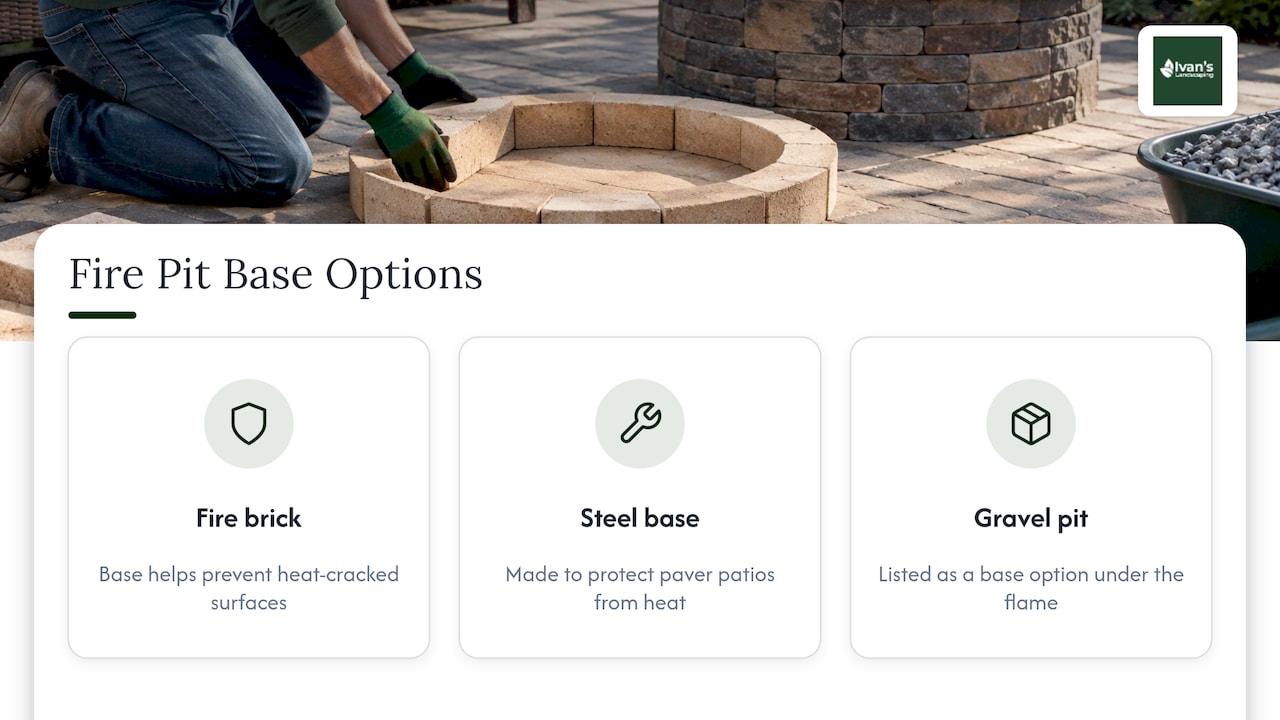
Some manufacturers go further. The Semco Blue River fire pit manual does not recommend placing a pit directly on concrete, paver or masonry surfaces without fire bricks as a base, because excessive heat can crack the surface over time. Metal bases made for the purpose exist as well: Breeo’s user guide lists paver patios among the noncombustible surfaces its base is meant to protect from heat damage, and it warns that the steel base itself gets hot in use.
The practical rule: pave around the fire, and put the flame on fire brick, steel or a gravel-filled pit.
Which pavers and stones can sit near the flame
There are two grades of material here, and mixing them up is where most damage starts.
| Part of the build | What belongs there | What to avoid |
|---|---|---|
| Pit interior, exposed to direct fire | Fire brick, set with fire-rated mortar or adhesive | Regular pavers, retaining wall block, river rock |
| Pit exterior wall | Heat-resistant block or stone | Decorative veneers not rated for heat |
| Patio surface around the pit | Concrete, clay brick or natural stone pavers | Polished stone that gets slippery when wet |
| Fill inside the pit | Fire-rated lining, lava rock or a steel insert | Pea gravel and river rock |
Lowe’s calls for fire bricks on the interior and warns against pea gravel and river rocks in the pit, since they can retain moisture and explode under extreme heat. Solidshape’s stone guide also points to fire brick, refractory mortar, lava rock or metal inserts for fire pit interiors.
If you are choosing a paver style for the whole patio, our guide to paver patio ideas covers pattern, slope and base together, which matters more than color when a fire feature is part of the plan.
What the base under a fire pit should look like
A fire pit is heavy. A ring of block plus a lining weighs far more than the furniture around it, and it sits in one spot through freeze and thaw cycles. A weak base shows up as a tilted ring or sunken pavers beside it.
Published build guides agree on the idea and differ on the numbers:
- Lowe’s says to tamp the soil level, add about 2 inches of gravel base, wet and tamp it, then add and tamp another half inch and check that it is level. It adds that a paver base may not be required on a stone or concrete patio.
- The Home Depot says to excavate about 7 inches, pack the dirt, then add crushed gravel paver base to a finished thickness of about 5 inches, and wet and tamp it into a hard, level layer. It also calls for two to seven days of adhesive curing between block layers before the first fire.
- The Semco manual calls for a compacted crushed-limestone pad at least 4 inches deep, extending 6 inches past the base course.
Those are for pits built in a yard. In Northern Illinois, where frost heaves unprotected ground every winter, the base under a pit that sits inside a patio should be planned together with the patio base and its drainage. Water that collects in a pit ring freezes, expands and pushes block apart. Our guide to paver patio drainage explains the slope and base specs, and the same compaction logic is in our piece on base depth and compaction for outdoor kitchen pavers, another heavy feature on a patio.
Adding a fire pit to an existing patio
This is the most common situation. A rough order that works:
- Check local rules first. Fire and building codes, and any HOA guidelines, come before materials. This Old House says local ordinances take precedence over manufacturer directions.
- Call 811 before you dig. Lowe’s lists it as a step before any excavation, and underground utilities are not always where you expect.
- Pick the spot. Keep it well clear of the house, fences and overhanging branches (distances below).
- Decide: built-in or sit-on. A built-in pit means lifting pavers, excavating and building a new compacted base inside the opening. A sit-on steel or fire-brick-lined unit needs a heat barrier under it and a level surface.
- Build the ring. Stack block with construction adhesive, line the interior with fire brick, and let the adhesive cure fully before lighting a fire.
- Re-lay and finish the pavers around it. The cut pavers at the ring edge should be tight and the joints refilled, so the patio looks designed rather than patched.
Steps 4 to 6 are where DIY projects go wrong: pavers lifted in a hurry, base compacted in thick lifts that settle later, and cuts that never fit the curve. Our Pavers & Patios crews build in McHenry County, and we put the scope in writing, so the pit, the base and the surrounding pavers are priced and planned as one job.
Clearances and local rules in McHenry County
General guidance is to keep a fire pit at least 10 feet from the house, overhanging branches and shrubs, with property-line setbacks of 10 to 25 feet depending on local code. Keep a hose, dry sand or a fire extinguisher within reach. Towns can be stricter, and two local examples show how:
- Crystal Lake: the city code says stationary fire pits and portable fire pits must be at least 15 feet from any structure or combustible material. It also describes a stationary pit as built below ground, surrounded by noncombustible material, with a minimum depth of 10 inches.
- McHenry: the city’s code allows recreational burning in an enclosed fireplace designed for outdoor use, and limits the open area of a pit to 48 inches across and 24 inches deep.
Codes get amended, so read the current text or call your village or city hall, or the fire department, before you design the pit. Algonquin, Lake in the Hills, Cary, Huntley and Woodstock each have their own ordinance. Homeowners associations may add rules on top. A pit that fits the code from the start avoids rebuilding it later.
Protecting the pavers over the years
Even a well-built pit leaves the pavers around it taking embers, ash and spills. Sweep ash off the surface promptly, refill joint sand where it has dried out, and rinse off any wet ash, which stains. A seasonal routine keeps the joints tight and the patio level, and we lay one out in our paver patio maintenance schedule. If a section has already cracked or sunk near an existing pit, our guide on repairing versus replacing a paver patio helps you decide.
Our view on fire pits and pavers
A fire pit is the feature people gather around, so it earns its place in the patio plan from day one. When it is drawn in early, the base under the ring, the drainage around it and the pattern of the pavers all work together, and nothing has to be cut out later.
We build paver patios across McHenry County, and the work that holds up is the work done in the right order: excavation, compacted base, then the surface. A fire pit adds weight and heat to that routine, which is why we plan it as part of the patio rather than as an extra on top of it.
Clean job sites and a satisfaction guarantee are part of how we work, and a written scope means you know what is included before the first paver is lifted.
Chas
Plan your fire pit patio with Ivan’s Landscaping
If you want a fire pit built into a new patio, or added to one you already have, we handle paver and patio construction for homes in McHenry County, from design through installation. We offer quick free estimates. Start on our McHenry County paver patio page or go straight to Pavers & Patios to request one.
FAQ
Will a fire pit crack my pavers?
Concrete, brick and natural stone pavers are noncombustible, but intense heat directly on the surface can crack it over time, which is why manufacturers call for fire brick or a heat barrier underneath. A lined pit on a solid base keeps the flame off the pavers.
Can I put a fire pit on pavers without a base?
A portable pit needs a level, stable surface and a heat barrier under it. A pit built into the patio needs a compacted gravel base, and the published guides put it at roughly 2 to 5 inches of compacted gravel for a yard pit. Frost in Northern Illinois makes a well-compacted base more important.
What should I put inside a paver fire pit?
Fire brick is the standard lining for the interior. Avoid pea gravel and river rock, which can hold moisture and burst under heat. Lava rock or a steel insert are also used as fire-rated fill.
How far should a fire pit be from my house?
General guidance is at least 10 feet from the house, branches and shrubs. Crystal Lake’s code sets 15 feet from any structure or combustible material, so use the larger figure your city requires.
Do I need a permit for a fire pit in McHenry County?
Requirements differ by town. Crystal Lake’s code, for example, exempts recreational fires and campfires from its permit requirement but still sets location and construction rules. Call your city or village hall and your HOA before building.
Sources
- How to Build a Fire Pit, Lowe’s
- How to Make a Fire Pit, The Home Depot
- Semco Blue River Fire Pit user manual
- Breeo Base user guide
- Best Outdoor Stone for Fire Pit Areas, Solidshape
- All About Fire Pits, This Old House
- Chapter 397: Pollution, City of Crystal Lake, IL
- 6-7-5: Recreational Burning, City of McHenry, IL