A French drain collects water that is soaking through the soil. A trench drain (also called a channel drain) catches water that is running across a hard surface such as a driveway, patio or parking lot. If puddles sit on pavement, you most likely need a trench drain. If your lawn or the ground beside your foundation stays saturated, you most likely need a French drain. Many properties in McHenry County need both, each in its own spot.
TL;DR
- French drain: a buried, gravel-filled trench with a perforated pipe that moves groundwater and saturated soil water away from lawns and foundations.
- Trench (channel) drain: a slotted surface grate over a channel that intercepts runoff across driveways, patios and parking lots.
- Match the drain to the water: water over pavement calls for a trench drain, and water in the soil calls for a French drain.
- Fix the cause first: a drain does not cure a leaking line or poor grading. Correct those before you dig.
- Large paved lots: permeable pavers are a third option that lets water soak through the surface itself.
Table of Contents
- What each drain actually does
- French drain vs. trench drain at a glance
- When to choose a trench or channel drain
- When to choose a French drain
- Fix the source before you buy a drain
- Using both on the same property
- Parking lots: trench drains and permeable pavers
- Our perspective
- Get it assessed in McHenry County
- FAQ
- Sources
What each drain actually does
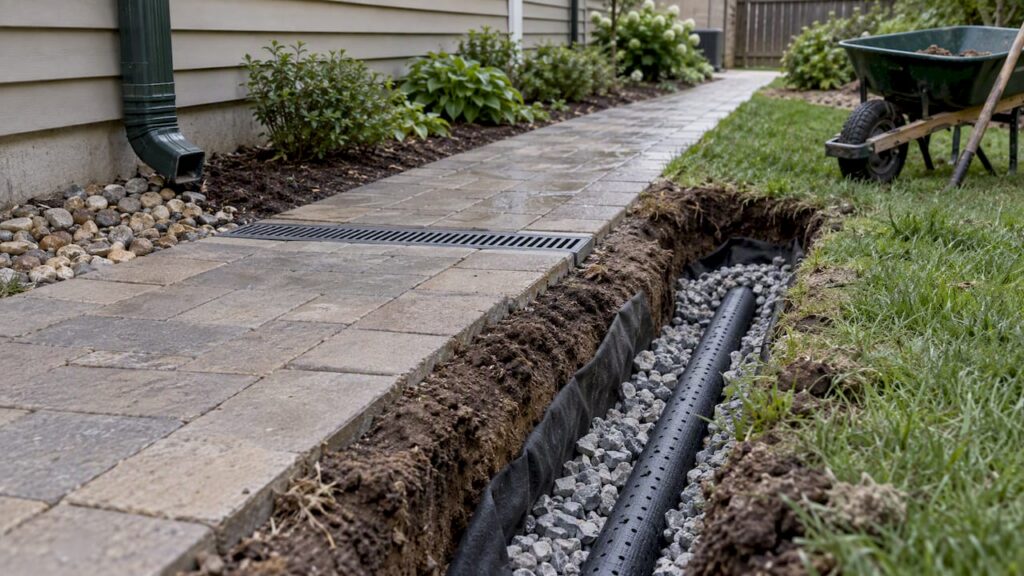
A French drain diverts water from areas such as lawns, foundations or basements. It is built from a trench filled with gravel or rock and a pipe, according to Lowe’s drain buying guide. The pipe is perforated, and fabric lines the trench so soil does not clog the gravel. Because it is sloped, gravity carries the water to an outlet such as a storm drain or a dry well, as The Home Depot’s installation guide describes.
A trench drain works at the surface. Lowe’s describes it as a small trench with a slotted cover or grate that captures and redirects surface water from driveways, patios, parking lots and pathways. A channel drain is the same idea built from a manufactured channel. Those channels come in widths from 1 to 16 inches and in concrete, steel or plastic, according to the NDS exterior drainage short course.
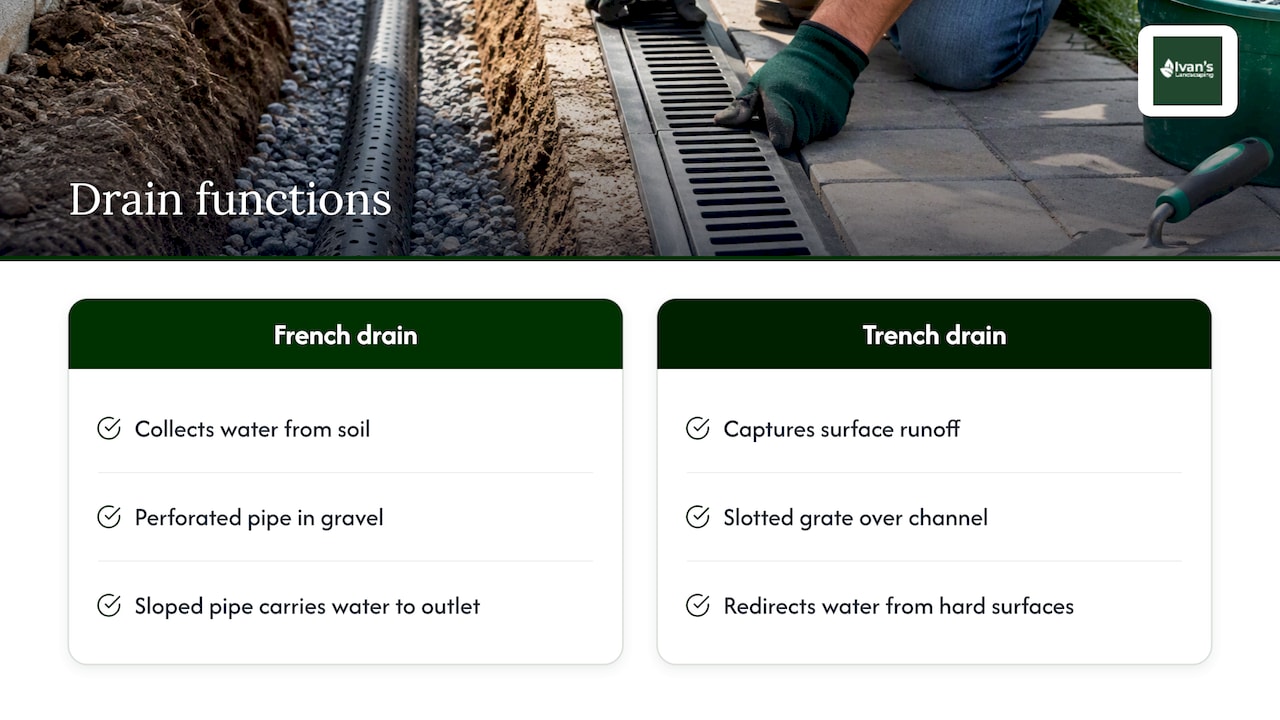
The terms overlap in casual conversation, which is why the two get mixed up. The difference that matters is where the water is when it meets the drain.
French drain vs. trench drain at a glance
| French drain | Trench / channel drain | |
|---|---|---|
| Water it handles | Saturated soil, underground seepage | Sheet runoff over hard surfaces |
| Where it sits | Buried under gravel, often under lawn | At the surface, flush with paving |
| Visible parts | None, or a small outlet | Grate along the edge or low line |
| Typical locations | Lawns, beds, beside foundations | Driveways, patios, garage aprons, parking lots |
| Cleaning | Occasional flushing, outlet checks | Grate and channel debris removal |
| Main failure risk | Clogged fabric or pipe, no outlet | Pavement sloped away from the grate |
When to choose a trench or channel drain
Channel drains suit hardscape. The NDS guide recommends them for driveways, patios, parking lots and loading docks. Bob Vila’s driveway drainage guide adds that a channel drain is installed into concrete or asphalt, captures water across a wide linear area and routes it to a pipe or another drainage system. It is a good fit for driveways that slope toward a garage, a foundation or a planting bed.
Typical situations:
- Water pours down the driveway and pools at the garage door.
- A paver patio sheds water toward the house.
- A retail or HOA parking lot has a low line where runoff collects across the full width of a drive lane.
- A walkway ices over every winter because meltwater has nowhere to go.
One caution applies to every trench drain. Drainage Helper advises that a channel drain is often ineffective when the pavement slope is wrong, because water has to reach the grate to be removed. If the surface slopes away from the drain, the grading comes first. Our paver patio drainage guide covers the slope and base specs that keep water moving toward the right place.
When to choose a French drain
A French drain is the better tool when the ground itself is wet: a soggy lawn after every rain, a low corner that never dries, or soil that stays soft along the foundation. Water enters the gravel from the soil and flows through the pipe, so nothing needs to sit on the surface.
It has limits. Delaware’s environmental agency says simple, shallow yard French drains may run 8 to 24 inches deep, while deeper or foundation-adjacent systems may need a drainage contractor. Its yard guide also cautions that French drains are not meant for severe flooding or for sites without enough slope, and that a poor design can make foundation risk worse. The Home Depot suggests a trench about 18 inches deep and 9 to 12 inches wide, with at least a 1% slope.
Three details separate a drain that lasts from one that fails:
- A place for the water to go. A French drain needs a discharge point at a lower elevation, such as daylight on a slope, a storm inlet where permitted, or a dry well.
- Filter fabric around the gravel. The NDS guide describes a buried perforated pipe in a gravel bed with a fabric envelope lining the trench.
- Perforations facing down. For smooth-wall and dual-wall corrugated pipe, the small holes sit on one side and should face downward so soil does not enter the pipe, according to the same guide.
Before any digging in Illinois, call 811 so underground utilities are marked.
Fix the source before you buy a drain
The Foundation Performance Association notes that French drains can reduce wet soil conditions but do not correct the underlying source of the water, such as irrigation leaks or improper grading. If a spot stays wet in dry weather, rule out a broken sprinkler line or a leaking supply line first. A simple meter test for yard leaks is a sensible first step.
Next, look at where your gutters discharge and how the ground slopes near the house. Our guides on downspout drainage and grading around a foundation cover the two most common causes of a wet yard that a drain alone will not fix. If a shallow swale might do the job, test your soil before you choose a swale or French drain.
Using both on the same property
Paving and soil often need different answers side by side. A driveway can dump water onto a lawn that is already saturated. The practical fix is a trench drain across the pavement and a French drain in the soil beside it, with both routed to the same outlet where the grade allows.
A few simple rules for deciding:
- Water moving across a surface: trench or channel drain.
- Water collecting at one small low point: a catch basin, which is a surface inlet with a grate and a sump, is often the neater answer. Drainage Helper notes channel drains are preferred when water follows a predictable line across hardscape.
- Water rising through soil: French drain.
- Water falling from a roof: gutters, downspout extensions and buried solid pipe before anything else.
People also ask whether drain tile is the same thing. The names are used loosely, but in basement work drain tile usually refers to pipe at the footing, far deeper than a yard French drain. Deep foundation systems are a job for a waterproofing or drainage specialist.
Parking lots: trench drains and permeable pavers
For commercial lots, the usual solutions are catch basins at low points, trench drains where runoff crosses a drive lane or entrance, and correct grading toward a storm system. A trench drain across an entrance keeps water from running into the street or the building.
Permeable pavers are a different approach. Washington State University’s guide to managing surface water explains that they let water pass through joints or the blocks themselves into a subsurface layer of aggregate, which reduces runoff and encourages infiltration into native soil. Depending on the soil and the volume of water, a system may also include engineered storage or piping. Clay-heavy soils drain slowly, so the base design matters more than the paver.
Our perspective
Most drainage calls we get start with a request for a specific product: “I need a French drain.” Often the real problem is somewhere else. A downspout dumping at the corner of the house, a patio pitched toward the wall, or a lawn that was graded flat can each produce the same wet spot.
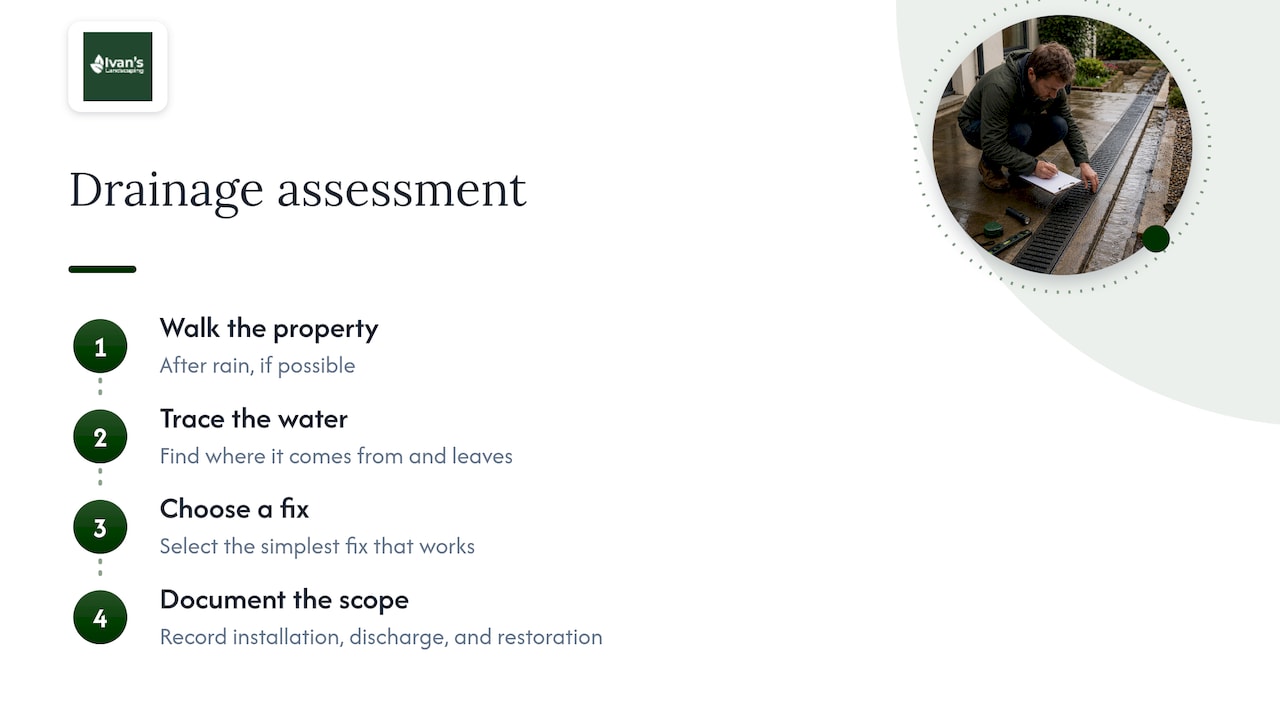
Our approach is to walk the property after rain if we can, find where the water comes from and where it can leave, then choose the simplest fix that works. Sometimes that is regrading and a swale. Sometimes it is a buried pipe, a trench drain at a garage apron, or a paver base built with proper slope. We document the scope in writing so you know what is being installed, where it discharges, and what is left to restore afterward. We keep job sites clean, because a drainage project should not leave a yard in worse shape than we found it.
If we think a drain would not solve your problem, we will say so before you spend the money.
— Chas
Get it assessed in McHenry County
Ivan’s Landscaping has served residential and commercial properties in McHenry County since 2008, with drainage and grading solutions among our services. If you are weighing a French drain, a trench drain or a regrade, contact us for a free estimate. For a patio or walkway project where drainage is built into the base, see our pavers and patios work. After installation, our French drain maintenance checklist shows what to inspect each year.
FAQ
Is a trench drain the same as a channel drain?
In everyday use, yes. Both are linear drains with a grate set into a surface to intercept runoff. “Channel drain” usually refers to a manufactured channel in concrete, steel or plastic, while “trench drain” is the broader term.
Can a French drain replace a trench drain on a driveway?
Usually not. A French drain collects water that soaks into soil, but driveway water runs across a hard surface and needs to reach a grate. If both the pavement and the adjoining soil are wet, use a surface drain for the paving and a buried drain beside it.
How deep should a French drain be?
Shallow yard systems commonly run 8 to 24 inches deep, according to Delaware’s environmental agency. The Home Depot suggests about 18 inches deep and 9 to 12 inches wide with at least a 1% slope. Deeper or foundation-adjacent systems are best left to a drainage contractor.
Do permeable pavers work for a parking lot?
They can, when the base is designed for the site’s soil and the volume of water it will receive. Water passes into an aggregate storage layer beneath the surface and infiltrates the ground. Heavy clay soil may need engineered storage or piping.
Sources
- French Drain vs. Trench Drain Comparison, Lowe’s
- How to Install a French Drain, The Home Depot
- Principles of Exterior Drainage short course, NDS
- 7 Driveway Drainage Solutions, Bob Vila
- Channel and Trench Drains, Drainage Helper
- French Drain for Yard, Delaware DNREC
- Drainage Guidelines, Foundation Performance Association
- Options for Managing Surface Water Drainage, Washington State University