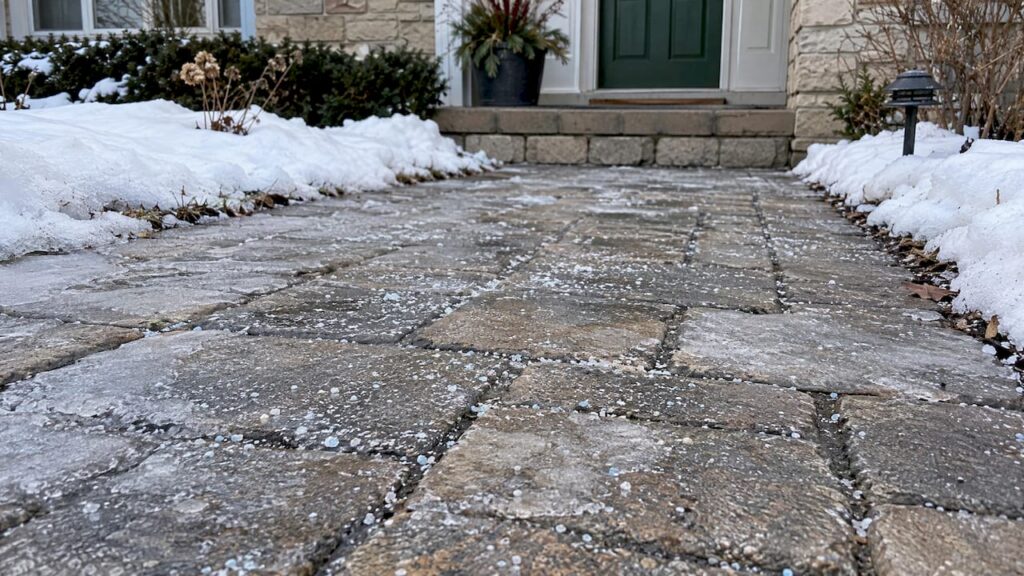
Plain rock salt (sodium chloride), spread lightly and swept up after the melt, is the least damaging ice melt for pavers. Magnesium chloride and CMA (calcium magnesium acetate) are the ones to avoid. Even the safe choice does harm when it is overused, so the amount, the timing and the cleanup matter as much as the product. If you would rather not manage that yourself, our snow removal crews in McHenry County can handle your paver walks and patios as part of a winter plan.
TL;DR
- Use sodium chloride (rock salt) as your default deicer on pavers, and apply only as much as the job needs, according to the paver industry association CMHA.
- Skip magnesium chloride, CMA, potassium chloride and fertilizer-type melters on pavers.
- Plow or shovel first, treat before the ice bonds, and sweep up leftover granules and salty slush once the ice is gone.
- Below roughly 0°F no deicer works, so use sand for traction instead.
- Newly laid, poorly drained or unsealed pavement is the most vulnerable, so tell whoever clears your snow exactly where the pavers are.
Table of Contents
- Why ice melt can harm pavers
- Which deicers are safest for pavers
- How to apply ice melt on pavers
- When sand is the better choice
- Protect the pavers before winter
- Our view on salt and pavers
- Let us handle snow on your pavers
- FAQ
- Sources
Why ice melt can harm pavers
Pavers are made of concrete, and concrete is porous. Water soaks into it, freezes, expands and breaks off small pieces of the surface. CMHA explains that ice forming inside a paver causes stress that can lead to degradation, and that deicing materials mixed with the ice can increase the potential for damage. Dense, well-made pavers with plenty of cement resist this far better than cheap ones.
The chemistry matters too. A federal highway study found that magnesium chloride and calcium chloride are often applied to dry pavement at high concentrations. That can pull strong solutions into the surface and the joints, especially where liquid pools in joints that do not drain. At low salt concentrations the damage is mostly ordinary freeze-thaw. At higher concentrations chemical attack takes over.
One point from a major paver manufacturer is worth knowing. Pavers are generally two to three times stronger than poured concrete and absorb less water, but all concrete remains susceptible to deicer damage. A better paver buys you margin. It does not make salt harmless.
Which deicers are safest for pavers
In short, sodium chloride is the safest choice, calcium chloride is a limited backup, and the rest should stay off your patio.
| Deicer | Verdict for pavers | Notes |
|---|---|---|
| Sodium chloride (rock salt) | Best option | Least damaging of the common products; works down to about +20°F |
| Calcium chloride | Only when needed | Faster and effective at lower temperatures; use sparingly |
| Magnesium chloride | Avoid | Chemically degrades concrete |
| CMA (calcium magnesium acetate) | Avoid | Damage rises with magnesium content |
| Potassium chloride, potassium acetate, ammonium-based fertilizers | Avoid | Not recommended by the manufacturer |
The ranking comes from CMHA, which recommends rock salt as the least damaging deicer, calcium chloride only when a faster-acting product is needed, and says magnesium chloride and CMA chemically degrade all concrete types. A Brigham Young University review for the Utah Department of Transportation, which CMHA cites, found only minor or no effects from sodium chloride. Calcium chloride, magnesium chloride and CMA specimens showed scaling, cracking and strength loss.
The temperature ranges come from Unilock, which recommends sodium chloride down to +20°F and calcium chloride only when necessary, for colder conditions down to about -2°F. Its research also found that some products labeled “safe for concrete” were not, and still damaged pavers. Read the ingredient list rather than the front of the bag.
Two exceptions apply. Unilock’s warranty says wet-cast pavers, slabs and coping can be damaged by deicers and are not recommended for chemical treatment at all. If you are not sure what type of paver you have, ask the contractor who installed it. If we built it, we can tell you.
How to apply ice melt on pavers
The principle from CMHA is simple: use only as much deicer as needed to make the surface safe. Here is how to do that in practice.
- Clear the snow first. Shovel or plow before you spread anything. Salt applied to deep snow gets diluted and wasted, which is why state salt-training guidance says to plow before applying deicers.
- Treat before the ice bonds when you can. Applying deicer ahead of an event, called anti-icing, is more efficient. The McHenry County parking-lot manual puts it at about a quarter of the material and a tenth of the cost of deicing after the ice forms. That same manual says pavers and other pervious surfaces need reduced or no deicing.
- Spread thinly and evenly. Follow the bag directions and use the minimum. Heavy piles dissolve into concentrated brine that sinks into joints. Keep granules off the edges of lawn and planting beds too.
- Mind the temperature. Do not apply magnesium chloride or calcium chloride when the pavement is above 35°F, because the wet surface can turn slippery, as the county manual warns. State guidance also says dry salt below about 15°F pavement temperature works poorly and should be wetted first.
- Sweep up afterward. Once the ice is gone, sweep off leftover granules and salty slush. Unilock also advises washing the paver surface after winter.
For a deeper comparison of what is in the bag, see our guide to deicing salt types and our note on rock salt versus ice melt.
When sand is the better choice
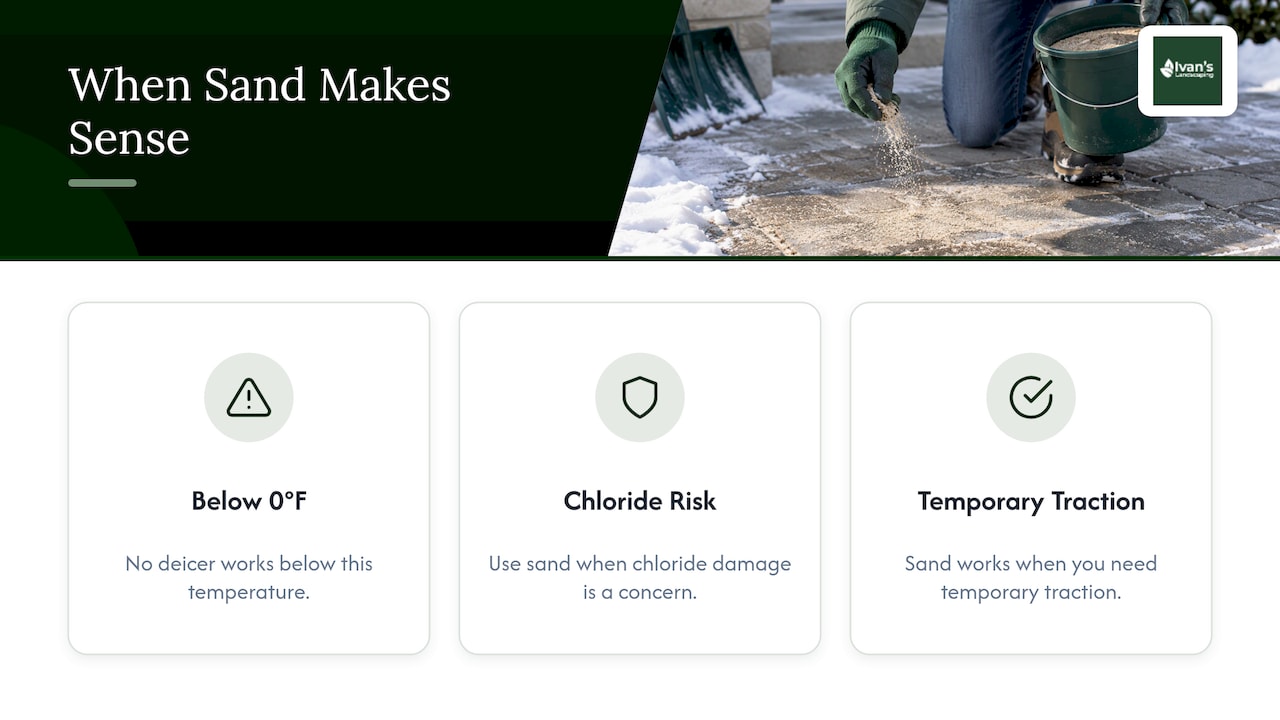
Salt is not always the answer. The Minnesota Pollution Control Agency’s property management manual says sand and other abrasives make sense when it is too cold for deicers to work (no deicer works below 0°F), when chloride damage to infrastructure or plants is a concern, or when you only need temporary traction. It also advises against mixing salt and sand, which it calls an inefficient strategy.
On pavers, coarse sand has a bonus. CMHA notes that sand that melts into the joints tops up the joint sand your pavers rely on. Sweep the excess away once the ice is gone. Sand tracked indoors is its own cleanup headache, and there is practical advice on keeping sand out of stairwells if you manage a building with shared entries. For local conditions, read our comparison of sand versus salt in McHenry County.
Protect the pavers before winter
Most deicer damage starts with a weakness you can fix in fall.
- Drainage. Water that sits in joints or on the surface freezes repeatedly and soaks up deicer. Proper slope, base and drains keep the patio from holding that water. Our paver patio drainage guide covers the specs.
- Joint sand. Full, firm joints keep brine from reaching the base. Check them in fall and refill where needed.
- Age of the installation. Newer pavement is the most vulnerable, so go lighter, or use sand only, on a patio in its first winter.
- Seasonal upkeep. A simple routine of cleaning and joint checks is laid out in our paver patio maintenance schedule.
If a white film or stain appears on the surface in spring, that is usually leftover salt residue. Sweeping, then a thorough rinse, is the right first step. For the wider picture on slabs and driveways, see our steps to prevent ice melt damage to concrete.
Our view on salt and pavers
We build paver patios and walkways in McHenry County, and we clear snow from them. That gives us a simple view: the winter plan should be set when the patio is designed, not after the first storm.
Most of the damage people report comes from three habits: spreading too much, using the wrong product, and leaving the leftovers to sit. All three are about the plan more than the pavement. A property with a clear scope for which surfaces get what treatment avoids them.
That is why we put scope in writing. When a client’s walks, patio and driveway are listed with the surface type beside each one, the crew knows where the pavers are before the first snowfall. We also stand behind our work with a satisfaction guarantee and keep job sites clean, and that includes winter.
If your property has pavers, tell whoever clears your snow. If that is us, we will note it in the scope.
Chas
Let us handle snow on your pavers
We have served McHenry County homeowners, HOAs and commercial properties since 2008. Our snow removal service covers walks, driveways and lots, and our crews respond quickly to estimate requests. Property managers can read how we approach commercial snow removal and what to look for in a snow removal contract. If you are planning a new patio or walkway, our paver and patio team can design it with winter in mind.
FAQ
Will salt damage pavers?
It can, mainly when it is overused or when the pavers are new, poorly drained or low quality. Rock salt is the least harmful common option. Apply it lightly and sweep up what is left after the melt.
What is the safest deicer for pavers?
Sodium chloride is the one the paver industry recommends. Calcium chloride is a limited backup for very cold conditions. Avoid magnesium chloride and CMA, and do not trust a “safe for concrete” label without checking the ingredients.
How much ice melt should I put on pavers?
Use the minimum on the bag directions, spread evenly after clearing snow. The goal is a thin, even layer that makes the surface safe, not a blanket of granules. Sweep up any excess once the ice has melted.
When should I use sand instead of ice melt?
Use sand when it is too cold for deicers to work, around plantings you want to protect, or when you only need short-term traction. Choose coarse sand and sweep it up afterward, because it can also refill your joints.
Sources
- CMHA: The Effects of Deicing Chemicals on Interlocking Concrete Pavements
- CMHA: Top 3 Tips to Prepare Your Interlocking Concrete Paver Patio for Winter
- FHWA: Chemical Deicers and Concrete Pavement
- Unilock Technical Reference: Deicing Chemicals
- Unilock Warranty for Pavers and Walls
- McHenry County Parking Lot Manual
- Maryland MDE Salt Training Manual
- Minnesota PCA: Smart Salting for Property Management
- Keeping sand out of stairwells