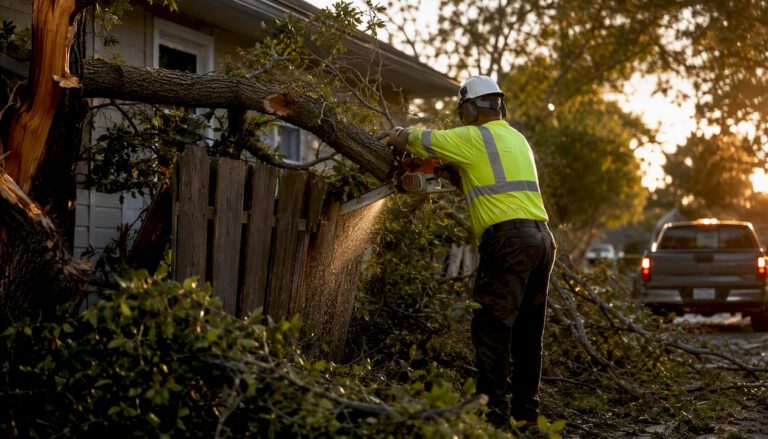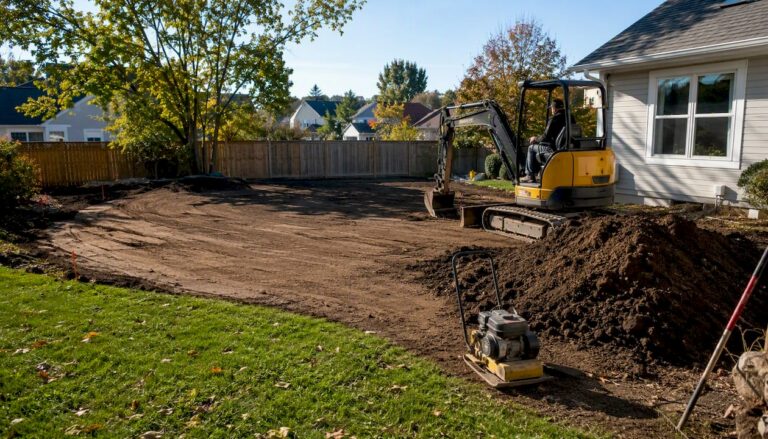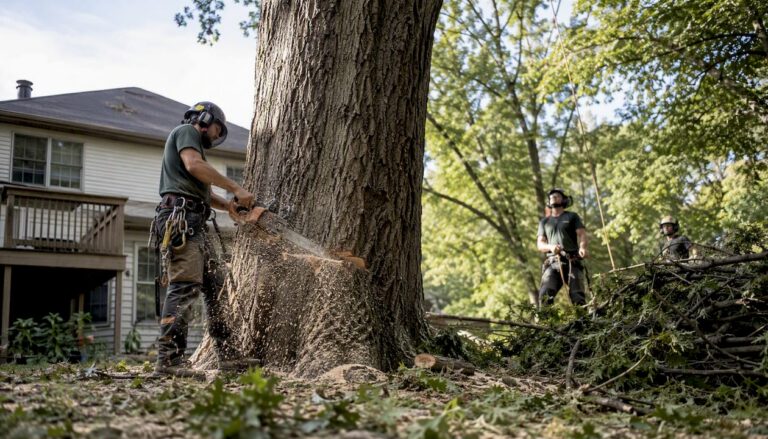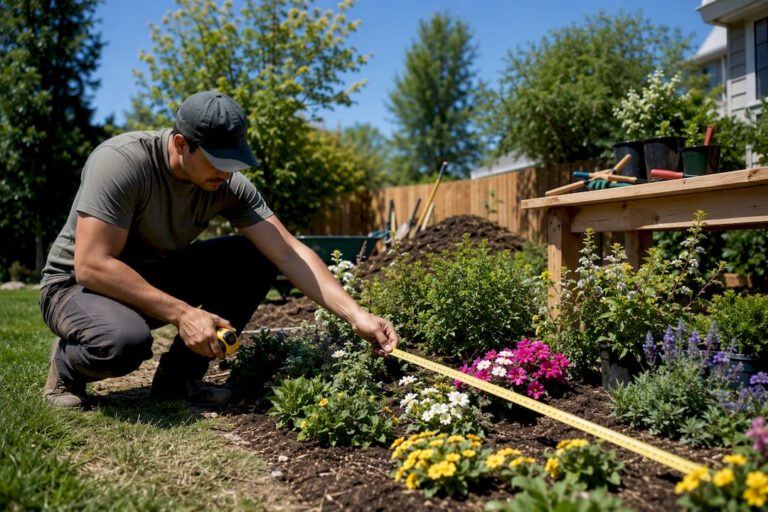
The safest storm cleanup follows a fixed order: check for hazards, clear the small debris yourself, hand anything high, heavy or near power lines to professionals, then repair the lawn and drainage. In McHenry County, we handle the heavy part of that list: tree removal, brush clearing, cleanup and regrading, so you can start on your yard without taking on the dangerous work.
TL;DR
- Walk the yard first and look up. Hanging limbs, trees leaning on other trees or roofs, and anything touching a wire are not DIY jobs.
- Pick up twigs and small branches yourself, working in sections, with gloves, boots and eye protection.
- Work at height, cutting under tension and anything near utility lines belongs to a professional arborist.
- Sort debris into separate piles (vegetation, construction material, appliances, trash) so local pickup goes faster.
- Once the soil dries, repair low spots, bare lawn and drainage before the next storm.
Table of Contents
- Start with a hazard walk, not a rake
- What you can do yourself
- What to leave to a professional arborist
- Sorting and disposing of storm debris
- Repairing the lawn and drainage afterward
- Our perspective
- Get the yard cleared and restored
- FAQ
- Sources
Start with a hazard walk, not a rake
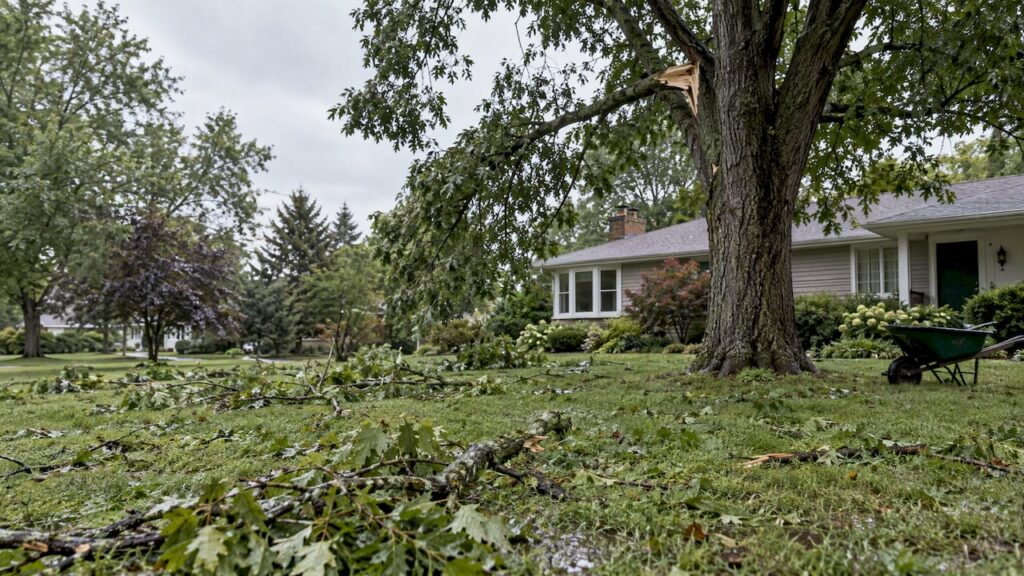
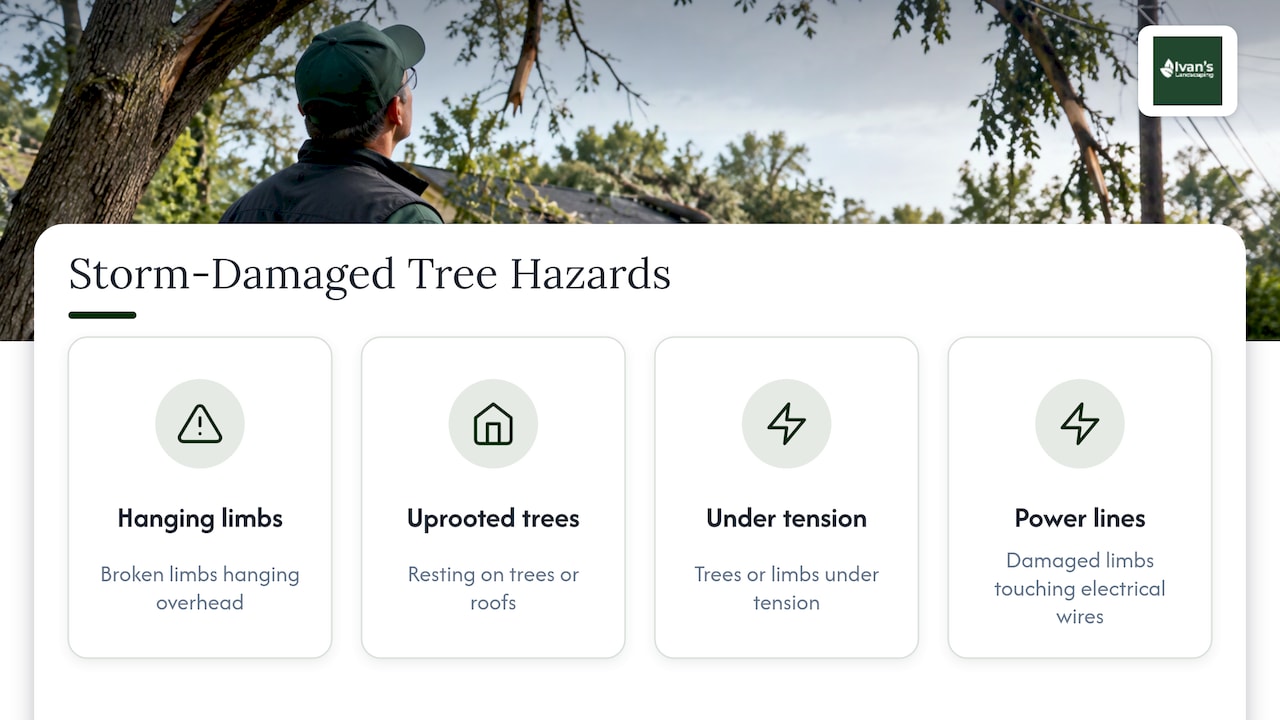
Do not pick up a single branch until you have looked at the whole yard. The Illinois Department of Natural Resources lists the hazards to look for before assessing storm-damaged trees: broken limbs hanging overhead, uprooted trees resting in other trees or on roofs, trees and limbs under tension, and damaged limbs touching electrical wires.
Treat any branch near a wire as live. Illinois Extension warns that fallen branches can be larger than they look and are life-threatening on or near power lines. Stay back and call your utility.
If you are unsure whether a damaged tree is worth saving, signs a tree needs an arborist are a good way to judge how serious the damage is. Leaning trunks, split crowns and cracks at the base all point to a professional assessment.
What you can do yourself
Some cleanup is plain yard work, and a homeowner can do it in an afternoon:
- Pick up twigs, leaves and small branches by hand, starting at access points such as the driveway, gate and walkways, then working toward the center of the yard.
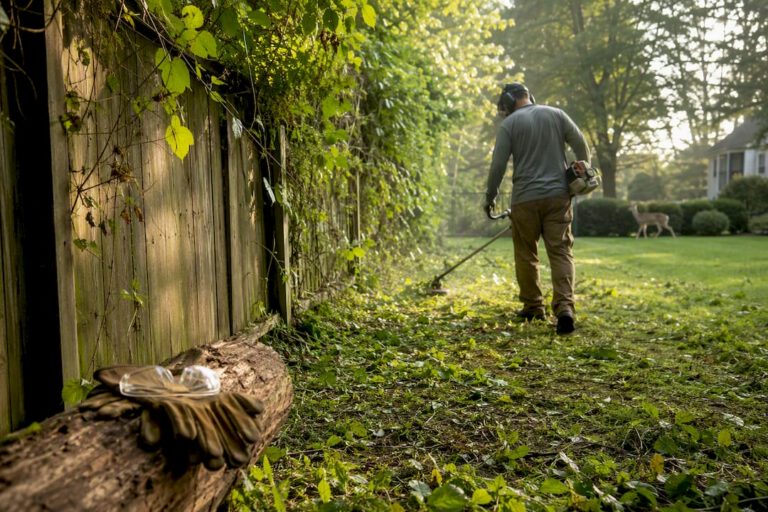
- Wear work gloves, sturdy boots, long sleeves and eye protection. OSHA notes that cleanup and recovery work can cause serious injury or death, and that the public should assess hazards before starting.
- Check gutters, downspouts and storm drains near your property for mud and leaves, so the next rain has somewhere to go.
- Keep portable generators outside and dry. Never plug one into a wall outlet or home wiring: back-feeding can kill utility workers working on the lines.
If the yard is covered in more than you can haul in a weekend, our spring and fall cleanup service and brush and land clearing cover this ground for McHenry County properties.
What to leave to a professional arborist
The Illinois DNR is direct about this: tree work at height, removing fallen tree parts from buildings or utility service lines, and running cutting equipment are inherently dangerous and should be done by a professional arborist. It also notes that ISA Certified Arborists have shown knowledge and experience in tree care and can assess storm damage.
In practice, call for help when:
- A limb is hanging over the house, driveway or play area.
- A tree has fallen onto the roof, fence or another tree.
- A trunk or limb is bent under tension. It can spring when cut.
- Anything is touching or near a power line.
- The job needs a ladder and a chainsaw at the same time.
Our tree removal service in McHenry County handles this kind of work, and our guide to emergency tree removal explains what to do while you wait. If a stump is left behind, read what to ask about grind depth before you decide between grinding and removal. Insurance often covers less than owners expect, which our page on tree removal insurance caps explains.
Do not pour fuel on a stump to get rid of it. McHenry County’s public health ordinance guidance says this risks soil contamination, and burning as a disposal method should be checked against local ordinances first.
Sorting and disposing of storm debris
After a widespread storm, towns in McHenry County often set up extra brush collection. After a severe August 2025 storm, the county reported municipalities running special debris collections, and Algonquin Township offered a brush drop-off site. Dates and rules change with each storm, so check your village, township or the county for the current schedule.
The Illinois DNR advises residents to check with the city, county or IEPA for special debris or household hazardous waste collection after storms. The same guide recommends separate piles for construction material, vegetation, appliances and household trash, which speeds up government pickup. For more on organizing storm debris for collection, keep the roof and siding debris apart from the yard waste.
A practical layout:
| Pile | What goes in it | Where it sits |
|---|---|---|
| Vegetation | Branches, leaves, brush | Curb edge, off the street and away from storm drains |
| Construction material | Fence boards, shingles, siding | Separate from brush |
| Appliances | Grills, water heaters | Apart from other piles |
| Household trash | Everything else | In your regular bins |
If your yard sits in a floodplain, call your local Floodplain Administrator before repairs. A local permit is required for all development in the floodplain.
Repairing the lawn and drainage afterward
Once the debris is gone, the yard itself needs attention. North Carolina State Extension advises letting saturated soil dry before working it, testing for contaminants after flooding, avoiding fertilizer while plants recover, and adding compost for badly damaged beds. Working wet soil compacts it, which is the most common way a storm-damaged lawn gets worse.
Then deal with what the storm exposed:
- Bare or torn lawn: reseed small patches, or lay sod where large areas washed out or were crushed by a fallen tree.
- Washed-out mulch: replace it so beds hold moisture and suppress weeds. See our mulch service.
- Standing water: if puddles linger after storms, start with simple yard drainage fixes and check the slope around your foundation.
Our perspective
Storm cleanup goes wrong when people do it in the wrong order. They start sawing before they have looked up, or they rake before the soil has dried.
We would rather you do the hazard walk, pick up what is safe to pick up, and call us for the rest. Our tree removal, brush and land clearing, cleanup and drainage and grading work are set up for exactly that sequence, for homes, HOAs and commercial properties in McHenry County.
A clean job site matters as much as the removal itself. Debris hauled away, ground left graded, and a written scope so you know what is covered before work starts.
Chas
Get the yard cleared and restored
Ivan’s Landscaping has served McHenry County residential and commercial properties since 2008. We handle tree removal, brush and land clearing, cleanup, sod installation and drainage and grading solutions. We offer quick responses to free estimate requests and a satisfaction guarantee. Property managers can also set up annual maintenance plans so the next storm does not start from zero. Request a free estimate.
FAQ
What does a yard cleanup include?
It typically means removing fallen branches, leaves and debris, and tidying beds and lawn edges. After a storm it may also include hauling brush and clearing around trees. Our spring and fall cleanup page describes how we scope it.
How should I get rid of storm branches?
Sort them into a vegetation pile and check your village, township or county for current brush collection or drop-off options. Do not burn them without confirming local ordinances allow it. Brush too large to handle safely can be cleared by us.
When should I wait before working on my lawn?
Wait until saturated soil has dried. Walking and working on wet soil compacts it and slows recovery. Skip fertilizer while plants are recovering.
Can I cut up a fallen tree myself?
Small branches on the ground, yes. A tree on a roof, in another tree, under tension or near a wire is a professional arborist’s job. Call us for removal, and your utility if any wire is involved.
How can I get ready for the next storm?
Keep drains and downspouts clear, have trees assessed, and sign up for local alerts. Illinois Extension also recommends assembling a disaster kit and making a plan.
Sources
- Storm-Related Tree Damage, Illinois DNR
- After the storm: Illinois Extension resources
- Keeping Workers Safe during Disaster Cleanup and Recovery, OSHA
- Illinois post-flood quick guide, June 2026
- Public Health Ordinance for McHenry County
- McHenry County storm damage and special debris collections, Northwest Herald
- Handling Flooding and Storm Damage in the Landscape, NC State Extension