For close-up spots like wreaths, railings, and small indoor trees, C7 bulbs give you a cleaner, more detailed look. For rooflines, large outdoor trees, and anything meant to read from the street, C9 bulbs carry better because of their larger size. LED versions of either bulb use far less power than incandescent while matching or beating their brightness, so the size you pick matters more for appearance than for your energy bill. The sections below break down the specs and safety steps that back up this choice.
TL;DR:
- C7 bulbs are ideal for detailed indoor features and small trees, with bulbs spaced 8 to 12 inches apart for close-up views.
- C9 bulbs are better suited for large outdoor features like rooflines and big trees, with wider spacing and higher visibility from a distance.
- LED versions use significantly less energy than incandescent bulbs and produce comparable or greater brightness for the same size, influencing the choice based on appearance preferences.
- Bulbs of different sizes should only be mixed across separate strings, as socket sizes and current ratings prevent safe swapping within the same string.
- For long-lasting, safe outdoor displays, always verify UL or ETL certification, use GFCI outlets, and choose LED strings for lower circuit load and durability.
Table of Contents
- Size and Physical Specifications: C7 vs C9 Dimensions and Bases
- Brightness and Appearance: Lumens, Color, and Perceived Glow
- Energy Use and Circuit Load: Watts, LEDs, and Safe Run Length
- When to Pick C7 and When to Pick C9
- Compatibility, Mixing, and Installation Safety
- Pros and Cons at a Glance
- Buying Checklist: What to Check Before You Buy
- What We’ve Learned Installing Holiday Lighting
- Our Take on Mixing Sizes the Right Way
- Let Us Handle Your Holiday Lighting Setup
- FAQ
- Sources
Size and Physical Specifications: C7 vs C9 Dimensions and Bases
The names refer to bulb diameter in eighths of an inch. A C7 bulb measures roughly seven-eighths of an inch across and about two inches long, while a C9 runs closer to one and one-eighth inches in diameter and around two and a half inches long. Both typically use an E12 (candelabra) base for C7 and an E17 (intermediate) base for C9, though LED replacements sometimes use smaller plug-in bases that still fit the same sockets.
That size difference changes how dense your display looks and how far apart you should space bulbs:
- C7 strings usually come spaced 8 to 12 inches apart, which suits detailed trim work like window frames or small trees.
- C9 strings are often spaced 12 inches apart, built for bold outlines rather than tight detail.
- Indoor trees generally look better with C7 or even smaller mini lights, since C9 bulbs can overwhelm the branches.
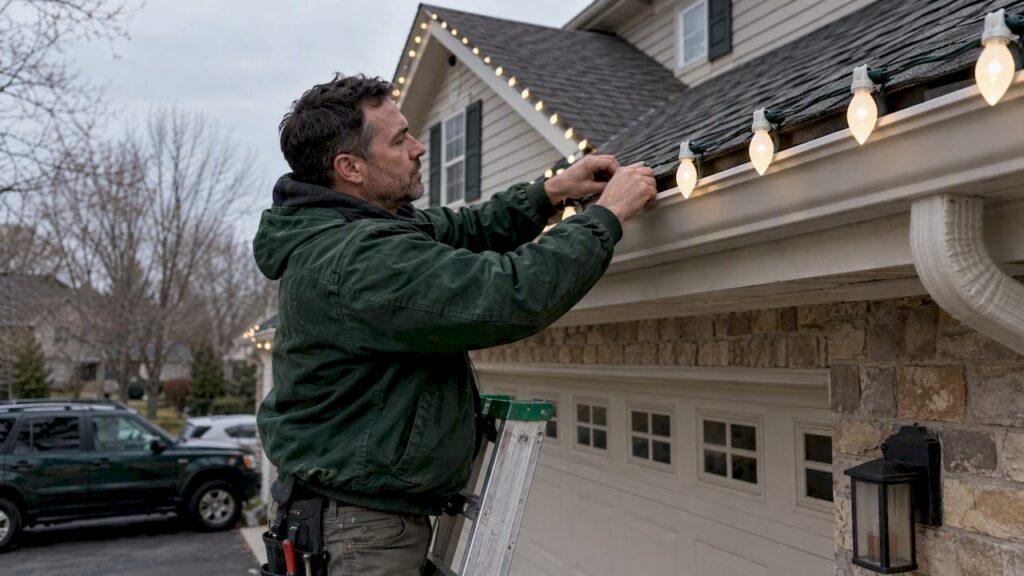
- Rooflines and eaves benefit from the wider spacing and larger profile of C9, which holds up visually from the sidewalk or street.
Brightness and Appearance: Lumens, Color, and Perceived Glow
Watts measure power draw, not brightness. Lumens are the correct way to compare how bright a bulb actually looks, and the DOE’s consumer guide recommends comparing lumens rather than wattage when shopping for LED replacements. LED C9 bulbs tend to produce more total light output than LED C7 bulbs simply because the larger envelope holds more diodes or a bigger diffuser surface, which also means light spreads over a wider angle instead of concentrating into a single point.
A few things shape how bright a string actually looks on your house:
- Bulb surface area and diffuser design affect how light scatters, not just how much is emitted.
- Beam spread matters for viewing distance: a tighter beam reads brighter up close, while a wider spread reads better from the road.
- Color temperature changes the mood: 2700K renders the classic warm white associated with traditional incandescent lighting, while cooler tones near 5000K give a crisper, more modern outline.
When lighting a tree for uplighting rather than string wrapping, testing placement with 2700 to 3000K LEDs before committing to a final layout helps you avoid harsh or uneven color once the bulbs are fixed in place.
Energy Use and Circuit Load: Watts, LEDs, and Safe Run Length
Switching from incandescent to LED changes both your power bill and how many strings you can safely run from one outlet. LED holiday lights use about 70 to 90% less energy than comparable incandescent strings, and a typical 100-bulb LED string draws roughly 4 to 10 watts compared with 40 to 100-plus watts for an incandescent string of the same length, according to EnergySage.
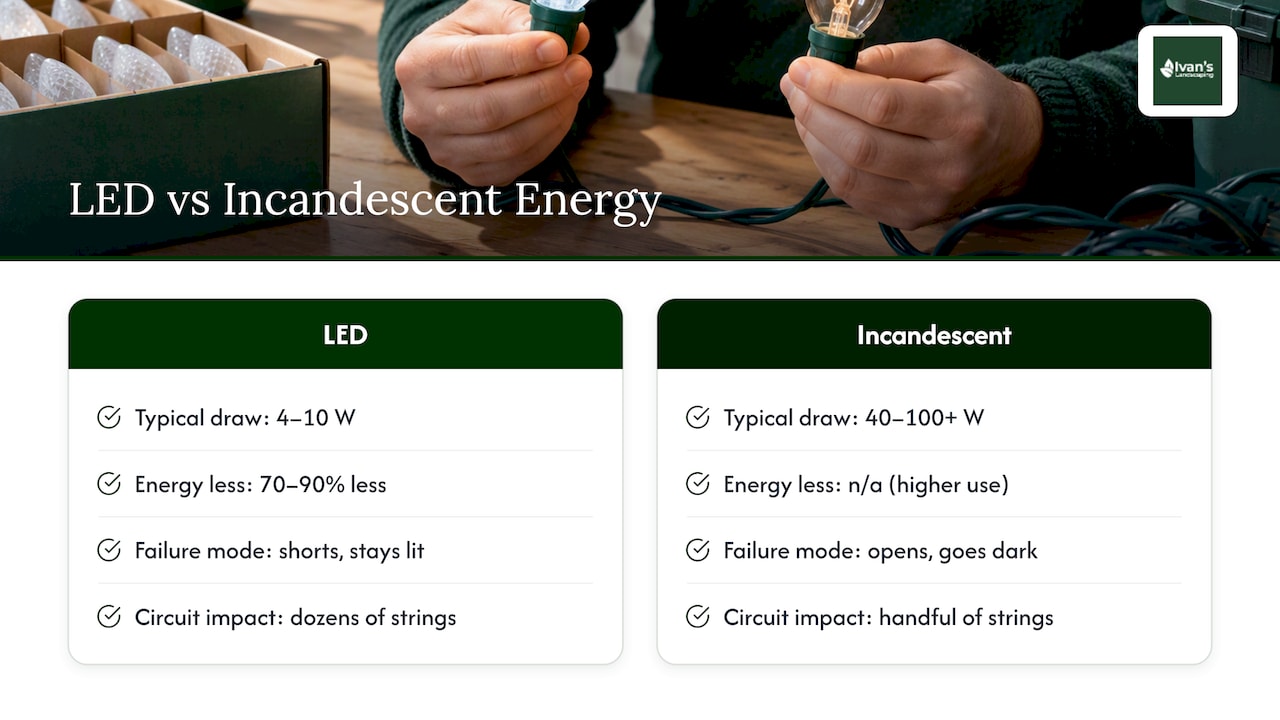
A standard 15-amp household circuit has a continuous-load limit typically calculated at 80% of its rated capacity for safe usage. That means you could run dozens of LED strings on a single circuit before hitting that ceiling, while incandescent strings reach the limit far sooner, often after just a handful of strings.
Separately, the Department of Energy notes that LED strings are wired in a series-parallel pattern and tend to short rather than open when a single bulb fails, which keeps the rest of the string lit instead of going dark the way older incandescent sets often do. For long roofline runs or multi-string displays, LED is the practical choice both for your circuit and for avoiding a string that quits halfway through the season.
When to Pick C7 and When to Pick C9
Matching bulb size to the job saves you from a display that either disappears from the street or overwhelms a small feature up close.
- Porch railings and window trim: C7 works well here because the smaller bulb keeps detail visible without crowding the lines.
- Wrapped trees and shrubs, especially indoors: C7 or mini lights avoid the bulk that makes C9 look out of place on thinner branches.
- Rooflines and eaves: C9 holds up at distance, which is exactly where a display needs to read clearly from the curb.
- Large outdoor trees and commercial storefronts: C9’s bigger profile and wider spacing suit sightlines that span a parking lot or a wide yard.
- Pathway and walkway borders: Either size works, but C7 tends to look tidier at ground level where viewers pass close by.
Commercial and municipal displays often lean toward C9 for the same reason: maintenance crews need a bulb that stays visible from a distance and survives handling across a longer install season.
Compatibility, Mixing, and Installation Safety
C9 bulbs generally will not seat correctly in sockets built for C7 strings, since the base and socket housing are sized differently even when both use a similar base type. Mixing bulb sizes cosmetically, such as placing C9s along a roofline and C7s along porch trim, works fine as separate strings, but swapping bulb sizes within the same string usually does not work because the socket spacing and current rating are built around one bulb type.
Incandescent bulbs commonly use a shunt that keeps a string lit when one bulb burns out, while LED bulbs behave differently and often fail in a way that does not break the circuit. Before plugging anything in outdoors, run through this checklist:
- Confirm the product is listed by a nationally recognized testing laboratory such as UL or ETL for outdoor use, a standard covered under UL 588 for seasonal decorative lighting.
- Plug outdoor lighting into GFCI-protected outlets, as recommended by the Consumer Product Safety Commission.
- Inspect cords and sockets for cracks, fraying, or exposed wire before every use, and retire any damaged set.
- Treat holiday lighting as a temporary installation, since standards like UL 588 generally define temporary seasonal use as capped around 90 days.
Pro Tip: Test every string on a short run before mounting it. A bulb that flickers or a socket that feels loose on the ground is far easier to fix than one thirty feet up a ladder.
Pros and Cons at a Glance
Each size carries clear trade-offs depending on where you’re hanging it.
- C7: clean, detailed look up close; limited visibility from a distance; well suited to indoor trees and trim.
- C9: strong visibility from the street and large coverage; can look oversized on delicate branches or small features.
- LED (either size): lower running cost, longer bulb life, and cooler operating temperature, but a higher upfront price per string.
- Incandescent (either size): familiar warm glow at a lower purchase price, but shorter bulb life and higher energy draw over a season.
Buying Checklist: What to Check Before You Buy
A little label-reading at the store or online saves you a return trip later.
- Check lumens, not just watts, to compare true brightness between products.
- Confirm the color temperature in Kelvin matches the look you want, warmer for classic, cooler for crisp.
- Look for UL or ETL listing and a wet-location or outdoor rating on the packaging.
- Note the socket type and whether individual bulbs are replaceable if one fails.
- Check the string length and bulb spacing against the area you’re covering, and review the warranty terms before buying multiple strings.
Pro Tip: If you’re lighting a long roofline or a commercial frontage, prioritize LED C9 strings for coverage and lower load. Save C7 for porch rails, wreaths, and anywhere you want the detail to show.
What We’ve Learned Installing Holiday Lighting
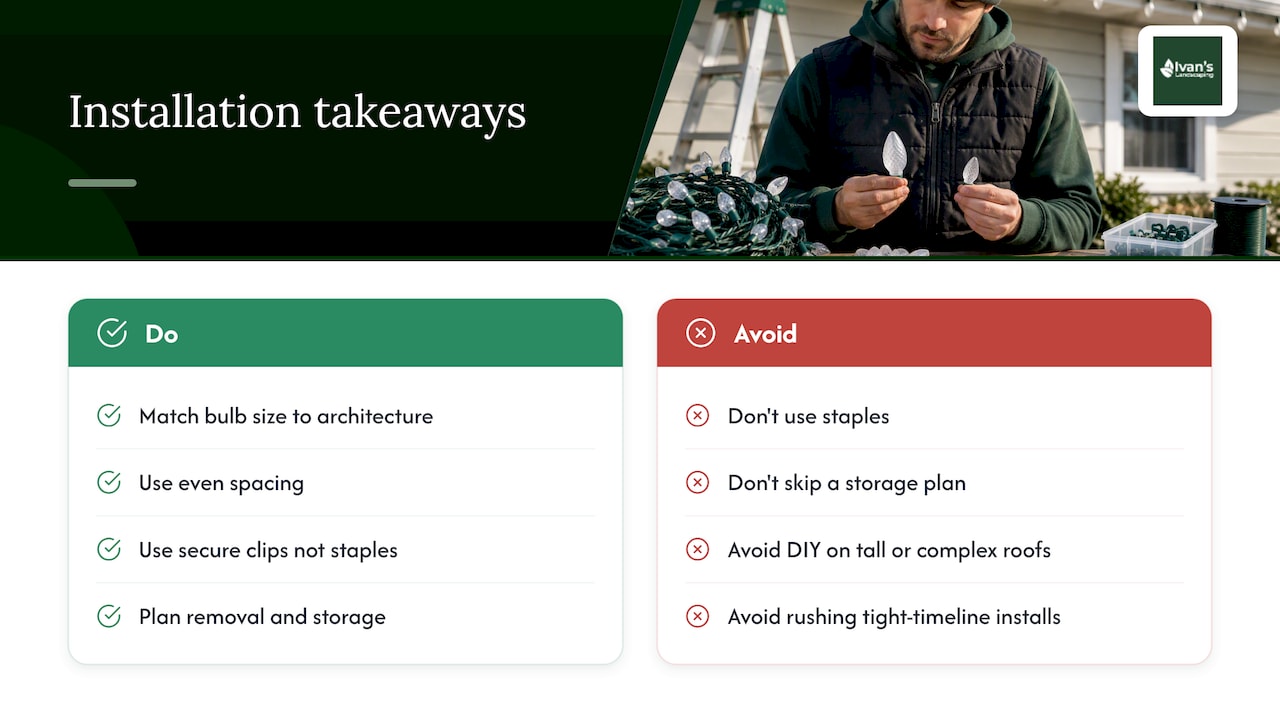
Through holiday light installation work across McHenry County properties, we’ve found that matching bulb scale to the architecture makes the biggest visual difference, more than brand or price. We favor even spacing, secure clips rather than staples, and a clear plan for removal and storage so bulbs survive to the next season. For tall rooflines, complex wiring runs, or displays on a tight timeline, hiring a professional installer takes the risk out of working at height.
Our Take on Mixing Sizes the Right Way
Most properties look best with a layered approach: C9 along the roofline for visibility from the street, C7 along porch rails and smaller trees for detail up close. LED should be the default for both, given the energy savings and lower heat output, and anything above a single story is worth handing to someone comfortable on a ladder. The size debate matters less than getting the placement and safety right.
— Chas
Let Us Handle Your Holiday Lighting Setup
We offer full holiday light installation across McHenry County, matching bulb size to your home’s scale, wiring it safely, and handling takedown and storage when the season ends. You skip the ladder, the tangled bins, and the guesswork on spacing. Reach out for a free estimate and we’ll size your display right the first time.
FAQ
Can you mix C7 and C9 bulbs?
You can mix them across separate strings, such as C9 on the roofline and C7 on the porch rail, but you generally cannot swap bulb sizes within the same string because sockets and current ratings are built for one bulb type.
Is C9 or C7 brighter?
C9 bulbs typically produce more total light output than C7 because their larger envelope holds more diodes or a bigger diffuser surface. Lumens, not watts, are the correct measure to compare, according to the DOE’s lighting guide.
Will a C9 bulb fit in a C7 socket?
No, C9 bulbs generally will not seat correctly in a socket built for C7 strings, since the housing and spacing differ even when the base type looks similar. Trying to force the fit can damage the socket or create a loose connection.
Are C9 lights too big for a Christmas tree?
C9 bulbs often look oversized on indoor trees, especially on thinner branches, which is why C7 or mini lights tend to suit indoor trees better. C9 works best on large outdoor trees or rooflines where its bigger profile reads well from a distance.
Sources
- How much electricity do Christmas lights use? | EnergySage
- UL 588 | UL Standards & Engagement | UL Standard