Yes, ice melt can damage concrete, and it happens more often than most homeowners realize. Under common winter conditions like saturated slabs, repeated freeze-thaw cycles, or over-application, deicing salts accelerate scaling and spalling on the surface. Stop heavy chemical use on vulnerable or new slabs right away, switch to sand for traction, and sweep or rinse off residue once temperatures allow.
TL;DR:
- Moderate salt applications during winter cause the most damage, especially when spread repeatedly on the same spot, due to the pessimum concentration effect.
- Using chloride-free deicers or moderate calcium chloride in thin, even layers reduces damage risk compared to excessive rock salt or heavy salt buildup.
- Protecting new concrete with penetrating sealers and ensuring proper drainage can prevent the initiation of salt scaling and freeze-thaw damage.
- Repair or replacement becomes necessary when concrete shows deep spalling, exposed aggregate, or widespread hollow sounding areas, indicating structural failure.
- Homeowners should avoid chemical deicers during the first winter, reapply sealers periodically, and rely on mechanical snow removal to minimize long-term damage risks.
Table of Contents
- How Ice Melt Damage to Concrete Actually Happens
- Which Deicers Are Hardest on Concrete (and Which Are Safer)
- When and How to Apply Ice Melt Without Making Things Worse
- Preventing Salt Scaling Before It Starts
- How to Fix Salt-Damaged Concrete Based on Severity
- What the Salt-Scaling Research Means for Your Winter Routine
- A Landscaper’s View on Where Homeowners Go Wrong
- Protect Your Concrete This Winter With a Professional Inspection
- Sources
- FAQ
How Ice Melt Damage to Concrete Actually Happens
Concrete is porous. Water gets in, and when it freezes, it expands with enough force to crack the surface from the inside out. Deicing salts make this worse in a specific way: they lower the freezing point of water sitting on and inside the slab, which keeps water liquid longer and increases how often it cycles between frozen and thawed during a typical winter. More freeze-thaw cycles means more expansion stress on the same square foot of concrete.
The deeper mechanism is what researchers call brine ice cracking, tied to what’s known as the “pessimum” concentration effect. Peer-reviewed salt-scaling research from the Scherer Group at Princeton found that moderate salt concentrations, not the strongest ones, often produce the worst surface cracking. A light dusting may do little damage, and a heavy application might behave differently than expected. It’s that in-between zone, the kind you get from casual, repeated salting, that does the most cumulative harm.
Several factors make a slab more vulnerable:
- Poor finishing techniques, especially over-troweling exterior slabs, which seals in bleed water and traps weak surface layers
- Low air entrainment in the concrete mix, leaving fewer microscopic pockets to absorb expansion stress
- High permeability from a wet mix or inadequate curing, letting more brine soak deeper into the slab
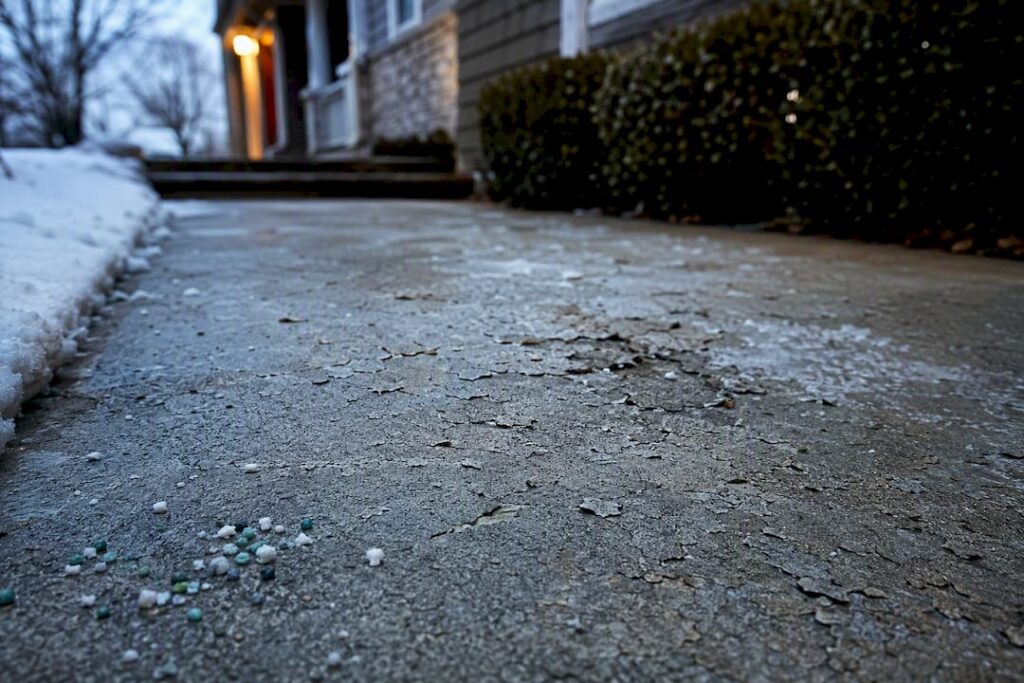
Signs to watch for: light scaling looks like a rough, flaking surface, almost like the top layer of frosting peeling off a cake. Left unaddressed across two or three winters, it progresses to pitting and then to visible aggregate, exposed stones where smooth cement used to be. A concrete surface that looked fine last November can show real deterioration by February if the same spot keeps getting salted and thawed.
Which Deicers Are Hardest on Concrete (and Which Are Safer)
Not every ice melt product carries the same risk. The active ingredient determines both how well it melts ice and how much stress it puts on the slab underneath.
- Sodium chloride (rock salt): the cheapest and most common option, effective down to moderately low temperatures. It’s also the chemistry tied to the most surface damage over repeated seasons, largely because people use so much of it.
- Calcium chloride: works down to roughly negative 25°F and acts faster than rock salt. Consumer Reports notes it’s often considered a comparatively gentler chloride option when applied correctly, though it’s still a chloride and still contributes to scaling with heavy use.
- Magnesium chloride and potassium chloride: generally easier on concrete surfaces, but both have narrower effective temperature ranges and some corrosion concerns for metal fixtures nearby.
- Chloride-free blends (CMA, beet juice based products): the lowest corrosion and surface impact profile, useful for sensitive pavers, stamped concrete, or newer slabs. They cost more and their melting performance varies more with temperature than traditional salts.
If your driveway or walkway already shows early scaling, switching away from straight rock salt is one of the simplest changes you can make this season.
When and How to Apply Ice Melt Without Making Things Worse
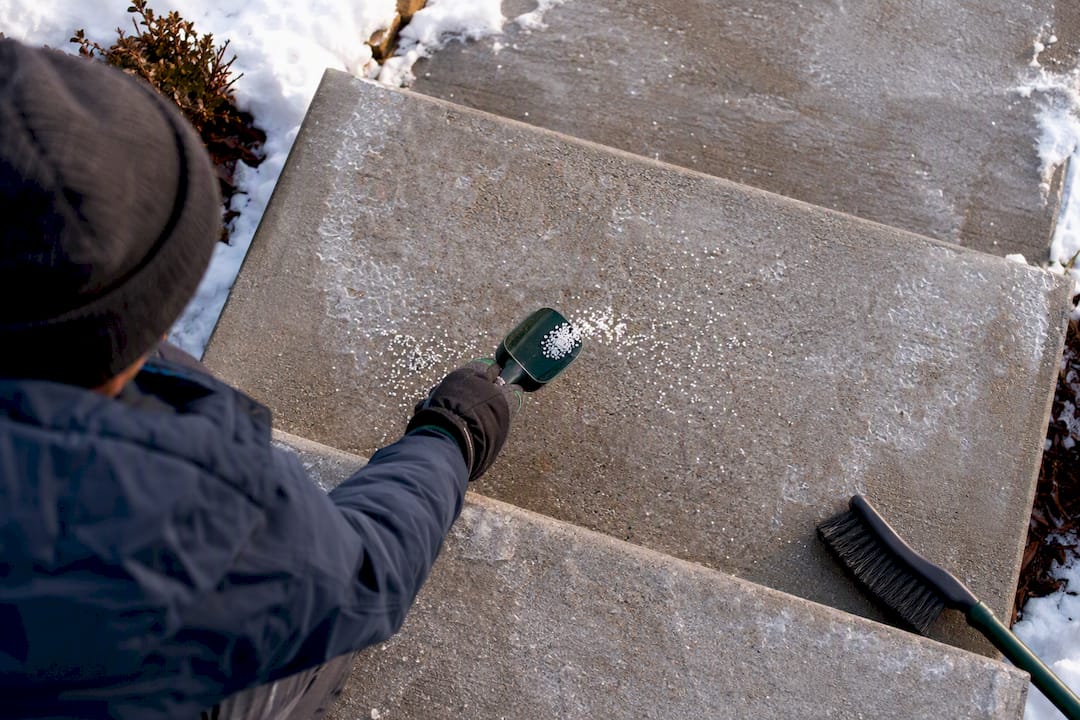
New concrete is the one absolute rule here: skip chemical deicers entirely through the first winter after a pour. Fresh concrete hasn’t finished curing internally, and its surface is far more porous until it fully hardens, which makes it especially prone to scaling before it’s had a real chance to strengthen. Use sand, or a similar abrasive, for traction on new slabs instead.
For established concrete, follow this sequence:
- Check the product label for the correct application rate, and don’t guess.
- Spread deicer thinly and evenly, never in piles or repeated heavy doses on the same spot.
- Avoid re-treating the same section daily. Repeated moderate applications are part of what drives that pessimum concentration problem.
- Once temperatures rise enough to melt runoff safely, sweep or hose off the residue rather than letting it sit and soak in, as detailed in how to winterize your doors for keeping entryways clear of salt damage.
- Pay closer attention to joints, wheel paths, and low spots where water pools. Poor drainage concentrates brine exactly where damage starts.
Pro Tip: Keep a bag of sand near your door alongside your ice melt. Using sand first on a light glaze, and saving chemical deicer for genuine ice buildup, cuts your seasonal chloride exposure by a wide margin without sacrificing safety.
Preventing Salt Scaling Before It Starts
Prevention costs far less than repair, and most of it comes down to controlling how much water and chloride actually reach the concrete’s interior.
- Penetrating sealers. Silane and siloxane sealers soak into the surface and chemically block water and chloride absorption, unlike cure-and-seal films that just sit on top and wear away within a season or two. Euclid Chemical’s technical guidance recommends penetrating sealers as the stronger long-term option for exterior winter durability. Reapplying roughly every three to five years maintains that protection.
- Correct mix and finishing. Air entrainment creates microscopic air pockets that relieve internal pressure from freezing water without cracking the surface. Proper broom finishing, rather than steel-troweling exterior slabs, avoids sealing weak layers into the surface during the pour.
- Grading and drainage. Water that pools on a slab freezes there repeatedly. Correcting slope and drainage around patios, walkways, and driveways reduces standing water before it ever becomes an ice problem.
- Non-chemical alternatives. Sand, snow-melting mats, or in-slab heating for high-traffic steps and entries reduce how often you reach for salt at all. Where plowing is involved, pile snow away from slabs rather than against them, so meltwater doesn’t repeatedly re-saturate the same section.
Once damage has progressed to deep spalling or exposed aggregate across large areas, sealers and drainage fixes won’t reverse it. At that point you’re planning for resurfacing or replacement, not prevention.
How to Fix Salt-Damaged Concrete Based on Severity
Start by inspecting what you’re actually dealing with. Light scaling and surface staining are cosmetic and often fixable without a contractor. Deep spalling, cracking that runs below the surface, or widespread exposed aggregate is structural and usually needs professional attention.
- Light damage: clean the surface with a concrete-safe cleaner, and treat white staining with a poultice designed to draw out mineral deposits. Thin resurfacing overlays can restore appearance on shallow scaling.
- Moderate to severe damage: bonded patching or full resurfacing systems can restore both appearance and function, but only when the base concrete underneath is still sound. A contractor typically checks this with a hammer sound test, listening for a hollow versus solid tone.
- Severe or widespread damage: if large sections sound hollow or the aggregate exposure covers a big portion of the slab, replacement is usually the more sensible long-term call rather than repeated patch repairs.
- Documentation: keep a record of your concrete’s pour date and any maintenance or sealing history. Contractors use that information to judge whether damage falls under a warranty or points to an installation issue.
If you’re weighing replacement anyway, it’s worth considering paver patios as an alternative surface, since individual pavers can be replaced without redoing an entire slab.
What the Salt-Scaling Research Means for Your Winter Routine
The pessimum concentration finding has a simple, practical takeaway: moderate, repeated salting is often worse for concrete than either very light dusting or occasional heavier use. That runs against the instinct to just keep salting a little bit every day “to be safe.”
Deicing salts increase surface saturation and freeze-thaw cycling, which is why industry guidance consistently points to two rules: never apply chemical deicers to concrete during its first winter, and use penetrating sealers rather than film-forming ones for long-term protection.
Pair that with good drainage and correct mix design, and you’ve covered the four levers that matter most: timing, dosage, sealing, and water management. Everything else, brand names, marketing claims about “pet-safe” formulas, is secondary to getting those four right.
A Landscaper’s View on Where Homeowners Go Wrong
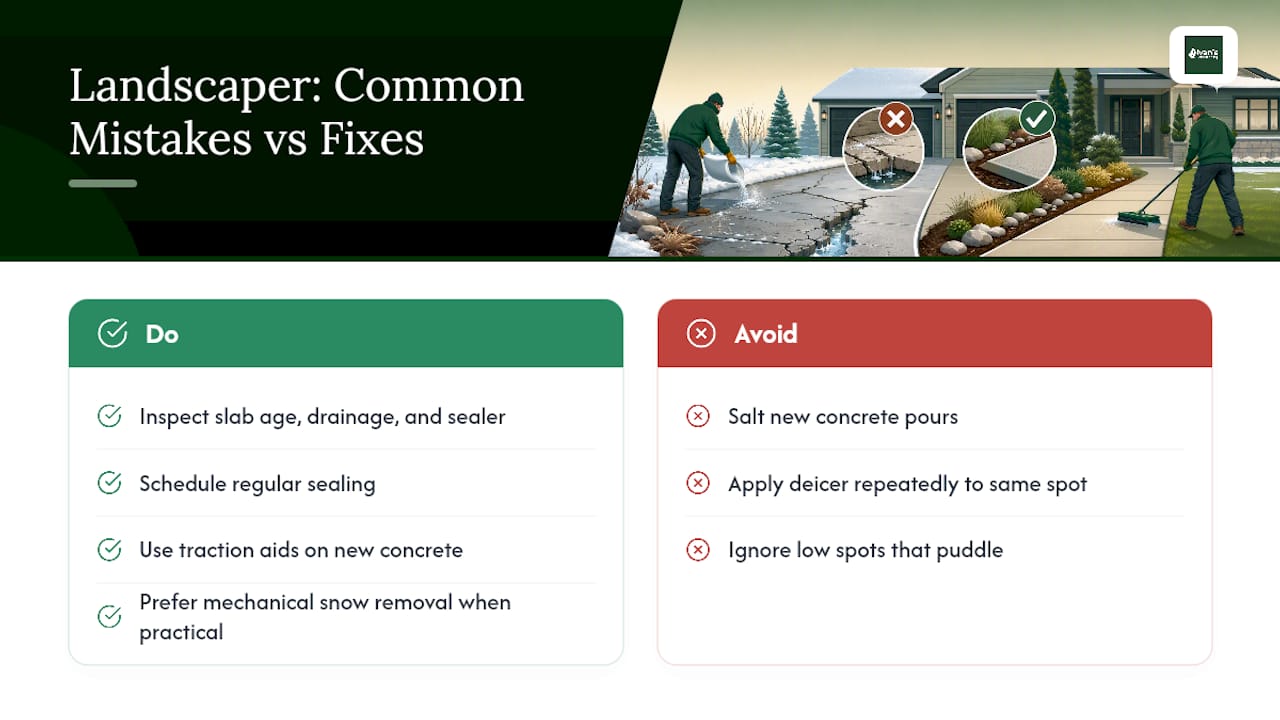
The mistakes we see most often in the field aren’t complicated. Homeowners salt new pours because they don’t realize the concrete is still vulnerable. They dump extra deicer on the same icy patch three days running instead of clearing it once. They ignore a low spot that puddles every thaw, then wonder why that exact corner scales first.
Our approach on winter jobs starts with inspection: checking slab age, drainage, and existing sealer condition before recommending anything. From there, it’s usually a mix of sealing schedules, traction alternatives for early-age concrete, and steering snow removal toward mechanical clearing instead of chemical dependence wherever it’s practical.
— Chas
Protect Your Concrete This Winter With a Professional Inspection
Sealing schedules, drainage corrections, and seasonal snow management all reduce the odds of ending up with a scaled or spalling slab, and Winter property care services can include sealing schedules, drainage corrections, and seasonal snow management. If you’re not sure whether your driveway or patio needs a penetrating sealer this year, or you’d rather skip chemical deicers entirely, our snow removal service gives you a mechanical alternative backed by our satisfaction guarantee and fast estimate turnaround. Contact us for a quick inspection: we’ll look at your slab’s age, drainage, and current sealing condition, then recommend the right fix, whether that’s a sealing plan, a repair, or a full paver patio replacement if your existing concrete is already past saving. If scaling has already started, book that inspection before the next freeze-thaw cycle does more damage.
Sources
- How to Melt Ice Without Damaging Concrete – ConcreteNetwork
- Mechanism for salt scaling (research paper) – Scherer Group / Princeton
- CP-31 Protecting exterior concrete for winter durability – Euclid Chemical
FAQ
Will Concrete Settle After Frost Heave?
Minor frost heave can settle somewhat as the ground thaws, but slabs that have shifted noticeably or cracked usually don’t return to their original position without repair or releveling.
What Kind of Ice Melt Won’t Damage Concrete?
No deicer is completely risk-free, but chloride-free options like CMA or beet juice blends, along with calcium chloride used in moderation, carry the lowest damage risk when applied at the correct rate.
How Do You Get Ice Melt Stains Out of Concrete?
Clean the area with a concrete-safe cleaner and, for stubborn white mineral staining, apply a poultice made for drawing salts out of porous surfaces, letting it sit before rinsing clean.
How Long After Pouring Concrete Should You Worry About Freezing?
Treat new concrete as vulnerable through its entire first winter, avoiding chemical deicers that whole season and relying on sand for traction until the slab has fully cured.
Should I Call a Professional for Salt Damage?
Light surface scaling is usually a DIY cleaning or resurfacing job, but once you see deep spalling or large patches of exposed aggregate, it’s time for a professional inspection to check whether the base concrete is still sound.