LED bulbs are the better choice for most household and outdoor lighting because they use less electricity and last many times longer than incandescent bulbs. Incandescent bulbs still have a place where their warm, familiar glow or a lower purchase price matters more than long-term savings. Once you know how to shop by lumens and check dimmer compatibility, switching over becomes a straightforward decision rather than a guessing game.
TL;DR:
- LEDs consume over 75% less energy than incandescent bulbs for equivalent brightness, leading to significant long-term savings on energy bills.
- The main advantage of LEDs is their lifespan, lasting around 15,000 hours compared to 1,000 hours for incandescent bulbs, reducing replacement frequency.
- When shopping, compare lumens instead of watts, with 800 lumens matching a 60-watt incandescent, and check for dimmer compatibility and enclosed fixture ratings.
- Color temperature options range from warm white to daylight, with higher CRI values recommended for living spaces and artwork to ensure natural colors.
- Outdoor and holiday lighting benefit from LEDs due to cooler operation, weather resistance, and longer durability, minimizing maintenance during seasonal displays.
Table of Contents
- How LED and incandescent bulbs generate light
- Why lumens matter more than watts when comparing brightness
- Energy use, lifetime, and a simple savings example
- Matching color and warmth: CCT and CRI explained
- Avoiding flicker and dimmer problems when switching to LED
- Choosing the right bulb for each room and outdoor use
- Why the energy used during operation matters most
- A step-by-step checklist for buying LED replacements
- Initial cost and how long it takes to break even
- Common myths about LED and incandescent bulbs
- A landscaper’s view on LED lighting for outdoor and holiday installs
- Get LED holiday lighting installed without the ladder work
- Sources
- FAQ
How LED and incandescent bulbs generate light
Incandescent bulbs create light by heating a thin metal filament until it glows, which wastes most of the electricity as heat rather than usable light. LED bulbs generate light through a semiconductor chip, and many white LEDs use a phosphor coating to convert that light into a broader, more usable spectrum. This difference in method explains nearly every practical gap between the two technologies.
- Incandescent bulbs run hot to the touch and can pose a burn or fire risk near flammable materials.
- LED bulbs stay much cooler, which makes them safer for enclosed fixtures, tight lampshades, and outdoor strings.
- LEDs often produce more directional light, so a fixture designed for an omnidirectional incandescent may need an LED rated for the same beam pattern.
- LED efficacy (light per watt) is dramatically higher, which is the root of most energy savings.
These physical differences show up the moment you swap a bulb: a ceiling fixture may throw light differently, and an enclosed fixture rated for incandescent heat may need an LED specifically rated for enclosed use.
Why lumens matter more than watts when comparing brightness
Watts measure the electricity a bulb draws, not how bright it is, so comparing wattage across LED and incandescent bulbs tells you almost nothing useful. Lumens measure actual light output, and the FTC recommends shopping by lumens rather than watts when picking a replacement bulb.
- About 450 lumens matches the light from a 40-watt incandescent bulb.
- About 800 lumens matches a 60-watt incandescent, a common benchmark for living rooms and kitchens.
- About 1,600 lumens matches a 100-watt incandescent, suited to larger rooms or task-heavy spaces.
A 60-watt incandescent produces roughly 800 lumens, while a comparable LED uses significantly fewer watts to reach that same output, according to ENERGY STAR’s buying checklist. Keep in mind that a bulb’s beam pattern, omnidirectional or focused, affects how bright a room feels even when the lumen count matches on paper.
Energy use, lifetime, and a simple savings example
The lifetime gap between these two bulb types is the main reason LEDs win on cost over time. ENERGY STAR’s checklist lists example LED lifetimes around 15,000 hours, while a typical incandescent bulb lasts closer to 1,000 hours, meaning you might replace an incandescent more than a dozen times before a single LED burns out.
- Fewer replacements mean less time spent on ladders or in hard-to-reach fixtures.
- Lower wattage per lumen means a smaller electric bill for the same amount of light.
- DOE/CALiPER testing found LEDs often use more than 75% less energy than incandescent bulbs for comparable light output.
LED bulbs can use significantly less energy than incandescent bulbs for the same brightness, based on CALiPER retail testing, which is the single biggest driver of long-term savings. To see this in your own home, take your electricity rate in cents per kilowatt-hour, multiply by the wattage difference between an incandescent and its LED equivalent, and multiply that by your daily hours of use. ENERGY STAR’s lifetime savings modeling uses a similar approach, built on assumed lamp prices and electricity rates, so treat any online savings calculator as an estimate tied to its own assumptions rather than a guarantee.
Matching color and warmth: CCT and CRI explained
Color temperature (CCT), measured in Kelvin, describes whether light looks warm and yellowish or cool and bluish. Traditional incandescent bulbs sit around 2700K to 3000K, which is why many people associate that warm glow with home comfort. ENERGY STAR notes that LEDs are available across a wide CCT range, from warm white to daylight, so matching incandescent warmth is simply a matter of checking the Kelvin number on the package.
Color Rendering Index (CRI) measures how accurately a bulb reveals true colors compared with natural light, on a scale up to 100.
- For most living spaces, a CRI of 80 or higher looks natural and avoids washed-out skin tones or colors.
- For kitchens, bathrooms, and artwork lighting, aim for CRI 90 or higher for more accurate color rendering.
- Task lighting for reading or detailed work benefits from higher CRI paired with a cooler CCT around 4000K.
Avoiding flicker and dimmer problems when switching to LED
Incandescent bulbs dim smoothly because the filament simply glows less as voltage drops. LED bulbs rely on internal drivers, and not every driver pairs well with every dimmer switch, which is why some LED installations flicker or dim unevenly. DOE/CALiPER testing found that dimming and flicker performance varies substantially between LED products, so there is no single fix that works for every bulb and dimmer combination.
- Buy bulbs labeled “dimmable” if the fixture is on a dimmer switch.
- Check whether your existing dimmer is rated for LED loads, since many older dimmers are built for incandescent bulbs only.
- Install one test bulb before replacing an entire fixture or room.
- Confirm the dimmer’s minimum load rating, since low-wattage LEDs can fall below what some dimmers need to function properly.
Pro Tip: If a new LED flickers on an old dimmer, the dimmer is often the problem, not the bulb, so an LED-compatible dimmer usually solves it.
Choosing the right bulb for each room and outdoor use
General household lighting, ceiling fixtures, and hard-to-reach fixtures are the clearest cases for LED, since the labor saved from fewer replacements adds up over time according to DOE guidance on energy-efficient purchasing.
- Choose LED for recessed lighting, tall ceilings, stairwells, and any fixture that is a hassle to access.
- Incandescent bulbs may still make sense for short-term decorative uses, vintage-style fixtures, or appliance bulbs used only briefly.
- Outdoor and holiday lighting benefit strongly from LEDs because they run cooler, resist weather-related failure better, and last through many seasons without replacement.
For homeowners planning permanent or seasonal exterior displays, the fixture location and run time matter as much as the bulb choice itself.
Why the energy used during operation matters most
Manufacturing a bulb takes energy and materials, but a bulb’s life-cycle impact is dominated by the electricity it consumes while running, not by how it was made. The DOE’s 2012 life-cycle assessment of LED lighting found that this use-phase energy is the largest component of total life-cycle energy, and LEDs consume far less of it per lumen-hour than incandescent bulbs.
- Fewer manufactured bulbs are needed over time since LEDs last longer, reducing packaging and shipping impact as a side effect.
- LEDs use far less energy per lumen-hour over their service life than incandescent bulbs, according to the DOE life-cycle assessment, which is the main reason LEDs come out ahead environmentally.
- LEDs contain small amounts of electronic components that require proper disposal or recycling, unlike the simple glass and metal of an incandescent bulb.
A step-by-step checklist for buying LED replacements
Shopping for the right LED replacement takes just a few checks on the packaging or product page.
- Match the lumen count to your old bulb’s brightness rather than comparing watts.
- Pick a CCT that fits the room, warm white for living spaces, cooler white for task areas.
- Confirm “dimmable” and “rated for enclosed fixtures” labels if your fixture needs them.
- Look for ENERGY STAR certification and check the warranty length, since certified bulbs meet tested performance standards according to ENERGY STAR’s product guidance.
A slightly pricier, well-reviewed LED often costs less over its lifetime than a cheap one that fails early or performs poorly on a dimmer. For fixtures with a distinct beam pattern, such as spotlights or decorative lamps, DOE guidance on LED equivalency recommends checking beam angle or photometric data, not just lumens, to make sure the replacement recreates the look you want.
Pro Tip: Keep one old incandescent bulb aside when you start replacing a room, so you can compare beam pattern and fit before buying in bulk.
Initial cost and how long it takes to break even
LED bulbs almost always cost more per bulb at the register than incandescent bulbs, sometimes several times more depending on the brand and features. That gap has narrowed over the years as LED manufacturing has scaled up, but it still shapes the decision for budget-conscious shoppers buying in bulk.
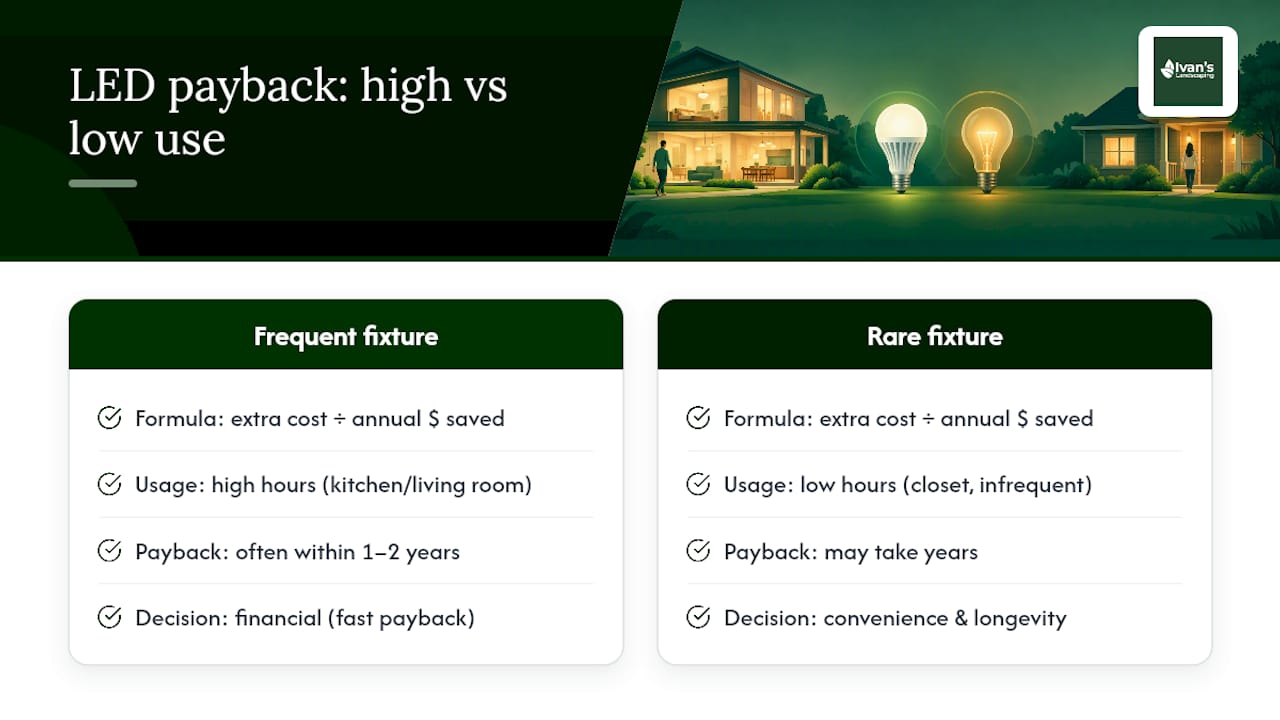
The payback period depends on how often a fixture is used and your local electricity rate. A bulb in a rarely used closet may take years to pay back its higher purchase price through energy savings, since it barely runs long enough to rack up a meaningful electric bill. A bulb in a frequently used kitchen or living room fixture pays back its price difference much faster, often within the first year or two, because the wattage savings compound every time it is switched on. ENERGY STAR’s lifetime savings documentation models these examples using assumed electricity rates and bulb lifetimes, and the real payback period in your home will shift with your own rate and usage pattern.
The clearest way to estimate payback for your own situation is to divide the extra upfront cost of the LED by the estimated annual savings from lower wattage, based on your hours of use and local rate per kilowatt-hour. High-use fixtures make LEDs an easy financial call. Low-use fixtures are more about convenience and longevity than fast payback.
Common myths about LED and incandescent bulbs
A few misconceptions keep showing up in conversations about switching bulb types, and clearing them up makes shopping easier.
One common myth is that all LEDs are dimmable by default. In reality, ENERGY STAR notes that not all certified LED bulbs are dimmable, so checking the package is still necessary.

Another myth is that LED bulbs always look harsh or cold. CCT options across the LED lineup range from warm white to daylight, so a poorly chosen bulb, not the technology itself, is usually the reason for an unpleasant color.
Some shoppers also assume watts still indicate brightness the way they did with incandescent bulbs. Since LED efficacy is so much higher, a low-wattage LED can easily outshine a much higher-wattage incandescent, which is exactly why the FTC recommends comparing lumens instead.
Finally, some believe incandescent bulbs are now essentially obsolete or unavailable everywhere. Incandescent bulbs are less common but still exist for specialty and decorative uses, even though LEDs are the practical default for most fixtures.
A landscaper’s view on LED lighting for outdoor and holiday installs
Working on outdoor and seasonal lighting installs, LEDs make a noticeable difference in maintenance and safety compared with older incandescent strings. Cooler-running bulbs mean less risk around dry landscaping materials, and the extended lifespan means fewer mid-season bulb failures on a display that took real time to hang. That reliability is part of why our holiday lighting installations lean on LED options for most residential and commercial setups across the season.
— Chas
Get LED holiday lighting installed without the ladder work
Choosing the right bulbs is only half the job. Getting them installed cleanly, safely, and ready for the season is the part homeowners usually want off their plate. Ivan’s Landscaping handles holiday light installation across McHenry County, IL, using LED strings selected for the property’s fixtures and layout, so you get the warm look you want without spending a weekend on a ladder testing bulb compatibility yourself.
If you are weighing a seasonal lighting install against handling it yourself, our guide on comparing landscaping proposals without choosing on price alone walks through what to look for beyond the quote. Reach out for a free estimate and we will walk your property, recommend a lighting plan, and get it installed cleanly from the start.
Sources
- Shopping for light bulbs – FTC
- Light bulb purchasing checklist – ENERGY STAR
- CALiPER retail lamps study – U.S. Department of Energy
- Life-Cycle Assessment of LED lighting – DOE (2012)
FAQ
Are LED bulbs really brighter than incandescent bulbs?
Brightness depends on lumens, not the bulb type itself, so an LED and an incandescent bulb with the same lumen rating produce the same brightness. The FTC recommends checking lumens on the package rather than assuming one technology is inherently brighter.
How much energy do LED bulbs actually save?
LED bulbs can use more than 75% less energy than incandescent bulbs for the same light output, according to DOE/CALiPER testing. Actual savings on your bill depend on your electricity rate and how many hours the fixture runs each day.
Why does my new LED bulb flicker on my old dimmer?
LED bulbs rely on internal drivers that do not always match older dimmer switches built for incandescent bulbs, which can cause flicker or uneven dimming. Testing one bulb first and checking for an LED-compatible dimmer, as suggested in DOE/CALiPER findings, usually resolves the issue.
Do LED bulbs last as long as manufacturers claim?
ENERGY STAR certified LED bulbs are commonly rated around 15,000 hours in their examples, compared with roughly 1,000 hours for a typical incandescent, based on ENERGY STAR’s buying checklist. Actual lifespan varies by product quality and how often the fixture is switched on and off.
Is it worth switching all my incandescent bulbs to LED at once?
High-use fixtures like kitchens and living rooms pay back the higher LED price fastest, while rarely used fixtures see a slower payback based on ENERGY STAR’s lifetime savings modeling. Switching high-use rooms first and rarely used fixtures later is a practical way to spread out the upfront cost.