The best first-year lawn plan for a new McHenry County homeowner is simple. Learn what grass you have, mow it high, do the heavy work in late summer and early fall, and hand the repetitive jobs to a crew so the lawn never falls behind while you unpack. We have cared for lawns here since 2008, and our lawn mowing service and annual maintenance plans exist for exactly this situation.
TL;DR
- Identify your grass and test your soil before you buy any fertilizer or lime.
- Mow cool-season grass at 3 inches or higher, and never remove more than one-third of the blade at once.
- In northern Illinois, late summer to early fall is the best window to seed, overseed and feed.
- Spring weed control is about timing: crabgrass prevention goes down around April 1 or a week or two later in the north.
- A maintenance plan keeps mowing, cleanup and seasonal work on schedule through your first year.
Table of Contents
- Start with what you actually have
- Test the soil before you spend on products
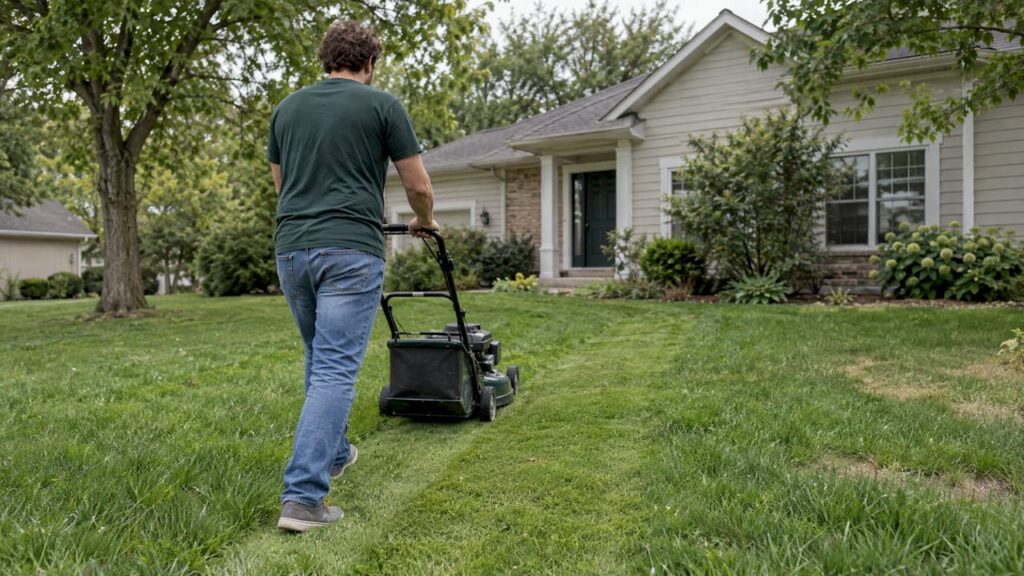
- Mow high, mow often, leave the clippings
- Water for deep roots
- A first-year calendar for northern Illinois
- Fall is the big job: seed, aerate, feed
- Weeds: prevent them with mowing and timing
- Leaves, mulch and beds
- What to do yourself and what to hand off
- Get your first-year plan started
- FAQ
- Sources
Start with what you actually have
Before you do anything to the lawn, find out what it is. Different turfgrass species need different soil conditions, mowing heights and seasonal care, which is why UGA Extension tells new homeowners to identify their grass first. In McHenry County, most lawns are cool-season mixes of Kentucky bluegrass, fescue and perennial ryegrass. If yours looks patchy, with some blades fine and others coarse, you probably have a blend or a builder’s seed mix. Our guide to bluegrass vs. fescue helps you tell them apart and decide what to keep.
Then walk the whole property and note:
- Shade and sun. Trees, fences and the north side of the house change what grows.
- Wet spots. Pooling after rain is a grading problem, not a watering problem. Our article on yard drainage fixes covers the common causes.
- Bare or thin areas. New construction often leaves compacted subsoil under thin topsoil.
- Leaves, branches and debris left by the previous owner.
If you are also planning a patio, deck or other outdoor space, settle the layout first. Good indoor-outdoor living ideas start with site, flow and thresholds, and it is cheaper to place them before you reseed than to tear up new grass later.
Test the soil before you spend on products
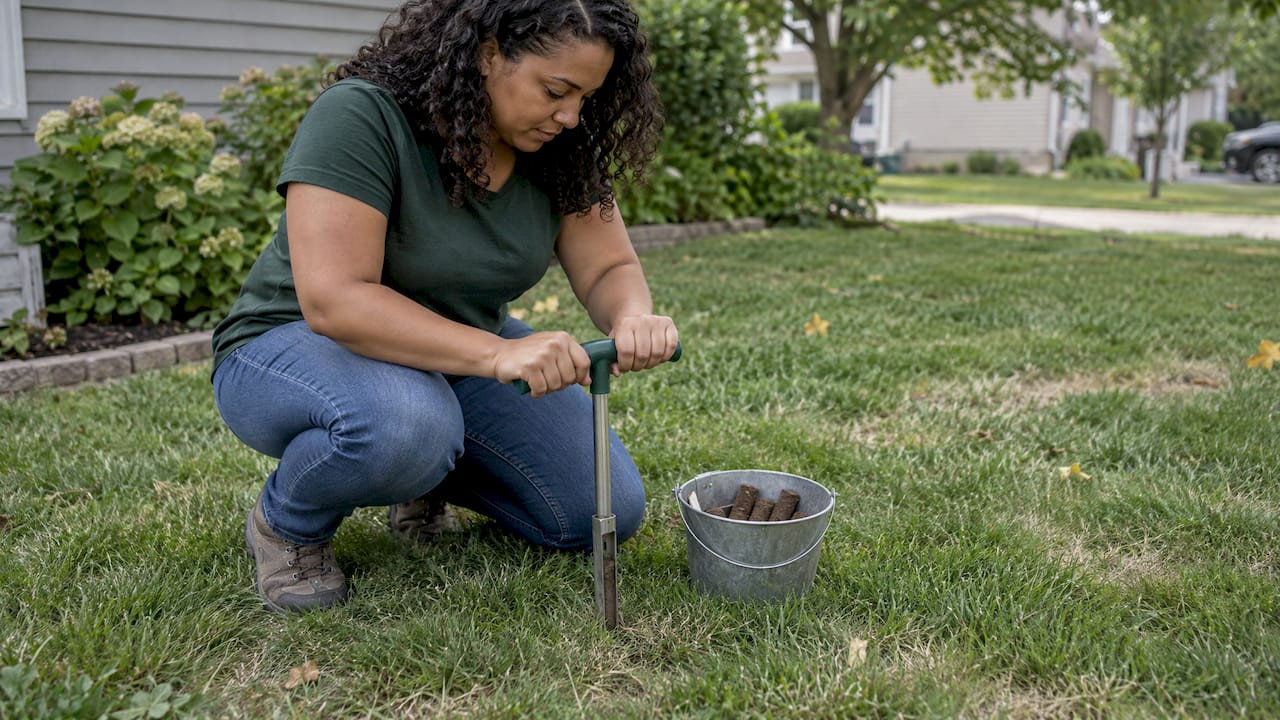
The UGA guide recommends taking a soil sample to your local Extension office for lab testing before applying lime, fertilizer or other amendments. The report tells you your soil pH and fertility, so you buy only what the lawn needs. Skipping this step is the most common way new owners waste money in year one.
Mow high, mow often, leave the clippings
Mowing is the task you will do most, and it affects everything else.
- Height. Illinois Extension says cool-season lawns compete better at 2 to 3 inches, and that turf-type tall fescue does better at 3 to 4 inches. Purdue Extension recommends 3 inches or more for Kentucky bluegrass, ryegrass and tall fescue in Indiana and Illinois. Three inches is a safe default.
- The one-third rule. Wisconsin Extension says to never remove more than one-third of the leaf tissue in one mowing. Cutting more stresses the turf, slows regrowth and lets light reach the soil, which helps weeds germinate. In a wet June you may need to mow twice a week to follow it.
- Sharp blades. Dull blades tear grass. Seedlings are especially sensitive, according to University of Maryland Extension.
- Clippings. Leave them where they fall. They return nutrients to the soil, and our note on mulching vs. bagging grass explains how much fertilizer that can save.
This is the easiest job to hand off. Missing a week in May means cutting far more than a third, and that is how a new owner’s lawn starts to struggle. Our crews handle mowing, edging, trimming and cleanup, and our page on what a lawn service includes shows what is covered and what costs extra.
Water for deep roots
Lawns need about one inch of water a week, according to UGA Extension, and deeper, less frequent watering pushes roots further down. A cheap rain gauge tells you how much nature has already supplied. Water in the early morning, or late evening at the latest, to cut evaporation and limit how long the blades stay wet.
In the Midwest, Purdue notes that a lawn usually needs some irrigation in summer to hold its color and density. It might need water only every 2 to 3 weeks in early summer but about twice a week in August. If the lawn goes dormant in a dry spell, a half inch every 3 to 4 weeks keeps it from thinning significantly.
New seed is different. Purdue says newly seeded lawns should be watered two to four times a day so the soil around the roots never dries out. Mowing starts once the first leaves reach 2 to 2.5 inches. Avoid watering through the night: Maryland Extension warns that seedling diseases that can kill entire stands are much worse when blades stay wet overnight.
If you chose sod instead, follow our sod watering schedule for the first 30 days.
A first-year calendar for northern Illinois
Timing matters more than effort. Use this as a pattern, and adjust for the weather each year.
| Season | What to do | Why |
|---|---|---|
| Early spring | Rake debris, finish your soil test, and plan weed prevention | Crabgrass germinates when soil stays above 55 to 60°F for several days |
| Around April 1, or a week or two later in the north | Apply crabgrass control | Illinois Extension gives April 1 as the target in central Illinois, later for northern Illinois |
| Mid-May | Optional first feeding | Illinois Extension says to wait until mid-May; early feeding can stunt roots |
| Summer | Mow at 3 inches or higher, water deeply, and watch for thin or stressed areas | Cool-season grass slows down in heat |
| Mid-August to mid-September | Seed or overseed bare areas, aerate if compacted, and feed | Illinois Extension lists August 15 to September 15 as the best seeding window |
| September and early November | Fertilize in fall | Purdue recommends 1.0 lb nitrogen per 1,000 sq ft in September and 1.0 to 1.25 lb in early November |
| Late fall | Remove leaves before they smother the grass | Matted leaves block light and hold moisture |
Illinois Extension explains that turf fertilizer pushes leafy growth over roots, so if you feed only once a year, late summer to early fall helps cool-season grass recover from summer stress. If you moved in this fall, you are in the right season for your first big task. Look at your lawn now, and again next August.
Fall is the big job: seed, aerate, feed
Wisconsin Extension reports that late summer to early fall gives warm soil, cool nights and much less weed competition than spring. Oregon State Extension adds that cool-season grass germinates best between 60 and 85°F. In practice, that is why a lawn seeded in September looks better than one seeded in May.
Compacted soil is common around new homes. Wisconsin Extension explains that compaction keeps roots shallow and leads to thin turf and more weeds, and that core aeration is the remedy. Not sure whether you need aeration or dethatching? Our comparison of aeration vs. dethatching walks through it.
If large areas are bare or dead, resodding can be faster than patching. Read sod vs. seed for McHenry County lawns for the trade-offs. We install sod across McHenry County, and you can see how that works on our sod installation page.
Weeds: prevent them with mowing and timing
Wisconsin Extension says proper mowing and timely fertilization alone can avoid 70 to 90% of weed problems, with herbicides as a last resort. For a new owner, that means three habits: mow high, feed in fall, and apply crabgrass prevention at the right time in spring. Pulling dandelions by hand while the soil is damp works well on small lawns.
Leaves, mulch and beds
Your first autumn will likely bring a lot of leaves, especially if the lot has mature trees. Clear them regularly so the lawn can still get light. Our spring and fall cleanup service covers this seasonal work. Fresh mulch in the beds in spring also keeps the edges neat; see mulch types to choose one, or our mulch service.
What to do yourself and what to hand off
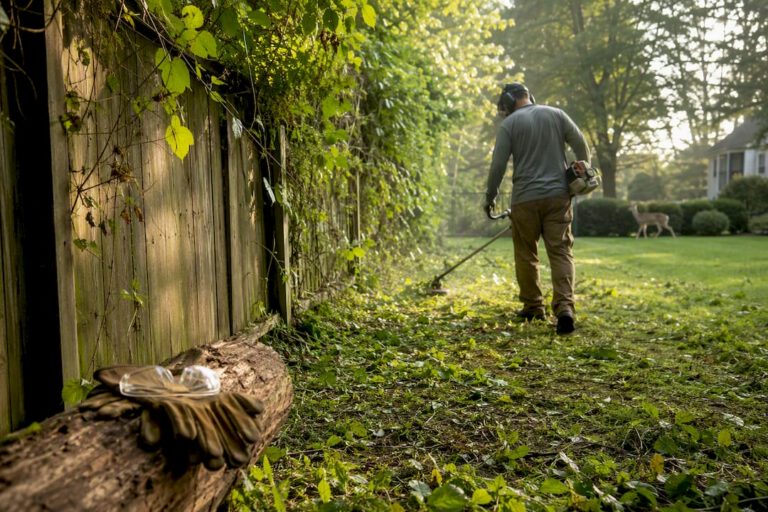
If you want to do it all yourself, you need a mower, a string trimmer for tight spots, a leaf rake, a spreader and a rain gauge. That is a real investment, plus storage, plus a weekly commitment from May through October. Most new owners are also busy with the house.
A practical split is to hand off the recurring work, which is mowing, trimming, edging and seasonal cleanup. Spend your own time on the soil test, the rain gauge and walking the lawn once a week. With a plan in place, the lawn gets the same schedule whether you are traveling, moving boxes or working late.
Our view: set the routine before the problems start
New owners usually call us after a lawn has already slipped, with grass cut too short in July, leaves left all winter, or a wet corner nobody noticed. The fix is almost always a routine, not a rescue.
That is why we build customized annual maintenance plans around each property. Mowing, cleanup, mulch and seasonal work are scheduled in advance, and we keep job sites clean while we do it. We stand behind our work with a satisfaction guarantee.
Chas
Get your first-year plan started
Ivan’s Landscaping serves homeowners in Crystal Lake, McHenry, Algonquin, Lake in the Hills, Cary, Huntley, Woodstock and across McHenry County. We offer lawn mowing, cleanup, mulch, sod installation, drainage and grading, and annual property maintenance plans, and we respond quickly to requests for free estimates. Request a free estimate and tell us when you moved in and what your lawn looks like.
FAQ
When should a new homeowner start lawn care in Illinois?
Start as soon as you move in with a walk-through and a soil test. Then plan the main work for August 15 through September 15, the best seeding window in Illinois, according to Illinois Extension. If you move in during winter, use the time to plan, and schedule crabgrass prevention for early spring.
How high should I mow my new lawn?
Use 3 inches for most cool-season lawns in northern Illinois. Purdue recommends 3 inches or more for bluegrass, ryegrass and tall fescue, and Illinois Extension says turf-type tall fescue does well at 3 to 4 inches. Never take off more than one-third of the blade in one cut.
Should I fertilize in the spring or the fall?
Fall is the priority. Illinois Extension recommends waiting until mid-May for any spring feeding, and says that if you fertilize once, late summer to early fall is ideal. Purdue suggests September and early November applications, with an optional one in mid-to-late May.
How much should I water a new lawn?
An established lawn needs about one inch of water a week, applied deeply and infrequently, per UGA Extension. Newly seeded areas need much more frequent watering, two to four times a day according to Purdue, until the grass is established.
Sources
- Landscape basics for new homeowners: Lawn care, UGA Extension
- Spring lawn care: What should you really be doing?, Illinois Extension
- 7 Simple Steps to a Better Home Lawn, Purdue Extension
- Lawn Maintenance, Wisconsin Horticulture
- Seedling Problems, University of Maryland Extension