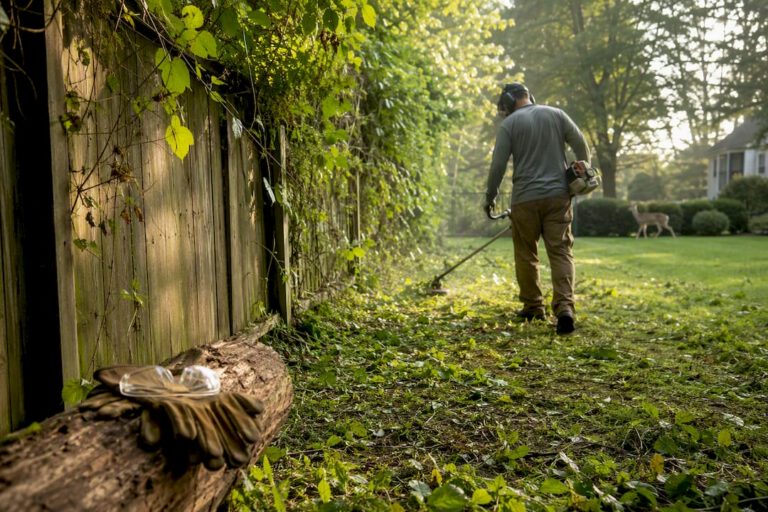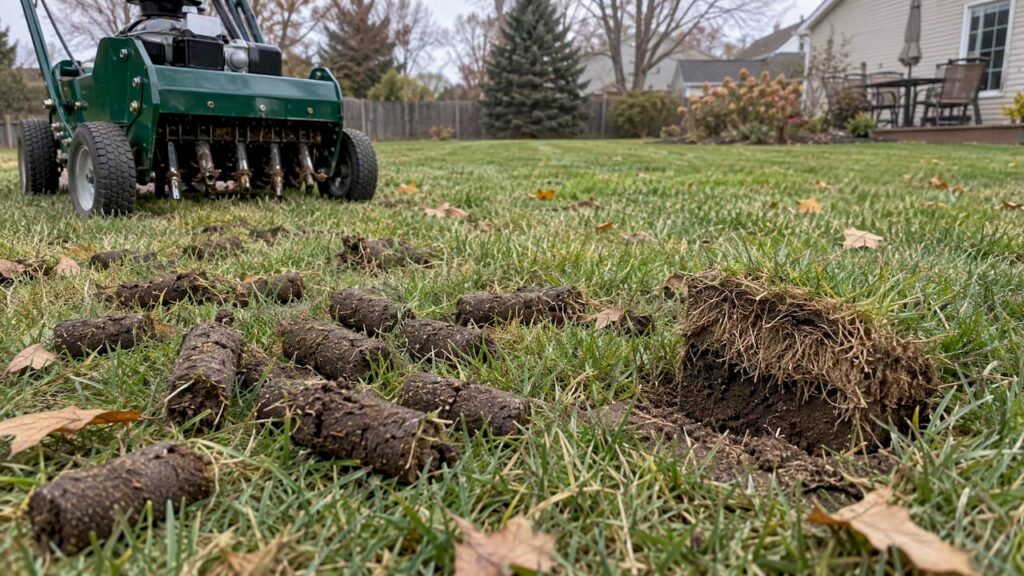
Core aeration and dethatching are two different jobs. Aeration pulls small plugs of soil out of the lawn to relieve compaction and let air, water and nutrients reach the roots. Dethatching removes the layer of dead and living stems and roots that builds up between the green blades and the soil. Most lawns in McHenry County need aeration far more often than dethatching, and many never need dethatching at all.
TL;DR
- Aeration fixes compacted soil. Dethatching fixes a spongy mat of thatch thicker than about 1/2 inch.
- Choose core (hollow-tine) aeration, not spike aeration. Spikes can make compaction worse.
- If you need both, aerate first, then lightly rake or power rake the leftover cores and debris.
- For cool-season lawns like northern Illinois bluegrass and fescue, late summer to early fall is the best window.
- Test before you pay for either: push a screwdriver into the soil and cut a small wedge to measure the thatch.
Table of Contents
- What each one actually does
- Why aerate a lawn
- Core aeration vs spike aeration
- When dethatching makes sense
- Which comes first: dethatching or aerating?
- The best time for northern Illinois lawns
- Aftercare
- Our perspective
- Get a plan for your lawn
- FAQ
- Sources
What each one actually does
Core aeration uses a machine with hollow tines that cut cylindrical plugs from the lawn. Dethatching uses a machine that cuts vertically into the thatch and brings debris to the surface, where it has to be raked up and hauled away, as Ontario’s lawn care guidance describes the two methods.
The two treat different problems:
| Core aeration | Dethatching | |
|---|---|---|
| Targets | Compacted soil | Thick thatch layer |
| What it does | Removes soil plugs, opens channels to the roots | Cuts into and pulls out the thatch mat |
| Cleanup | Plugs break down on the lawn | Debris must be raked and removed |
| Stress on turf | Moderate | High |
| How often | Often yearly on heavy or clay soil | Only when thatch is too thick |
Michigan State University Extension calls dethatching an aggressive procedure and describes core aeration as the less destructive of the two. That is a good reason to start with the gentler option.
Why aerate a lawn
Compaction is common on lawns that get foot traffic, mowers, kids and dogs, and on the heavy clay soils found across much of northern Illinois. Compacted soil holds little air, sheds water and starves roots.
According to University of Maryland Extension, aeration relieves compaction, encourages root growth by raising oxygen levels around the roots, and lets seed, lime and fertilizer move into the soil. Iowa State University Extension adds that core aeration improves growing conditions overall, which leads to a healthier, more vigorous lawn.
There is a thatch benefit too. Kansas State University notes that core aeration mixes soil into the thatch, which can speed its breakdown. So regular aeration often prevents the very problem people want dethatching to solve.
The practical signs of a lawn that needs aeration:
- Water pools or runs off after moderate rain
- A screwdriver is hard to push into the soil
- Thin, weak turf in high-traffic areas
- You plan to overseed or topdress
The University of Wisconsin Extension lists compacted soil, a thatch layer over 1 inch and upcoming overseeding as the reasons to aerate.
Core aeration vs spike aeration
This is the choice that trips up many homeowners. Spike or solid-tine aerators, including the spiked shoes sold at hardware stores, poke holes by pushing soil sideways. University of Maryland Extension says that compresses the soil into a denser mass and can raise compaction, while a core aerator removes plugs and relieves it.
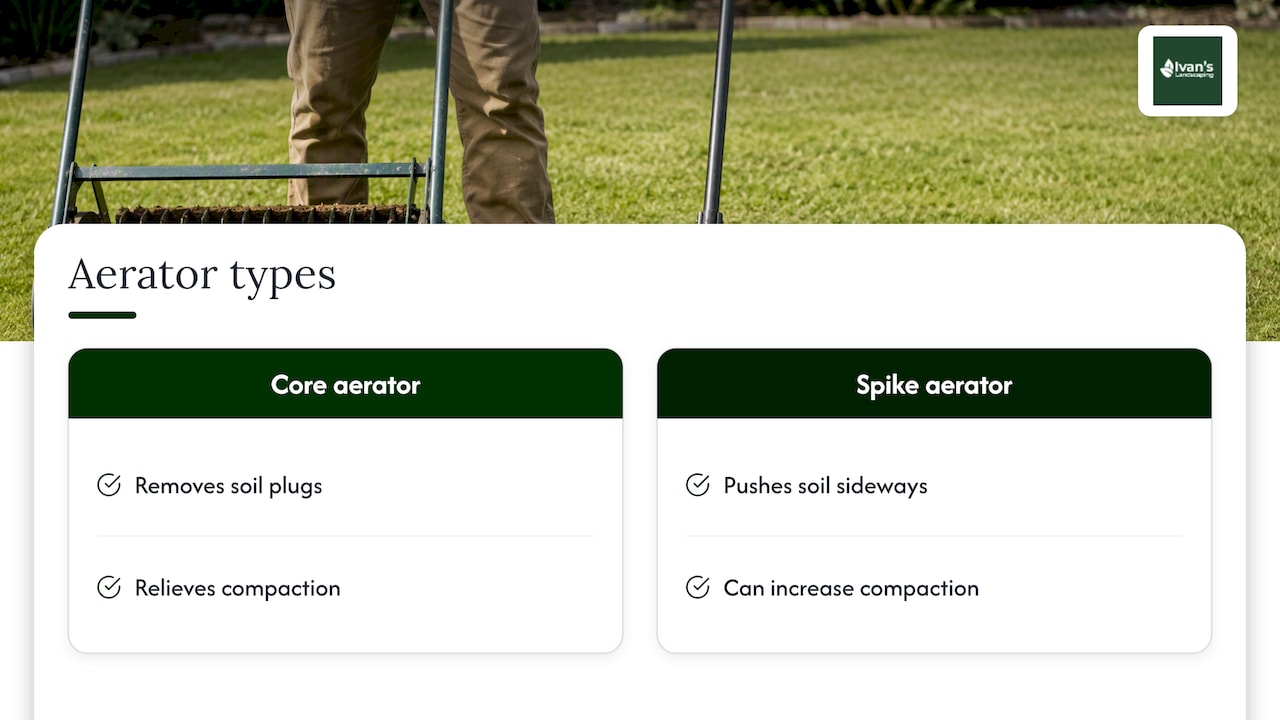
If you are paying for aeration or renting a machine, ask that it be a hollow-tine core aerator. Skip the spikes.
When dethatching makes sense
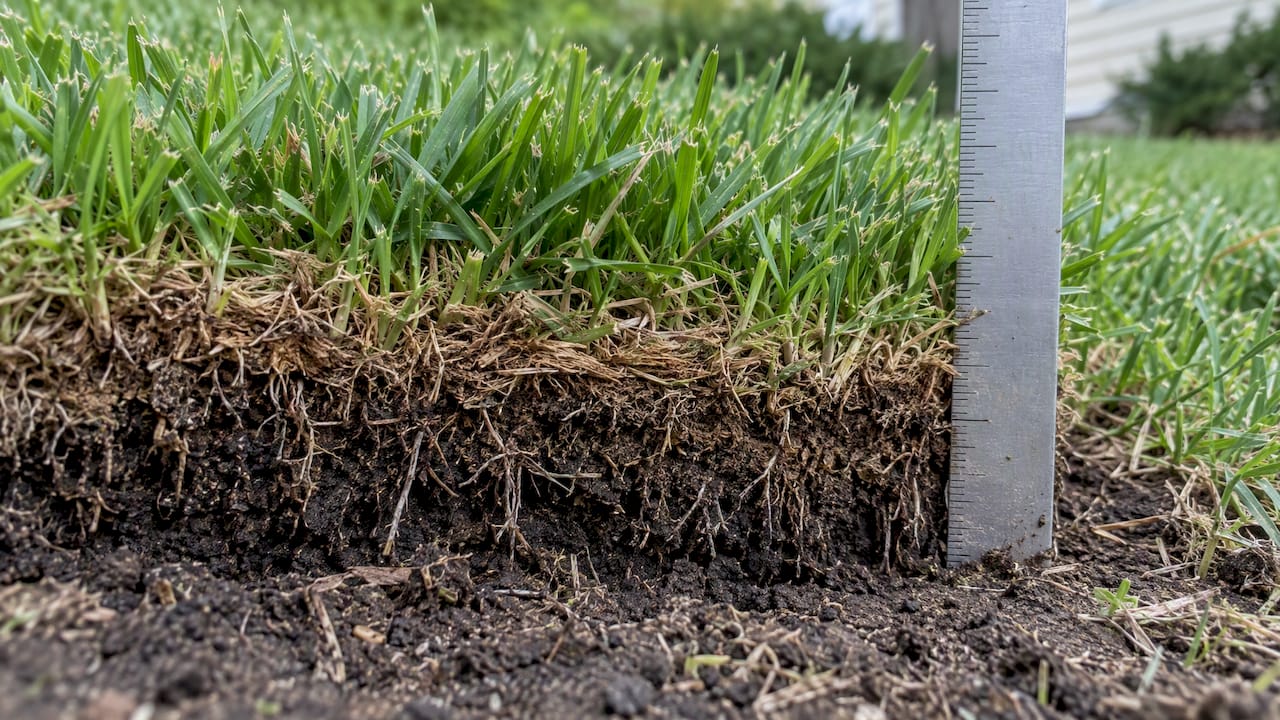
Thatch is not automatically bad. Clemson’s Home & Garden Information Center explains that a layer up to 1/2 inch can actually cushion the lawn and add resiliency. Extension advice is to consider dethatching only once the layer is thicker than 1/2 inch, the point at which the turf feels spongy underfoot.
To check, cut a small wedge of turf about 2 inches deep and measure the brown, fibrous layer between the green grass and the soil. If it is under 1/2 inch, leave it alone.
If you do dethatch, the equipment matters. Purdue Extension recommends machines with knives or blades, and advises against flexible rake-type tines or attachments that fit under a rotary mower. The same publication notes that thatch over 1 inch is most easily removed with a sod cutter, after which the lawn has to be reestablished. At that point, fresh turf is a real option, and our comparison of sod vs. seed for McHenry County lawns walks through the tradeoffs.
Which comes first: dethatching or aerating?
If your lawn truly needs both, we aerate first and then go over the lawn lightly to break up the remaining cores and pull out loose debris. Aerating first loosens the soil and starts mixing it into the thatch, so the second pass has less to fight. After dethatching, rake and remove the debris.
For most lawns, though, the answer is simpler: aerate, and skip dethatching.
The best time for northern Illinois lawns
Our lawns are mostly cool-season grasses such as Kentucky bluegrass, fescue and ryegrass. For these, University of Illinois Extension points to late summer and early fall as the critical maintenance window. Michigan State agrees that fall, when turf is not under stress and recovers well, is the best time to aerate or dethatch.
The June to July timing you may see online applies to warm-season lawns, according to University of Maryland Extension. Zoysiagrass, a warm-season grass, is dethatched in summer during active growth, per Purdue. Neither is typical in McHenry County.
It is late October now, so for this year the best window has largely passed. Plan for late August through September next season, when you can also overseed. Spring aeration is a fallback, but it can open the soil to crabgrass and other weed seeds.
Soil moisture matters as much as the calendar. Aerate when the soil is slightly moist, not soaked and not dry. The University of Wisconsin notes that wet soil bogs down the machine, while dry soil may be too hard for the tines to penetrate.
Aftercare
- Leave the plugs. They break down on the lawn within a couple of weeks, according to University of Maryland Extension.
- Feed the lawn. Fertilizing after aeration encourages quick recovery. See our fertilization service for what a program looks like in our area.
- Seed if you planned to. Seed falls into the holes and meets soil, which is the main reason aeration and overseeding work well together.
- Water as needed so new seed and stressed turf do not dry out.
- Rake and haul debris if you dethatched.
Our perspective
We have worked on McHenry County lawns since 2008, and the same pattern shows up again and again. Homeowners ask about dethatching because the lawn looks tired, but the cause is usually compaction, mowing too short, or uneven fertilizing, not thatch. Dethatching a lawn that does not need it only strips healthy turf.
Our advice is to measure before you decide, start with core aeration, and pair it with good basics: mowing at a proper height, mulching clippings instead of bagging when the lawn is healthy (see why mulching can return fertilizer to the lawn), and choosing a grass blend that suits your site. Our guide to bluegrass vs fescue helps with that last part.
If your lawn stays soggy even after aeration, the problem may be grading rather than soil. Our yard drainage fixes cover the common causes.
— Chas
Get a plan for your lawn
A lawn that needs the right treatment at the right time is easier to keep than one you keep rescuing. We offer lawn care for McHenry County homes and businesses, along with sod installation and customized annual maintenance plans. Free estimates come back quickly, and we keep job sites clean. Contact us through Ivan’s Landscaping and tell us what your lawn is doing, and we will help you work out the next step.
FAQ
Does aeration help a lawn?
Yes, when the soil is compacted. Core aeration lets air, water and nutrients reach the roots and encourages deeper rooting. A lawn on loose, healthy soil gets much less out of it.
How do I know if I need to dethatch?
Measure the thatch. Cut a small wedge of turf and look at the brown, spongy layer above the soil. If it is thicker than 1/2 inch, dethatching is worth considering. If it is thinner, it is helping rather than hurting.
Is June too late to aerate a lawn?
For a cool-season lawn in northern Illinois, June is not ideal because summer heat stresses the turf. Early fall is better. June and July are the recommended months for warm-season grasses, which are uncommon here.
Is core aeration better than spike aeration?
Yes. Core aeration removes plugs of soil and relieves compaction. Spike aeration pushes soil aside and can make it denser, so extension specialists advise avoiding it.
Sources
- Preparing your lawn for winter, Ontario.ca
- Core aeration and dethatching of lawns, MSU Extension
- Lawn Aeration, University of Maryland Extension
- Core Aeration of Lawns, Iowa State University Extension
- Cultivation and Thatch Control, Kansas State University
- Lawn Aeration and Topdressing, University of Wisconsin Extension
- Why You Should Aerate Your Lawn, Clemson HGIC
- AY-8: Mowing, Dethatching, Aerifying and Rolling Turf, Purdue Extension
- Five fall tips for cool-season lawn care, University of Illinois Extension