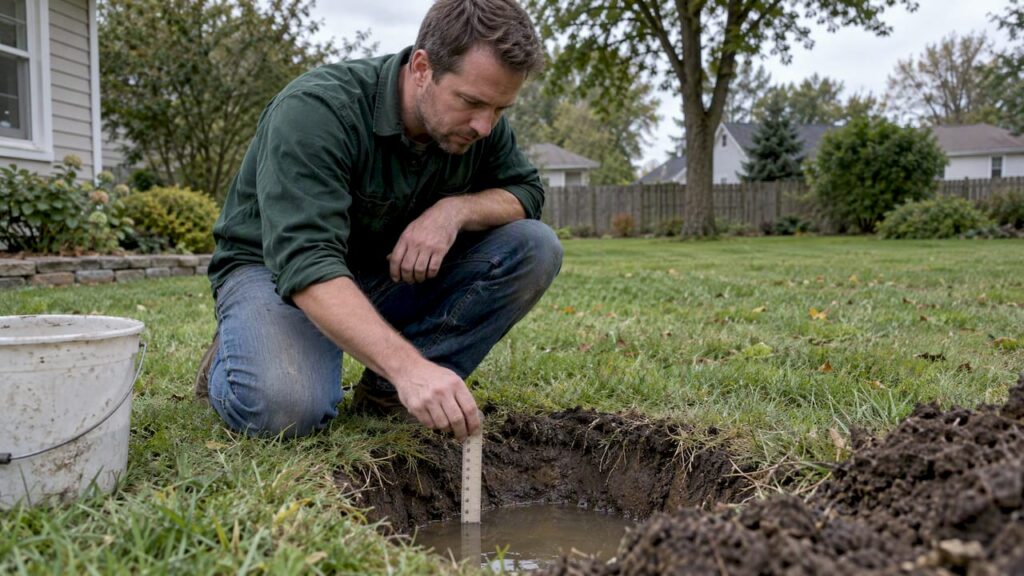
Aim for a bottom width of 4–8 feet, a longitudinal slope of 1–2%, and enough length to slow water so sediment settles. Whether a swale works depends on factors such as an in-situ infiltration test of your soil and an outlet that safely carries the 10-year storm. When width or slope exceeds those ranges, add check dams or an underdrain to keep the swale working.
TL;DR:
- Test saturated soil at several points along the planned route, use the slowest result for design, and check seasonal groundwater separation before setting depth.
- Keep side slopes at 4:1 where possible, never steeper than 3:1, and limit water quality flow depth to about 5 to 6 inches.
- Length depends on inflow: New Jersey guidance sets 50 feet for point inflow and 200 feet for linear inflow, while residence time may require more.
- Keep water quality flow near or below 1 foot per second, and provide a bypass so larger storms can avoid the treatment channel.
- At concentrated inlets, size a durable sediment forebay to about 5% of water quality volume, then remove deposits before they reach the channel.
Table of Contents
- Which design checks should you run first?
- How do you know your soil will infiltrate?
- What cross-section and length should your swale have?
- How do you check velocity and storm capacity?
- How do you protect the swale with forebays, check dams, and underdrains?
- Which plants and upkeep keep a swale working?
- What is the construction sequence from stakes to final check?
- How do you fit a swale into your landscape without hurting performance?
- When is hiring a pro the right call?
- Ivan’s Landscaping: drainage and grading that put the swale where it works
- FAQ
- Sources
Which design checks should you run first?
Start with a short checklist before you stake anything. It tells you whether a swale suits your lot and which extra measures to plan for.
- Site suitability: Keep the drainage area modest, and avoid placing a swale upslope of a building unless you have an easement or a safe outlet. Our guide on grading around a foundation covers the slope the house itself needs.
- Geometry: Target a bottom width of 4–8 feet, side slopes of 4:1 so a mower can cross them, and a longitudinal slope of 1–2%.
- Slope below 2%: Plan for an underdrain, since the Iowa Stormwater Management Manual calls for one at that grade.
- Steep slopes or wide channels: Consider check dams or armoring to help prevent erosion.
- Before digging: Call for a utility locate, set up erosion controls, place a forebay where water enters in a concentrated stream, and decide how you will establish vegetation.
Work through these in order. Each answer changes the next, and a “no” at the first step can save you the cost of the rest.
How do you know your soil will infiltrate?
Soil texture on a map is a weak guide. University of Minnesota stormwater research shows that infiltration depends on local site conditions, which is why in-situ testing of saturated hydraulic conductivity (Ksat) matters. A related Minnesota infiltration study found that texture alone underestimates what soil can take in, and it proposes ways to combine field tests into one effective Ksat. Poor siting or inadequate testing can undermine swale performance.
Begin with a desktop screening: map the catchment, note low spots, and check the seasonal high water table. Then test on site:
- Choose a test method such as a double-ring infiltrometer.
- Test at several points along the planned footprint, not one convenient spot.
- Compare results, since Ksat can vary widely across a single yard.
- Let the slowest results guide the design.
- Confirm separation from the seasonal high water table before finalizing depth.
Pro Tip: Dig a test hole where the swale will sit and observe it after a heavy rain. Persistent standing water may mean the design needs an underdrain or engineered media.
If infiltration is poor, you still have options: a dry swale with engineered media, an underdrain with a controlled outfall, or a conveyance-only design with pretreatment. Our comparison of a swale versus a French drain helps when you are weighing approaches.
What cross-section and length should your swale have?
Size the cross-section first, then set the length from your residence-time goal.
Bottom width. A 4–8 foot bottom width is a practical design target, though the suitable width depends on site conditions and the design. The NCSU dry swale factsheet notes that bottom widths are often limited to about 6 feet. Consider check dams where needed to slow flow and support treatment.
Side slopes. Choose 4:1 where possible and treat 3:1 as the steepest you should accept. Flatter banks are safer to mow and resist erosion better.
Depth and grass height. Keep flow depth near the height of the grass. The same NCSU guidance caps flow depth near 5–6 inches, and Oregon State Extension says depth should not exceed about 6 inches for water-quality flows. Deeper flow bends the grass flat and cuts filtering.
Hydraulic residence time (HRT). HRT is how long runoff spends in the swale. Longer contact means more settling and filtering. To turn a target into a length, multiply velocity by time. As an illustrative example, if water moves at 0.5 feet per second and you want 10 minutes (600 seconds) of contact, you need 0.5 × 600 = 300 feet of swale. If your yard cannot fit that, slow the water with check dams or flatten the slope so the same length does more work.
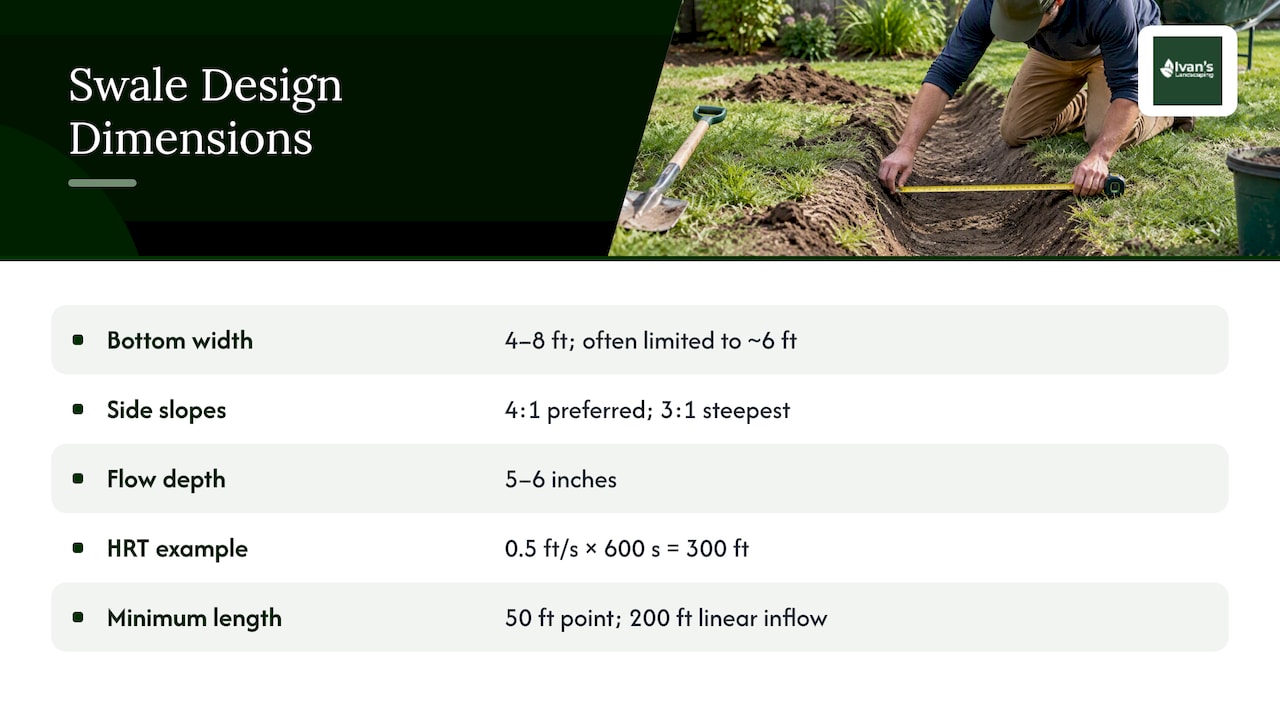
For a point of reference on minimum lengths, the New Jersey BMP manual sets 50 feet for point inflow and 200 feet for linear inflow.
How do you check velocity and storm capacity?
A swale that works on a light drizzle can still scour in a big storm. Check both.
For water-quality flows, aim for a velocity near 1 foot per second or less, as the Iowa manual advises. Grass holds up at low speeds and fails as velocity climbs.
Separate the storms you check:
- Water-quality storm: The frequent, small event the swale is built to treat.
- 2-year storm: A common check for stability.
- 10-year storm: The conveyance check. The swale should pass this flow without overtopping or eroding, as the North Carolina vegetated swale manual describes.
Three simple calculations cover most homeowner projects: flow depth at the design flow, velocity using Manning’s equation, and freeboard above the design water level. The New Jersey manual uses a Manning’s n of 0.25 for water-quality calculations in grass.
When velocity is too high, you have clear fixes. Add turf reinforcement matting, place riprap at inlets and outlets, or revise the geometry with a flatter slope or wider bottom. Also plan a high-flow bypass so larger storms have a safe path around the treatment area.
How do you protect the swale with forebays, check dams, and underdrains?
Most swale damage starts where water enters. Protect those points first.
- Sediment forebay: At concentrated inlets, the Iowa manual suggests a collection area sized to about 5% of the water quality volume. Use a durable surface so you can scrape out sediment without damaging the swale.
- Energy dissipation: Put a level spreader or rock plunge pool where a pipe or curb cut discharges.
- Check dams: Keep the crest rise to roughly 3–6 inches and the crest no wider than the bottom width. Spaced along the run, they create treatment cells and slow flow, as Oregon State Extension describes.
- Underdrain: Use one when slope is below 2% or when separation from the seasonal high water table is small. Route it to a controlled outfall so water never sits in the swale.
A forebay can make sediment removal easier and help protect the channel.
Pro Tip: Mark the forebay with a stake or a colored stone so whoever mows or maintains the yard knows to leave it alone.
Which plants and upkeep keep a swale working?
Treat vegetation as part of the structure. Choose dense, non-clumping, flood-tolerant grasses or mixes. Dense stems slow water, trap sediment, and resist scour, while clumping species leave bare gaps where rills start.
Manage grass height as a design parameter. The New Jersey manual specifies 3–6 inches, which balances flow resistance against plant health. Mow within that range, and keep mowers off saturated ground to avoid ruts.
For establishment, seed in the recommended windows for your region, or choose sod when you need immediate cover on a steeper bank. Use temporary erosion control blankets until the stand fills in.
A simple maintenance rhythm keeps repairs small:
- After storms, check the forebay and inlets and clear debris.
- Remove sediment when it builds up in the forebay.
- Inspect check dams and outlets for undercutting.
- Reseed and repair rills as soon as they appear.
If you want us to handle recurring mowing and cleanup, our lawn mowing and seasonal cleanup services fit neatly around a swale.
What is the construction sequence from stakes to final check?
Follow this order on site, whether you are supervising a crew or doing the work yourself.
- Mark contours with a level or laser, call the utility locate, and install erosion and sediment controls.
- Set grade stakes along the centerline and check the slope between each pair before cutting.
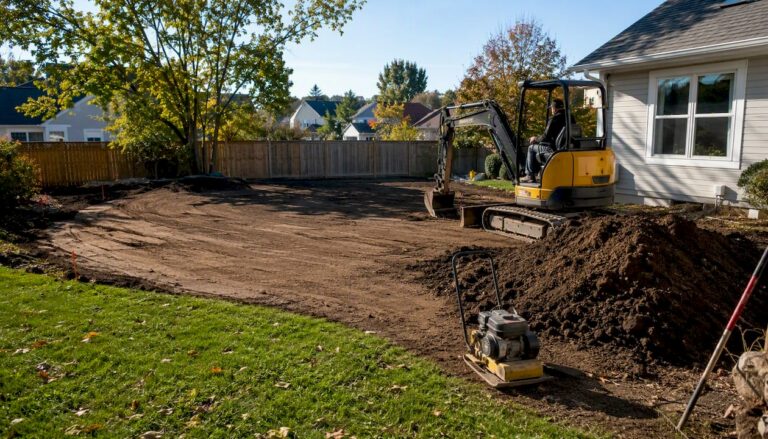
- Excavate to grade, benching where the ground drops sharply, and keep side slopes at 4:1 where space allows.
- Protect the infiltration zone from compaction: keep equipment out of the bottom, and place any amended media only after final grade is set.
- Backfill around an underdrain with clean stone and route it to a stable outfall.
- Verify the swale drains within your target drawdown time, confirm the outlet protection holds, and prepare planting zones.
Compaction is the quiet failure. A perfectly graded swale will not infiltrate if heavy machinery packed the bottom, so lighter equipment and careful staging pay off.
How do you fit a swale into your landscape without hurting performance?
A swale can look intentional and still work. Treat it like a dry creek bed: frame the edges with low planting or stone, and keep the water path visible so you can see how it flows.
Do not bury or disguise the channel. Hidden inlets and covered low points are how homeowners accidentally break the designed flow and cause failures.
Small material choices protect performance. Keep edges flush so water enters freely, use articulated block where the swale meets paving, and plant hardy species that tolerate occasional soaking. For patios that shed water toward a swale, see our notes on paver patio drainage.
When is hiring a pro the right call?
Bring in a professional when groundwater is uncertain, when a large paved area drains into the swale, or when the outlet is complicated. A trained crew cuts the risk of poor siting, compaction, and the wrong plant mix. If your lot fits any of these, ask us for a scoped site inspection or an estimate.
— Chas
Ivan’s Landscaping: drainage and grading that put the swale where it works
We design and build drainage and grading solutions for homes and commercial properties across McHenry County, with a focus on customer satisfaction and clean job sites. A free estimate visit includes clear recommendations. To get started, request an on-site estimate for your property or review our full services.
FAQ
What is a swale drain?
A swale drain is a shallow, vegetated channel that carries runoff away from buildings and slows it so water can soak in and sediment can settle. The EPA grassed swale guidance describes trapezoidal cross-sections with flat side slopes and gentle longitudinal grades.
How big are swales?
Most residential swales have a bottom width of 4–8 feet, side slopes of 4:1, and a longitudinal slope of 1–2%. Length depends on how much contact time you need, so longer is generally better.
How do you dig a swale?
Mark the contour, set grade stakes, and excavate to a gentle slope with a flat or slightly rounded bottom. Keep equipment out of the bottom to avoid compaction, then seed or sod and protect the soil until grass is established.
What does a landscape swale look like?
It looks like a broad, shallow grassy ditch with gently sloped sides, often finished with stone or low plantings along the edges. Many homeowners style it like a dry creek bed so it reads as a garden feature.
Sources
- NCSU Urban Waterways Factsheet: Designing Dry Swales for the Water Quality Event
- Iowa Stormwater Management Manual – 5.02 Grass Swales
- Water-Quality Swales: Low-impact development fact sheet | OSU Extension Service
- Chapter 9.3 Grass Swales