The best paver color is one that matches the tone of your roof and siding, hides everyday dirt, and still looks good after years of sun, snow and salt. For most McHenry County homes that means a blended neutral or earth tone rather than a single flat color. Below is how to narrow the field, combine colors, and test samples before you commit.
TL;DR
- Match your roof, siding and trim in tone, not exactly. Pavers a bit lighter than the house usually look best.
- Blended colors hide dirt, leaf stains and wear better than a single flat shade.
- Earth tones tend to hold their color longer than bright ones, and light colors stay cooler underfoot.
- Judge samples outside, in your own light, wet and dry, before you order.
- Lock in the color and the pattern together, because they change each other.
Table of Contents
- Start with what is already on your property
- Common paver colors and what they do
- Color combinations that work together
- Pattern, texture and size change how color looks
- Practical factors: sun, dirt, fading and heat
- Our perspective on paver colors in McHenry County
- How to test a color before you buy
- Want help choosing?
- FAQ
- Sources
Start with what is already on your property
Your pavers sit next to a roof, siding, trim, a foundation and plantings. Those fixed elements decide most of the color question for you.
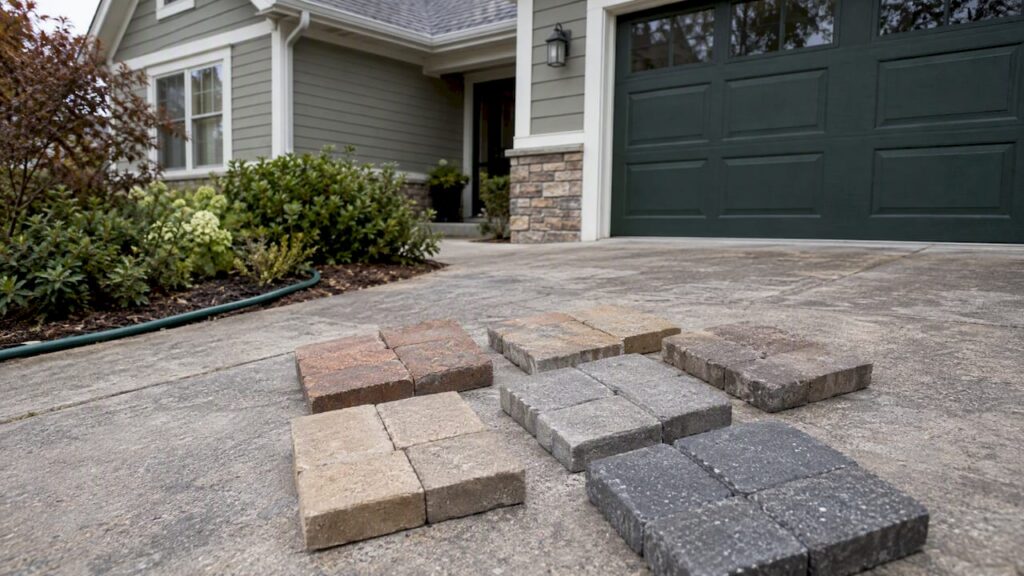
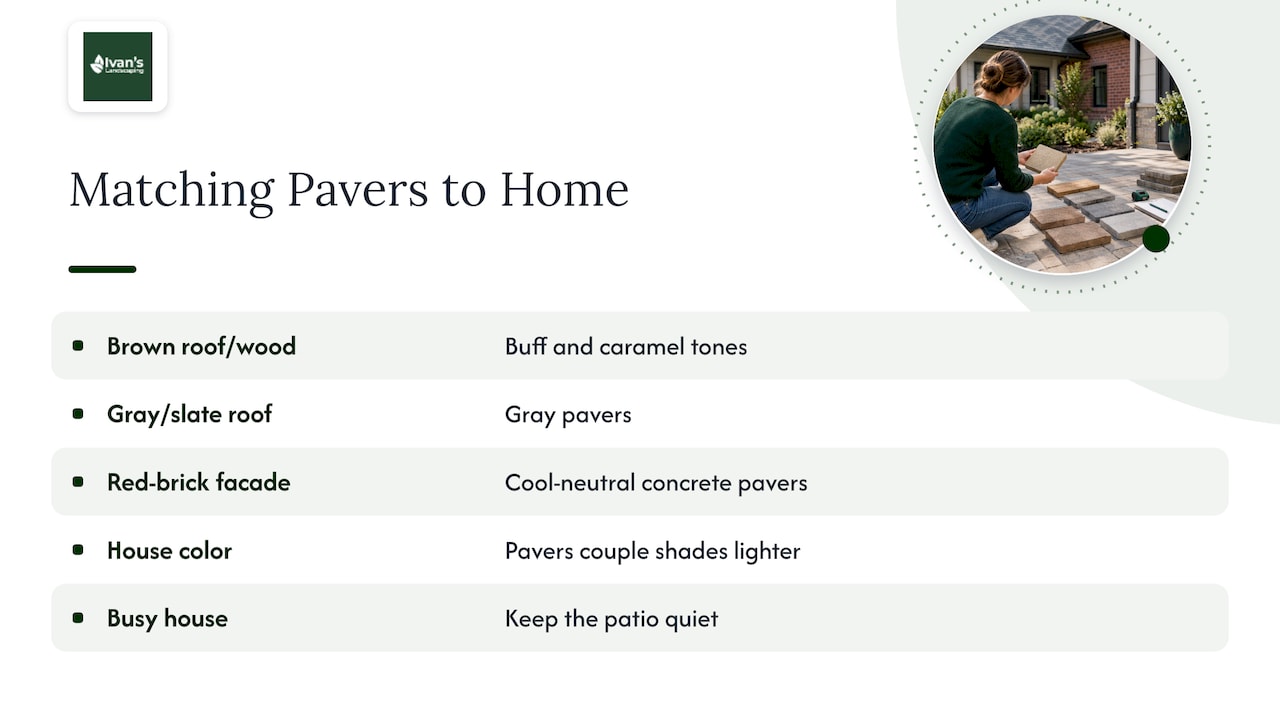
The guidance from paver manufacturer Unilock is to match the roof, body color, trim and walls in tone rather than exactly. A warm brown roof or wood siding points to buff and caramel. A cool gray or slate roof pairs with gray pavers. A red-brick facade can pair with cool-neutral concrete pavers so the two do not fight each other.
A university extension guide adds a simple rule: pavers a couple of shades lighter than the house harmonize with it and do not compete for attention. If the house is already busy, with brick, stone veneer and a patterned roof, keep the patio quiet.
Plantings matter too. Earthy tones such as sandy beige, muted brown and soft taupe blend with landscape greenery, so your beds and the patio read as one space instead of two.
Common paver colors and what they do
Manufacturers offer wide ranges. One national concrete paver line, for example, lists 28 blends from warm Adobe to deep Charcoal. You do not need that many options, because most choices fall into a few families.
| Color family | Looks best with | Practical notes |
|---|---|---|
| Warm tan, buff, caramel | Brown roofs, wood or cream siding, red brick | Forgiving, hides dust and soil well |
| Gray and charcoal | Gray or slate roofs, modern or white exteriors | Clean, contemporary look; dark shades show dust and efflorescence more |
| Red and brown blends | Traditional brick homes, older neighborhoods | Warm and classic; keep trim and plantings simple |
| Cream and light neutral | Pool decks, sunny patios | Stays cooler, but shows rust and leaf stains sooner |
| Multi-tone blends | Almost any exterior | Hide wear and add depth; best all-around choice |
Color combinations that work together
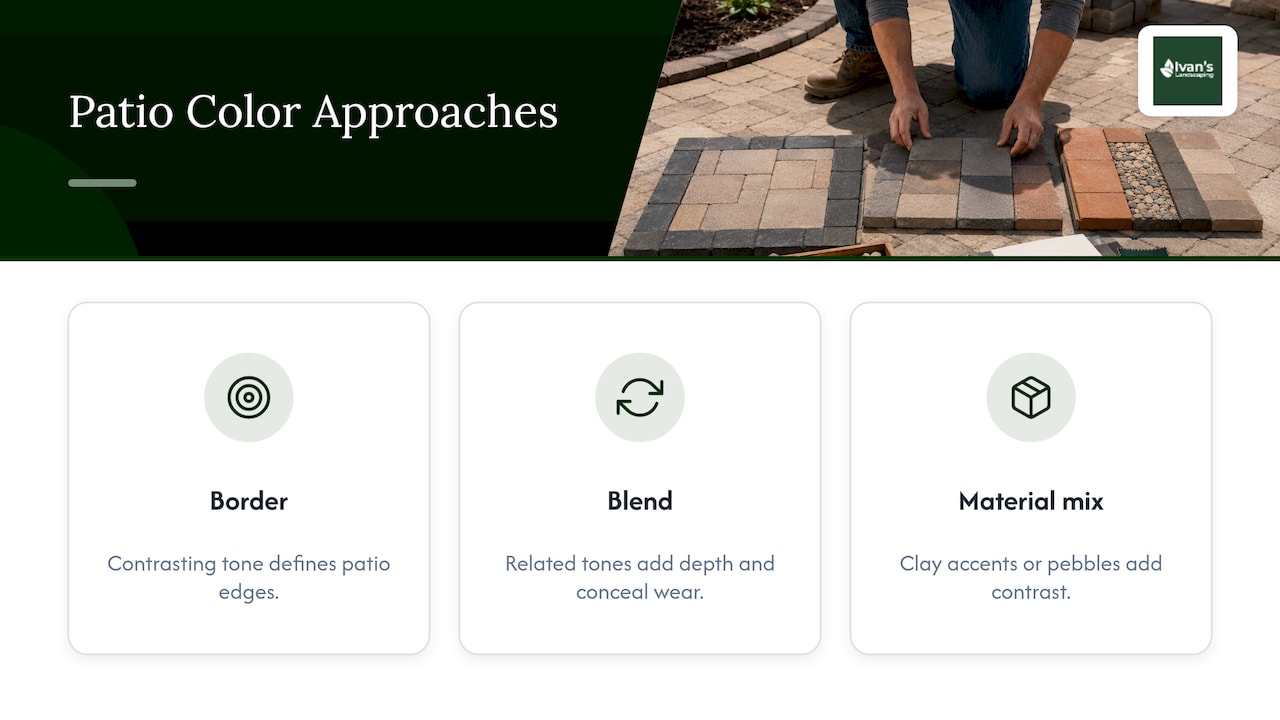
Most good patios use two or three related colors, not five. Three approaches cover nearly every project.
A field with a contrasting border. The main surface in one color, then a border in a darker or different tone. A border defines the edges and softens large areas, and inlays in contrasting color or texture add visual interest.
A blend across the whole field. Mixing tones inside the field adds depth and movement, and conceals daily wear. Tone-on-tone blends read as contemporary, while blends of three or more colors are more dramatic.
Pavers plus another material. A stone-colored field paired with a red clay accent, or a gray stone with pebble inserts, adds contrast in both texture and color. It works well around fire pits and planting beds.
Before you settle, sketch the layout. The pattern changes how color reads, and a herringbone layout shows blended tones very differently than a plain running bond. We cover that in more detail in our paver patterns guide and our paver patio ideas.
Pattern, texture and size change how color looks
Color never works alone. The extension guide notes that diagonal patterns can make a narrow path look wider, that smooth surfaces suit walking and play while rough textures suit borders and low-traffic areas, and that small areas should stay simple while large ones can handle curves or fan patterns.
In practice, a small courtyard in three colors looks cluttered. A large backyard patio in a single flat color looks like a parking lot. Blends and a border are the usual fix for the large space, and one calm color is the fix for the small one.
Practical factors: sun, dirt, fading and heat
Heat and sun
Light pavers stay cooler near pools, and strong sun can soften saturated tones, according to Unilock’s color guidance. If you walk barefoot on the patio in July, skip the darkest charcoals.
Dirt and water spotting
Medium earth blends hide soil, and textured blends hide water spotting in damp areas. Under trees, where leaves and sap stain surfaces, a single light color will show every mark.
Fading and white haze
Earth tones generally hold their color longer than brighter options, according to the Ontario Association of Landscape Architects. Ask the manufacturer how the pigment is made. Some lines run color through the entire paver, and one manufacturer guarantees that its through-body color will not fade.
A white haze on new pavers is often not fading at all. The Interlocking Concrete Pavement Institute explains that efflorescence is a natural process in cement-based products, more noticeable on dark colors, and that it usually corrects itself with time and exposure. Do not seal over it. Wait until the pavers are dry and haze-free first.
Can you stain pavers later?
Yes, if the surface is porous, clean and free of old sealer. Staining cannot repair structural damage, dense or sealed surfaces may absorb poorly, and the finish needs periodic resealing, according to a concrete supplier’s staining guide. New pavers should cure at least 28 days first. Choosing the right color at install is cheaper than restaining later.
Our perspective on paver colors in McHenry County
We build paver patios across McHenry County, and the color conversation almost always starts the same way: the homeowner loves a bright sample in the showroom. Then we hold it up against their siding and roofline in the driveway, and the choice changes.
Our advice is plain. Pick a blend, not a single flat color. Keep the field neutral and put your personality in the border or the plantings, because plants change every season and pavers do not. Think about snow and winter too: Illinois patios get salted, shoveled and frozen, so we favor medium tones that look clean in every season and a base built properly so the color stays level and even. Our drainage guidance matters here, since standing water is what stains and shifts pavers more than any color choice.
We also put scope in writing, so the color, pattern and border you picked are in the estimate before work starts.
— Chas
How to test a color before you buy
- Take large samples home. A small chip lies. Ask for several full pavers or a sample board.
- Look at them at different times. Morning shade, midday glare and evening light change how color appears.
- Wet them. Pour water on the sample to see how it looks after rain, then let it dry.
- Place them next to your house. Stand where you will sit and look at the paver beside siding, trim and a planting bed.
- Plan on paper first. Sketching pattern, edge and accent combinations lets you try options without lifting a single paver.
- Check material. Concrete, brick and natural stone offer different color ranges. Our guide on brick or concrete pavers lists the questions to ask, and natural stone options behave differently in heat and color.
Want help choosing?
If you are planning a patio, walkway or driveway apron in Crystal Lake, Algonquin, Lake in the Hills, Huntley, Cary, Woodstock or elsewhere in the county, we can walk your property with samples and give you a free estimate. See our paver and patio installation page, or start with a call through Ivan’s Landscaping. We are insured, offer a satisfaction guarantee, and keep job sites clean.
Once the patio is in, our seasonal maintenance schedule keeps the color looking the way you chose it.
FAQ
What is the most popular paver color?
Neutral earth tones and gray blends are the safest choices because they suit most roofs and siding. Tans, browns and charcoal-gray mixes hide dirt and pair well with plantings. A blend almost always looks better than a single flat shade.
Should pavers match the house?
They should coordinate, not match exactly. Pick a tone related to your roof and siding, and go a little lighter than the house so the patio does not compete with it.
Do paver colors fade?
Some lightening over the years is normal, and earth tones hold up better than bright ones. A white haze on new pavers is usually efflorescence, a natural process that fades with time, not lost color. Ask your installer how the pigment is made before you order.
Can concrete pavers be stained a different color?
Yes, if they are clean, porous and unsealed, and new pavers should cure at least 28 days first. Stain needs periodic resealing, so choosing the right color at install is easier to maintain.
Sources
- Unilock: How to Choose Paver Colors for Your Home
- Iowa State University Extension: Installing Interlocking Concrete Pavers, Part One
- Nicolock: Paver Colors, Styles and Textures
- Outerclé: How to Choose Paver Colors
- Nicolock 2024 Design Guide
- Belgard: Paver Colors
- Lurvey: Popular Paver Combinations
- OALA: The Basics of Coloured Paving
- ICPI: Managing Efflorescence on Concrete Pavers
- Black Hills Concrete: Can You Stain Concrete Pavers?